“IT’S a great honour to be appointed as Officer Commanding of the Equitation School. Was it what I thought would happen when I joined the Defence Forces back in 2000? No, but that doesn’t mean it’s not something I strove for in the last number of years.” So says newly-promoted Lt Col Sharon Crean of her recent appointment at McKee Barracks, where, in the School’s centenary year, she has become the first female officer to occupy this role.
Crean grew up in Celbridge, Co Kildare, in a family with previous connections neither to equestrianism nor to the military. “I learned to ride in a riding school, and it wasn’t even my parents who booked me in to my first lesson. It was my mum’s friend, who booked her son and myself in when we were about five years old. I took weekly lessons for a couple of years, and then I started to spend the weekends there, working in return for free lessons. I got my first pony when I was nine, and she was a typical pony, great to learn on. She could be good, bad and everything in between!”
It was around this time that Crean first considered the realities of a career working with horses. “I remember when I was very young, maybe nine or 10, observing people working in the riding school and thinking ‘yeah, I want to work with horses, but not like that’. They seemed to be losing the enjoyment of it, and I saw that it’s such hard work and horses cost so much money. I had some sort of appreciation that it was going to be difficult to make a career in this industry work.
“The answer didn’t come to me then, I didn’t know anything about the army, but a few years later, I began to see the guys competing in uniform, at the RDS and at events as well, and I looked into it. I saw you’re on a salary and, if you’re able to make the grade, you can benefit from military training and the payoff is great.”
Surrounded by support
In the meantime, however, Crean juggled the demands of her education at King’s Hospital with both swimming and eventing competitively. She credits swimming, the physical fitness she developed through it and the discipline built by early morning training, with giving her the foundation which enabled her to survive basic training in the Defence Forces later. She is also appreciative of what she learned at Donacomper Riding School, first under the tutelage of Sheila Cassidy and later the Kinsella family, saying “the Kinsella family have had the biggest influence on me ending up here at the School”.
Crean trained first with Gwen Kinsella, and then with Gwen’s elder children Ronan and Jane, as they began their coaching careers. The pony with whom she was most successful was the 14.2hh Dusty Wooster, whom her parents bought as a 10-year-old, and together they competed at the international event at Blarney Castle and on a team in England, as well as winning the Silver Spurs. Crean says: “He had never done dressage before in his life, but he learned very quickly and it ended up being his strongest discipline. He wasn’t an easy pony to ride, which is maybe why I did well in the Silver Spurs” [in which the top three riders have to swap ponies].
Crean continues: “My parents didn’t have huge amounts of money, and they made sacrifices for me to do what I wanted to do. I went to an excellent school, where I got the benefit of great academia and the swimming club was within the school, but it was a private school. I wasn’t buying ponies that were made, but I had the system in place to transform myself and the pony into a partnership which could win competitions and get on teams. All of the structure around me was so supportive.”
By the time Crean was in sixth year, she was working towards college and it was only a prompt from her father that reminded her to apply for a cadetship with the Equitation School. “By then, I knew it was very hard to get in. I knew a lot of people who had tried, who would have been at the same level as me or even more successful, but who hadn’t succeeded. I thought: I’m going to try, but I’m not going to bank on it. I had nearly forgotten to apply when my dad, who was working in London at the time, saw an ad for the cadetship in The Irish Times, and rang me to remind me.”
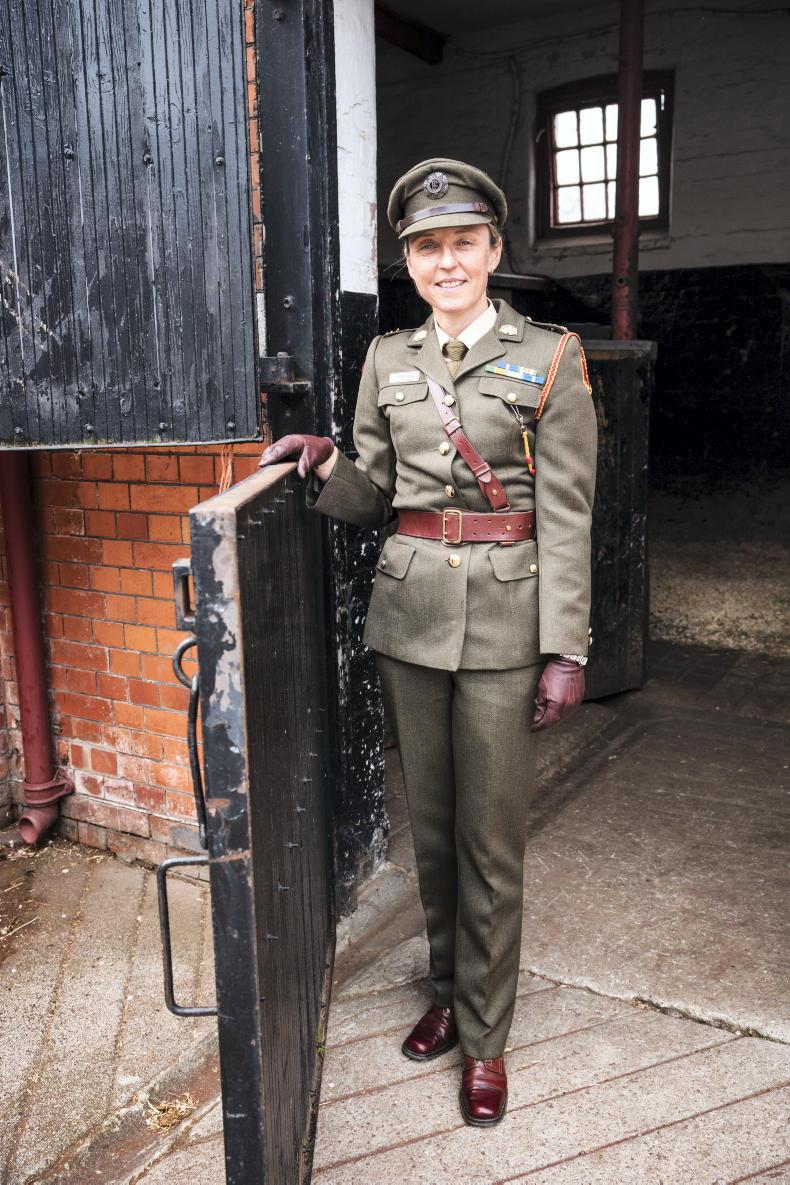
Lt Col Sharon Creen, Officer Commanding of the Equitation School / Claire Nash
A certain calibre of person
“My first time stepping into a barracks was for that first interview in Cathal Brugha. Seeing a lot of people in uniform sitting at the other end of the room and asking those questions: I came out of it thinking ‘that was a great mock interview experience’. I didn’t think I had done well.” Crean had, however, and after she had also passed the necessary medical and fitness tests, she embarked on her 21 months of basic training. Of this time, she says “the training wasn’t easy. I didn’t think I was going to survive.”
Yet she is passionate about the benefits of this system. “It gives you all the skills and competencies that you need to be competent in charge of 30 people in any environment, whether that’s at home or overseas. The same core competencies are required whether you’re joining the equitation school, or joining an infantry or engineering unit. The training is very comprehensive, very varied.”
When asked if lack of time in the saddle is to the detriment of new recruits, Crean is clear in her conviction. “Not riding during basic training doesn’t hinder someone’s progression, because the person that comes out the other side of that training is absolutely the person we need to do the job here. They’re not just riding horses. They’re representing the school every time they put their foot in the stirrup. They’re representing the country. They’re representing the sport horse industry. They’re representing breeders. They have to be a certain calibre of person to cope with all that. It’s pressure as well. They’re very identifiable wearing a uniform at shows in Ireland or overseas, and they’ve got to manage their teams. Their teams might not be very big, it might be just one groom and a number of horses, but they must have the skills to do that to the standard the military requires.”
Crean spent her first year at the School as a rider, in an era when ComdtGerry Flynn, Capt David O’Brien and Capt Shane Carey all frequently featured on Irish Nations Cup teams. She competed up to 1.40m at national level, and she says: “It was great to get exposure at a level of show jumping I had never done before.” Of the horses she rode during that time, she picks out Cruise Hill, who had previously been ridden by Gerry Flynn. “She wasn’t quite staying competitive at the top level for [Flynn],” she says, “and I felt like a got a nice tune out of her. After that, she was turned towards puissances and she ended up with the record in Dublin, sharing it with Casper. I suppose I feel like I had a part to play in that.
“Competition for horse power was very high,” she continues, “but a decision point came at the end of that summer.” Her peers, with whom she had trained at cadet school, were going to university, and she had the opportunity to take up a place which she had already deferred at NUIG to study law. “I thought about it for a little while, and made the decision which was the best option for me, considering how strong the field of riding officers was in the school at the time. It was a huge privilege to be in college as an officer, to be able to fully focus on your studies.”
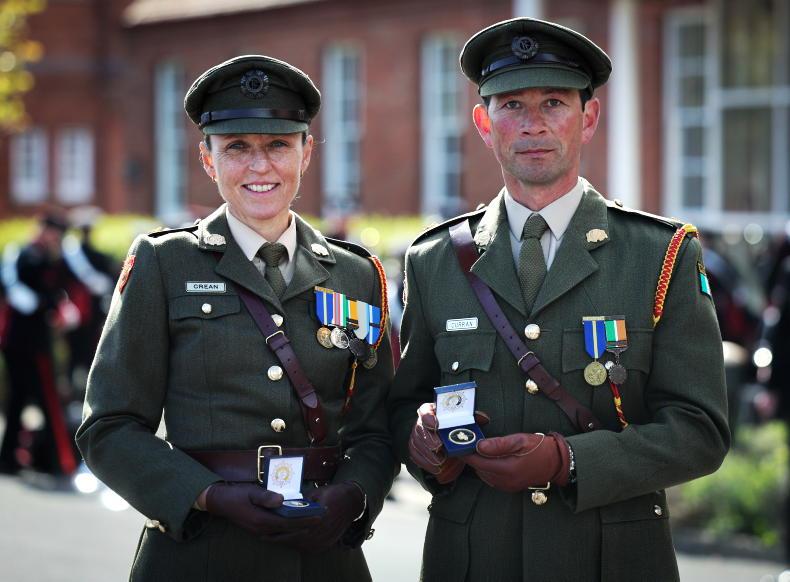
Lt Col Sharon Creen and Commandant Geoff Curran with their medals presented at the Centenary Parade for the Army Equitation School at McKee Barracks \ Lorraine O’Sullivan
Educational opportunities
Crean enjoyed undertaking her three-year law degree, when, during academic holidays, she would return to work with her transport unit at the Barracks in Rathmines. “I also went on my first trip overseas, to the NATO mission in Kosovo, which was a great experience. I got exposed to the work of legal officers over there, Irish legal officers, and they encouraged me to pursue the bar. I always had one eye to thinking about that, because you had to select certain subjects in your degree to be eligible and I would have discussed it. I did eventually do that [the Degree of Barrister-at-Law from the King’s Inns] in my own time, part-time over two years.”
“The Defence Forces offer wonderful educational opportunities to all ranks, which is something I’m always trying to put out there, as a lot of people are unaware. I could have looked at opportunities, and I did, going into the legal side of the house, but the only reason I joined was for the School, so I decided to stay.” During the period when Crean was studying part-time, she also occupied the role of administrative officer at the School, and then spent a decade as Second in Command to Tom Freyne. To be eligible for promotion to her current rank and role, she undertook a Masters in Leadership, Management and Defence Studies through Maynooth University.
Daily life
“As commanding officer, I am still getting my feet under the table. The job I was doing for the last 10 years was Second in Command and Chief Instructor, so the priority was training. We have around 35 horses and they’re all in work here in the barracks. They each have their own set of goals, their own pathway. It’s all individual. The planning of that alone takes office time, but the execution of it is outside, in the arenas and at certain shows, and then we come back into the office to review it. There’s a huge amount of analysis. It’s not just what happens at shows that we’re analysing. We’re constantly analysing what riders are to ride what horses. It is what everybody else is doing, but I hope we’re doing it in a very systematic and methodical way, and I suppose that makes it even more time consuming.”
Then there’s the sourcing of horse power, and any new acquisition must have been bred in Ireland. “We are looking for talented sport horses. We need to buy a certain number of good horses every year, because there is an attrition rate. I’m the main coordinator of it, but the more eyes you have sourcing horses, the better. We have a lot of other jobs to do, so the more people who can feed into that process, the better.”
Crean reflects: “I suppose we’re a different purchaser to other people, because we’re an end user. We don’t sell horses on, so the veterinary aspect is especially important to us, because we need to have that longevity. As somebody said, we’re married to them when we buy them, and that’s a wonderful thing for what that allows us to do, in terms of the development of that horse, but we’re very cognisant of it when we’re buying that horse. Their conformation and what the vet says is very important, and we have a board in charge of purchases. As CO, I’m chair of the board, but we also have Ned Campion as a member, and his knowledge and experience, especially of conformation; it’s just essential for us when we’re trying to see through that crystal ball.
“It’s the board which decides, when presented with a horse for assessment, whether we go ahead and purchase that horse or not.”
Connecting with breeders
Crean mentions the opportunity for owners and breeders to lease their horses to the School in the context of Jess Stallard’s DHF Alliance, who scored a double of international victories at the CSI4* in Arrezzo, Italy, recently. “Our lease programme works very well, because it allows us to carry out our mission of supporting the breeder and supporting the Irish horse. In the case of mares and approved stallions, it obviously provides promotion for them, ahead of their future breeding careers. One of the things we really want to work on going forward is that connection with breeders. There is a great opportunity there for professional breeders in particular, who are breeding many horses with certain bloodlines, to promote those bloodlines by offering their horses for sale or lease into the school for us to campaign them. It’s free advertisement for their bloodlines really.
“As I’ve said, we’re the end user. We’re not going to be selling the horse. For us to buy it, the condition is that it must have the potential to compete at the highest level, because that’s what we’re about. We don’t have any consideration other than what’s best for that horse. We don’t have to worry about the commercial aspect of it, or having to sell horses to pay the bills, so every decision for that horse is made in its best interests for it to fulfil its potential. Then there’s the guarantee that it will always be ridden under the Irish flag, by someone in uniform, and so it will always be identifiable at home or overseas, and we will retain a breeder’s prefix.”
Maintaining relevance
Ireland’s is the last army in the world to maintain a full-time Equitation School, and Crean cites two further points, in addition to promoting the Irish horse, that allow the School to maintain its relevance today. “Coaching, both the sport specifically and the people involved in the industry, the School has been an absolute leader in that, and in influence in the world. The FEI took on the syllabus of training that was established here by Mullins and Ledingham, and then there’s the professionalisation of grooming standards and acknowledging them with accreditation where that’s possible, so that we can continue to be seen as offering and displaying best practice in those endeavours, in our stable management and in the development of our horses and people.”
Crean continues: “My vision for the school is that we continue to fulfil the mission that was given to us 100 years ago and is still relevant today, and that’s promoting Ireland, the Defence Forces and equestrianism by competing the Irish horse at the highest international level. I’m fully committed to that endeavour, I ultimately want to do right by what is a wonderful establishment, and I want to secure and sustain it into the future.”
In conclusion, Crean’s passion for the organisation of which she is a part is clear. “The Defence Forces are a wonderful organisation to be a part of. I’ll be in 26 years in October, and I’ve given all of my professional life to it, but I’ve got so much more out of it from the very beginning. The uniqueness of what military training gives to a person never leaves you, and the education it provides, I don’t know any other organisation that offers what it does. The military does wonderful things for making the best versions out of people.”