I ESTABLISHED Killadeer Farm in Ballyheane, Castlebar, in 2015 with my partner Kate and our two children, Chloe and Darragh. We stand two Connemara stallions and have five Connemara mares, along with a selection of riding ponies and youngstock. From a young age, I was surrounded by horses and ponies, as my father, Owen Sr, kept stallions, a tradition that had been passed down through generations before him.
My brother Owen now stands two Irish Draught stallions: the RDS reserve champion Farmhill Highlander and Black Hero in Killawalla Stud near Westport, where I grew up. Throughout my childhood we stood a number of different stallions: Ginger Dick (ID), Householder (TB) and the Connemara ponies Glencarrig Oscar and Glanquin Larry, to name a few.
When we sold Glanquin Larry to Germany, I was on the lookout for a new stallion. In 2016, I was in Lettermore, Connemara, buying foals from a friend Tommy Hernon, when I spotted a beautiful Class 1 stallion Rogaire Na Locha in a field beside them. I asked Tommy would he consider selling him and after some thought - and lucky for me! - he agreed.
He is a super type with fabulous movement and has proven to be popular with the breeders. Foals have achieved great results in both the show and sales rings, including the Clifden colt foal class winner in 2023.
Over the years, we’ve put a lot of time and effort into building a breeding programme, selecting mares that we think will suit the stallions with bloodlines that are not overused.
I’ve recently completed training to become a CPBS inspector and, looking forward, we plan to continue developing our breeding programme with a focus on quality over quantity, carefully selecting pairings that will produce sound, true-to-type, athletic ponies with excellent temperaments.
We’re excited to see what the arrivals of our foals for 2026 will bring, and we hope to continue to produce ponies that excel in all areas, while preserving the traditional characteristics that make Connemara ponies so special.
1. Proudest breeder moment?
In 2025, my home-bred mare Killadeer Rebecca had her first foal, a beautiful filly Killadeer Sally. Instantly, I decided this second generation home-bred will definitely be a keeper!
2. Ginger Dick - tell us about him and his contribution?
My father owned and stood the well-known Irish Draught stallion Ginger Dick for 26 years. He was from the Laughton line out of a Battleburn mare, so one of the rare stallions to have a link to Boomerang.
He made a huge contribution to the Irish Sport Horse industry, and was one of the key stallions for influencing performance characteristics in the breed. A popular sire, his progeny proved to be athletic horses with substance, great trainability, lovely types and very saleable.
He produced many great horses in show jumping, eventing and showing: Ginger Watt, Seawolf, Proud Ginger to name a few. Ginger Dick’s legacy lives on through his progeny. The stallions that were approved include Classic Vision, Corran Ginger, Ginger Holly and Ginger Son, and many of his daughters became elite broodmares. Today, he still features in the bloodlines of many great Irish Sport Horses.
3. How many broodmares do you own?
We have five broodmares. Agharanny Diana (Garryhinch Finn x Ormond Oliver) is in foal to Rogaire Na Locha for 2026. Killadeer Rebecca (Dolan Mick x Rynn Richard) is in foal to Prince Maverick and William Pepsi (Westside Mirah x Glencairn Surprise) is in foal to Safin. Killadeer Winnie (Bay Shadow x Earlson) is another in foal to Rogaire Na Locha, while Rosscon Lady Mary (Rogaire Na Locha x Coosheen Stormboy) isn’t in foal for 2026, as we’re concentrating on showing her under saddle and will cover her next year.
We also have the two stallions at stud: Rogaire Na Locha (Rynn Richard x Glencarrig Sparrow) and Prince Maverick (Prince Richard x Robin Hood).
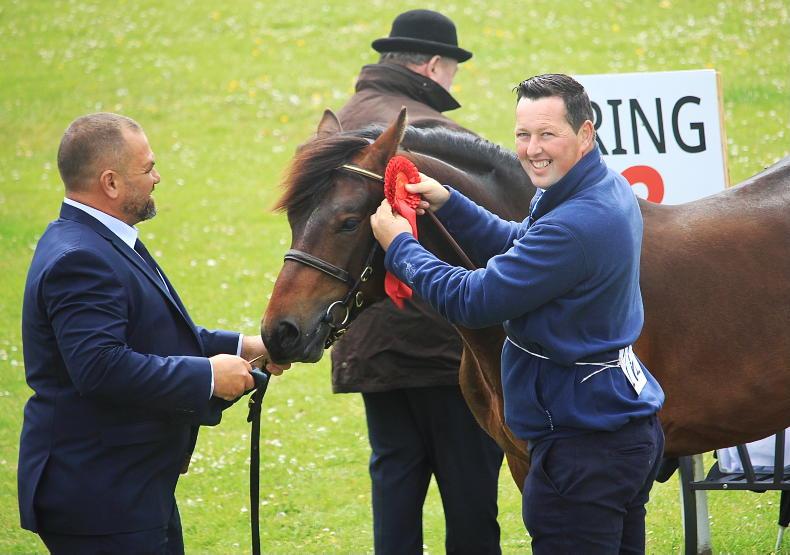
Clemerson Braga, last week’s popular Breeders 10 feature, holds Rogaire na Realta as Padraic places his Westport red rosette on the three-year-old winner \ Susan Finnerty
4. What’s your feeding regime in Mayo wintertimes?
The broodmares live out all year round. We give them Snaffles mineral licks in the field from October onwards and, when they’re running low on roughage, we put out bales of haylage for them. Approximately eight weeks before foaling, we will give them a feed once a day, which normally consists of beet pulp, oats and a good quality balancer. We use a balancer called Snaffle No 1, which we find very good.
We change feed to stud mix two weeks before foaling and continue to feed the mares until the foals are approximately two months old and mares are scanned back in foal.
From mid-October onwards, youngstock are normally wintered inside in pens, sorted into age groups, and have ad-lib haylage. From December/January, we feed beet pulp and balancer until they go out to grass in early April.
The stallions also winter out in the fields, fed on ad-lib haylage when roughage gets low, and have mineral licks. In January, we start to feed stud cubes to build them up, and they will come into the stables in early March for the season ahead.
Riding ponies that are in work are stabled at nighttime in the winter months, and turned out during the day. They’re also fed ad-lib haylage with some beet pulp and a balancer.
Generally, Connemara ponies are very good doers, and we feed according to workload.
5. The most sensible decision you made breeding/owning ponies?
Quality over quantity and keeping ponies true-to-type.
6. Best advice you ever got?
Willie Cusack once told me: “An ounce of breeding is worth a ton of feeding.”
7. Prefixes, your thoughts?
I think that prefixes are very beneficial, as they help a breeder to build a reputation. They make it easier to identify who bred the pony and also act like a trademark for a breeding programme.
8. It takes a team, who’s on yours?
My team includes Kate, my partner, and my children, Chloe and Darragh. Everyone has a different idea to bring to the table: one farm, four bosses!
9. If you could have bred any famous horse or pony?
I’d have to pick Coosheen Finn for his incredible influence on the breed and his ability to consistently produce quality offspring.
10. Next generation plans for 2026?
The children have a keen interest in ponies, they’re both riding Connemaras and compete them in showing and show jumping.
For the past two years, they’ve been lucky to be in the ribbons at Clifden and have great plans for their ponies for 2026, which I’m sure will keep us busy!