RUGBY, not horses, was the sporting religion in her household, as Michelle Lucey - Olympic groom, Irish Draught fan and fluent Italian speaker - recalls her early life.
“I grew up in Co Limerick, first Ballingarry then Croom, in a very sporty family, but most definitely not a horsey one. My dad Michael played rugby for Munster and ‘almost’ Ireland - that’s another story! - but did get to play against the All Blacks in Limerick.
“One of my brothers, Stephen, was a dual player for Limerick, so the GAA is in the blood too. Dad was the racecourse doctor for Limerick racecourse for over 30 years and is about as much connection to horses as there was!”
Luckily, the local Limerick hinterland provided the gateway. “As a kid, I did a few riding lessons, initially in Clarina Riding School and then in Crecora Riding School, but never had my own pony. Focus was on studying, rather than ponies.
“Over the summers, I would have helped out with the great Nuala Mangan and her family in Crecora Riding School, around the time of Lahorna Queen in all her glory,” she said, mentioning Greg Mangan’s star performer of the early 1990s.
Bred by Jim Seymour, the Clover Hill mare and Mangan competed for Ireland at Hickstead and Dublin, plus Millstreet and the iconic national championships at Salthill.
“I was always slipping out the back door of the house at 5am on my bike. I should have realised that horses were a massive obsession back then!”
A timely life lesson for Leaving Certificate students, wrapping up this year’s exams, is that ‘second choice’ careers can often work out for the better. “When I, not surprisingly, didn’t get Veterinary, one of my next choices was European Studies with Languages, and I started in UCC. The newest language was Italian and, as it happened, one of the many Mangan girls, Lesley, was in Italy.
“At the time, at 19 or 20 years old, you could au pair or work with horses for the summer. Back in the day, we had free accommodation, mostly free food, a car on hand and a great wage - nothing was pulling me back to college. I went for three months and stayed 23 years!”
Sydney-bound
Michelle’s extended gap year was even further enhanced, when she started working part-time for Italian eventer, Fabio Magni.
“He had qualified and competed for at least six Olympics and had a great Irish horse that some may know: Cool n’Breezy, bred by Madelaine Gervais.
“‘Cooly’, as he was known, was moving up through the ranks, and it started a cycle of European championships, World Equestrian Games and then the Sydney Olympics came around the corner.
“This was back in the glory days, where you had the four phases, and not only did you need the horse sound, but you needed the horsemanship.”
Italy’s proud equestrian history has been made famous through such world-renowned cavalry schools as Pinerolo and Tor di Quinto and game-changing instructors as Federico Caprilli, inventor of the modern forward seat. That legacy’s trickledown effect has also stamped modern equestrian sport.
“Fabio would have been very old-school, having trained with many of the historical Italian greats, be it in dressage, or eventing.”
He and ‘Cooly’ were duly selected for the Sydney Olympics, which took place in September 2000 at the Sydney International Equestrian Centre in Horsley Park.
Olympic grooms
The entire Olympic experience - even 26 years later - “is still fresh in my mind,” said Michelle, who treasures her Sydney Olympic groom’s lanyard and pass.
“Firstly, to get there, between quarantine in Rome, Germany and then in Sydney, but getting a horse there fit and sound was the achievement. Fabio insisted on travelling with the horses and I went down the day before to get everything ready.
“We went from 35 degrees in Pratoni in Rome, to freezing cold in Sydney We had to buy blankets for the horses, as we hadn’t expected the cold! All Sydney Olympic horses, of all disciplines, arrived together, to quarantine, and all left together,” she said, recalling Australia’s notoriously strict quarantine rules.
In fact, equestrian events were moved to Stockholm in 1956, while the remaining Games were held in Melbourne.
Australia is again set to host the Olympics in 2032, this time in Brisbane. The 2000 Games were also the last Olympics to hold separate team and individual competitions in eventing.
Have mirror ball, will party
“Horses arrived en masse in the early hours of the morning to Sydney, with a huge quarantine and military presence. The organisation was incredible and the horses came off the lorries bucking and rearing!
‘All work and no play’ can make for a dull experience and, before the Games began, there was a brief opportunity for the grooms to unwind after their equally long flight.
“Whilst we were in quarantine for the first week, it was party central! We had a mirror ball, a few choice CDs, and Olympic villages are alcohol-free, but this one didn’t stay that way for more than a day! Once things got serious though, it was a very busy place.”
The Down Under springtime climate presented challenges. “Sydney temperatures changed quite fast, and we went from being very cold to very hot. Sunscreen was out, and fans were bought for the stables.
“Our horses were used to the heat, and I was used to managing them in the heat, having been in Italy for so long,” said Michelle, whose years working in Mediterranean temperatures paid off.
“We started in the team event and were last to go. I knew the team wouldn’t last, and we went to the individual event. Something unheard of nowadays. We ended up doing our dressage twice and getting the same score!”
Next came the cross-country phase, over a course designed by Mike Etherington-Smith and lessons learned from the Atlanta Olympics.
“The cross-country course was a huge test. We had a very important few briefings when we arrived in Sydney and before cross-country day. The on-site vet clinic was well prepared.
“The veterinary team, composed of American and Australian vets, was well prepared for horses coming in ‘strained’, as Atlanta had been four years previously, so a lot of cooling and walking-off procedures were in place. We had misting fans and covered tents, for example.”
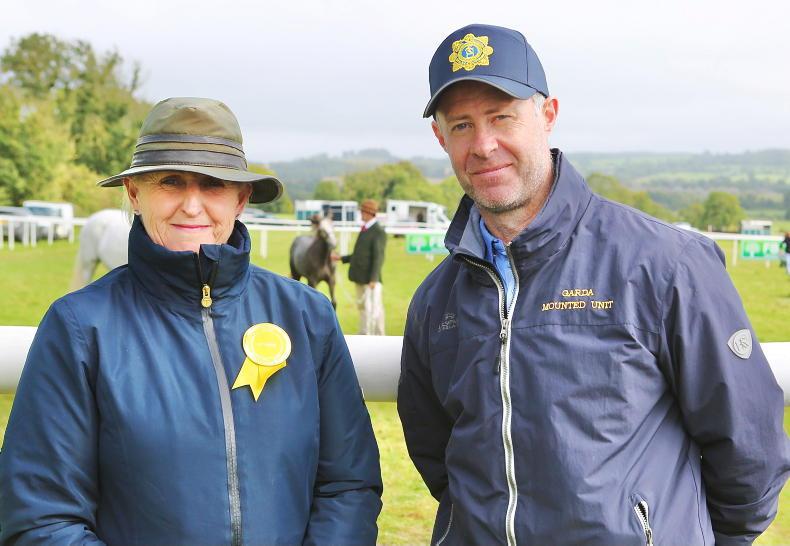
Michelle Lucey at last year’s IDHBA National Show at Punchestown with Sergeant Batt Moriarty, from the Garda Mounted Unit \ Susan Finnerty
Irish-bred horsepower
Cooly did his connections proud on cross-country day, but afterwards, it took Michelle’s rapport with the Tumblewind gelding to pinpoint the problem. “Cooly came in from the cross-country clear in the time, but when I called him, he neighed and looked at me. I knew something was up.”
“He was stripped, cooled and walked off, but his heart rate would not come down. He was quickly surrounded by vets and screens, but I knew the horse and all he needed was to get back to his stable to ‘relieve’ himself. After 30 minutes of total stress, the vets let him back to his stable, he did what he had to do, had a massive roll and started eating his hay! Perfectly fine and happy.”
A valuable lesson for the veterinary team then and now, as the eventing world gears up towards the Los Angeles Olympic Games, to be held during the Californian summer at Santa Anita Park.
Back to Sydney and the all-important final horse presentation before the show jumping phase decided the elements. “The toughness of the cross-country course made for a particularly nerve-wracking veterinary inspection for many, but we flew through it.”
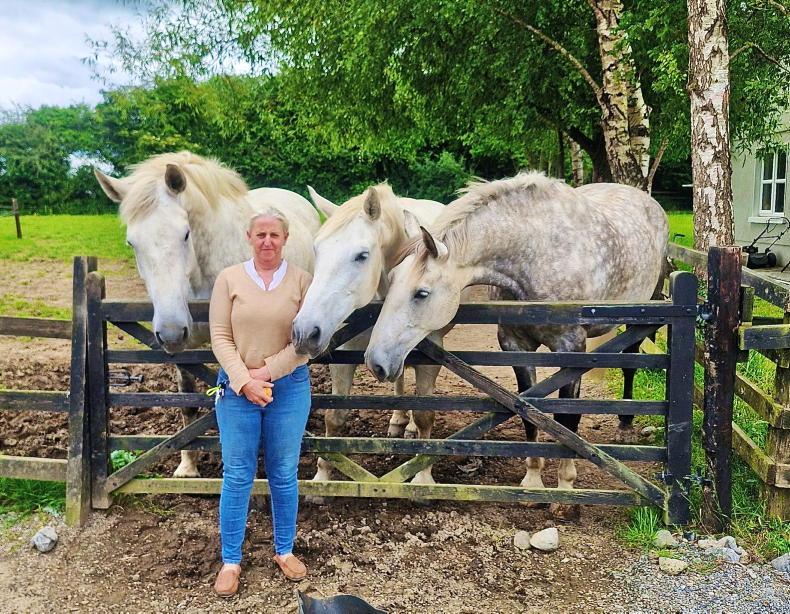
Three out of Michelle and Paul’s four Draughts that like to look in the windows and supervise Michelle working.
Team gold
To the delight of the home crowd, Australia - Philip Dutton (House Doctor), Andrew Hoy (Darien Powers), Stuart Tinney (Jeepster) and Matt Ryan (Kibah Sandstone) - had won the team gold.
Ian Stark’s Jaybee was the exception amongst Team GB’s silver medal horsepower, as three-quarters were Irish-breds: Over To You (Over The River x Gala Performance. Breeder: Mary Lett), Supreme Rock (Edmund Burke x Bassompierre. Breeder: Lindy Nixon-Gray) and Shear H20 (Stan The Man x Carnival Night. Breeder: Edward Walsh).
Right in contention for an individual medal was Cool N’Breezy. “Going into the show jumping standing fourth individually was an absolute dream. We had the planks down and moved to fifth, but to be up there with the likes of David O’Connor (gold), Andrew Hoy (silver) and Mark Todd (bronze)? A small team and a small Irish horse at the top of the world.”
O’Connor was already a member of the US bronze medal team with Gilt Edge (Glenbar). Under the dual system at that time, it was his other horse Custom Made (Bassompierre x Ben Purple. Breeder: Kitty Horgan and Liz O’Flynn) that won the individual gold for the American.
“The victory, really, was in qualifying, getting the horses there fit and sound and keeping them sound over the four phases,” said Michelle, reflecting on the Olympics groom experience.
“It takes years to get to that level, and what an Olympics Sydney was. We did have a horse [Loro Piano Vent d’Arade] in Athens in 2004 also, but a totally different story. There, the heat was a massive factor and heavily influenced the outcome, even though, by then, roads and tracks were well phased out.”
The Italian years were multi-tasking ones, as Michelle also worked in the European Commission office in Rome. “Most of the time I was in Italy, I was working part-time, and I would take my holidays, or summers off, to go to shows and championships.
“When working for the European Commission, I’d finish on a Friday at lunchtime, head off, wash and plait 10 or 12 horses, and off we would go. Get back early hours of Monday morning, sometimes a shower and straight into work in Rome - the good times!”
“The Irish boots”
She also saw a gap in the Italian market for what had become a must-have accessory. “A friend had asked me to help her with her tack shop in Pratoni, which led to me getting in contact with Dubarry of Ireland. I got so sick of all the Italians asking me for ‘the Irish boots’ that I sent an email to Michael Walsh, Head of Marketing in Dubarry! Almost immediately, we got going.”
After 23 years in Italy, Michelle moved back to Ireland in 2013 “and straight off the ferry to my first job at home. No resting!”
Or being horse-less. “I had moved to Kildare and a great friend of mine, Una Holohan, the Kildare Hunt Pony Club DC, is now responsible for me having four Irish Draughts looking in at me from the field.
“I met my partner Paul Corson, through work - he’s the sales manager for Dubarry - and he owns Graigueaverne Moonlight, one of the four horses. Irish Draughts have become quite the obsession!”
The flourishing Irish Draught performance classes have proved a fantastic shop window for the versatile native breed.
“I compete in the performance classes, as one of the very few pure amateurs. I was so lucky to qualify for Dublin on my five-year-old Bouncer’s Son and am a huge advocate for the Irish Draught. If I won the lottery, you would know!
“The Draught is our only native horse breed, and the foundation of what we know as the original Irish Horse. Draughts have so many positive characteristics,” she said and feels the breed is perfect for the current amateur and leisure riders. “The eventers of long ago had stamina and speed, they had to with the four phases, so different to what is needed today.”
Online support
That passion for the breed has found another outlet. “Due to my Draught obsession, I am on the IDHBA Kildare Branch Committee and sit on the IDHBA National Board. Draughts have really come into the limelight lately, and it is evident in the high standards of animals being bred and shown across the country.”
At the moment, plans are well underway for the IDHBA national show, which has changed dates this year.
“The IDHBA are holding their National Breed Show in Punchestown on Saturday, July 11th, for the first time before the RDS.
“We have invited judges from England, so that everyone gets an unbiased idea of their stock. The change of date was considered an opportunity to give horses going to Dublin some precious ringtime, especially for the youngstock, and a good strong course on grass using the bank for the performance classes.”
Changing from their former date is a brave step, however with many owners focused on Dublin Horse Show, autumn show entries have seen a steep decline.
“Many animals are turned out or sold on after the RDS, so we are hoping we will get an increase in entries and really help our National Show become a premier showcase for Irish Draughts in Ireland.
“I worked from home through Covid and beyond, and as I now have horses at home, I needed to work remotely. Essentially, a Virtual Assistant offers services to business owners who need help.
Prime candidates
“Generally, people who end up working evenings and weekends, trying to catch up on admin, marketing, social media, customer invoices, anything really, rather than growing their business - are prime candidates for my services. We work quietly in the background, sorting out where you need support.