THERE’S yet one more insightful reminder of the Eddie Macken era amongst the Boomerang Bar photos; a small black and white photo of the local hero at his first show - Longford, 1960 - being led along on a pony by local man Harry Farrelly.
Looking on in the background is a young barefoot lad, sporting a close-shaven haircut. “That was quite normal back then, children ran around barefoot during the summer,” remarked Brian Gormley when I later mentioned this photo to him.
Sixty-five years ago, the steady stream of horse lorries rumbling down Granard’s main street that day, to and from shows in Cavan and Mullingar, would have seemed like spaceships to those young boys at Longford Show.
Another change is the preference for competing on all-weather arenas. How do traditional shows, such as Granard and Longford, ‘compete’?
“I’d say the diehard horse person, like my husband [Tom], thinks that a horse should be able to jump on grass as good as it can jump on an all-weather arena. That’s his generation, whereas Thomas [their son], who’s 25, would be wary of bringing his ‘good horse’ to jump on grass, in case he got injured,” said Bernie Whyte, Longford Show equine secretary.
“Dublin, Hickstead, Aachen, they’re all grass arenas and Balmoral too,” Granard Show chairman Gerry Tully replied. He had noticed a rise in entries and distance travelled by some competitors, bidding to get in match practice on grass, in Granard’s pre-Balmoral show jumping classes.
“Lizzie’s cousin, Jimmy Macken and Sean Donohue, in the corner pub up the street, who also worked for Eddie, would have jumped together at Granard and the local shows on grass. It’s almost something that some children would never have now,” he added.
Badge of honour
One horse, well familiar with those international grass arenas, was the Army Equitation School’s speed specialist Mostrim, the Irish variant of nearby town Edgeworthstown.
“He was bred locally by Gerry Duffy in Coolaharty. We bought him from Gerry as a three-year-old and he was produced by my sister Hazel for a few years before he was sold to Ned Cash, who then sold him to the Army, ” recalled another of the Boomerang Bar posse that afternoon: Charlie Murphy.
“Mostrim was by Chilon, who stood with John Duffy, the father of the breeder and Pat Duffy [who owned Croker Cup champion Nad Al Sheba] was Gerry’s cousin,” Charlie went on, filling in yet another piece of Irish equine heritage.
Murphy has been involved with his local show - Longford - for over 50 years, serving as its chairman for “roughly 30 years until I retired two years ago and handed on the baton to the next generation”.
It was another show chairman – Newcastle West’s Liam Ruttle – who inspired the first ‘county tour series’ after last year’s impromptu visits to West Limerick’s yards and kitchens.
Here in the follow-up county Longford, you discover more about Mostrim in one minute than an hour of Google.
“I remember Mostrim competing in the secondary competitions of the 1982 world championships in Dublin, where Gerry Mullins was fourth with Rockbarton.”
“It was a real badge of honour to have your horse jumping for the Army and every time on the television, you’d hear ‘bred by Gerry Duffy in Springpark, Coolaharty, Co Longford,” said Charlie with a smile.
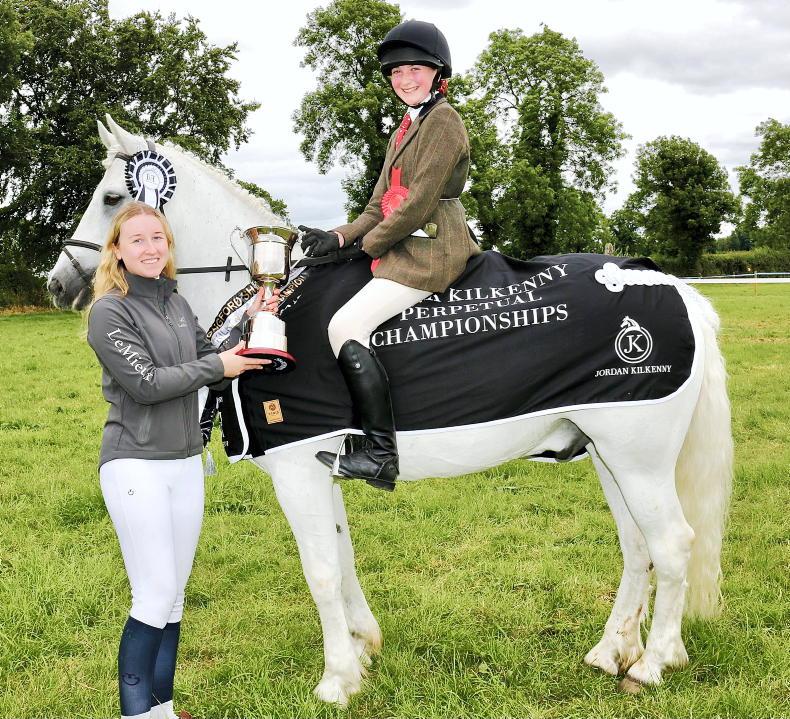
Katelynn Kilkenny presents the Frank Kilkenny memorial cup to Gemma Whyte and Shane’s Lad, the working hunter pony champion \ Susan Finnerty
100 + 21% VAT
Again, there’s fond memories for the Longford Show duo of the Eddie Macken era. “Iconic, it just brought the whole country together,” Bernie remarked.
Fast forward to 2025 - what’s the reality like now of running a country show?
“It starts the day after your show, the planning never really stops,” replied Hazel McVeigh, Granard’s show secretary. “You’re ‘mopping up’ afterwards, then say once your AGM is held, you’re back out again getting the next year’s show ready.
“I think you don’t appreciate the amount of work, that a committee and volunteers put in, until you get involved yourself. People arrive at a show, get their numbers and off they go, but you don’t see the work that goes on behind the scenes.”
Both teams – from the last two agricultural shows standing in Co Longford - are in unison about the vital importance of sponsorship and financial support, such as Leader grants and various Government department funding.
“Insurance is a huge but essential expense, sponsorship, tents, feeding the judges and then the cost of printing is outrageous! Although a lot of people want the schedule sent to them in the post. Particularly the traditional show man or show woman, who still want this piece of paper in their hand to go through the classes and, like Tom does, mark the ones to enter with an ‘X’!” Bernie said, detailing some typical show expenses.
Attracting new committee members is another challenge. “We find that people don’t want to attend meetings, but are often happy to help out on the day. We’re also very lucky to have that bond with Longford. I can just contact Bernie, Charlie or anyone there with a question, for example, and vice versa,” said Hazel.
“We have a lot of people that come to help on the day or two, three days before to help set up and the day after,” agreed Charlie.
And they each attend each other’s shows to steward and lend a hand on the day. It is Granard’s 75th anniversary show next month (July 19th-20th), while upcoming Longford celebrates its 121st anniversary on July 6th.
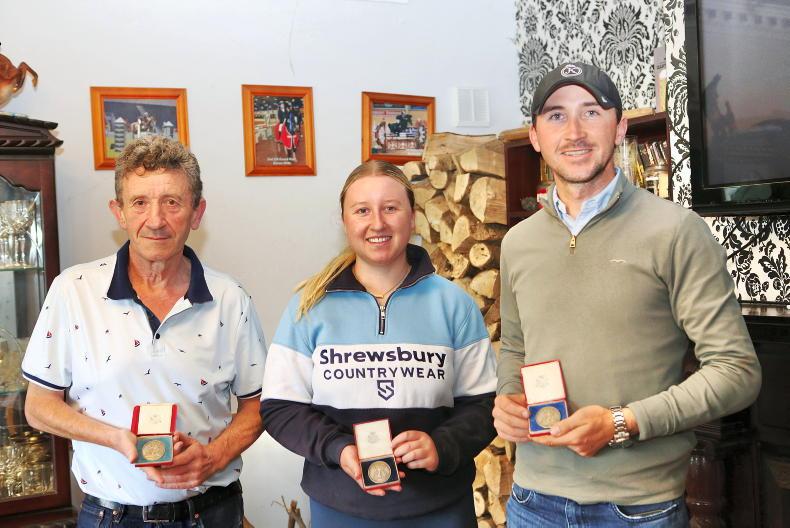
Tony, Katelynn and California-based Jordan with the three RDS silver medals won by Limekiln Lily, owned by the late Frank Kilkenny \ Susan Finnerty
God-like
Gormleys, Gannons, Clancys, Glancys, Harrisons, McGreals and, of course, Harold McGahern are just some more of the characters and anecdotes mentioned that special afternoon in the Boomerang Bar.
“Harold used to bring us to the Spring Show when we were kids,” Gerry said about his former teacher. “And he used to bring us from the science lab to his farm in Rincoola, said it was more productive for us than wasting our time in school!”
There’s two more visits to squeeze in and, as in less than 48 hours’ time, Jordan Kilkenny is heading back to California, it’s on to another Longford stop: Ballymahon.
For several years now, the Kilkenny family have sponsored the Frank Kilkenny memorial working hunter championship at Longford Show, as a tribute to the late stallion master. This year, the ridden hunter championship is the beneficiary.
“My father left school when he was very young, because his father died before he [Frank] was 12. He used to plough all day with horses, always loved horses and then he was in England for three or four years, working on the railways,” said his son, Tony.
Impeder and Nelgonde, both ex-racehorses, are the two stallions associated with Frank Kilkenny, who also won three times at Dublin with the prolific hunter mare Limekiln Lass (1954, 1955 and 1961), named after a placename in his native Leitrim.
“Impeders Girl would probably be the best known of Impeder’s show jumpers and my father used to do a lot of livery too. As kids, our biggest job was to round up the mares.
“Our local show Ballymahon, Granard, Longford, Roscommon, Oldcastle, Mohill in his home county and Dublin were some of the shows we’d go to. Dublin was my father’s holiday! And, of course, to see Eddie Macken jumping there - he was just a god.”
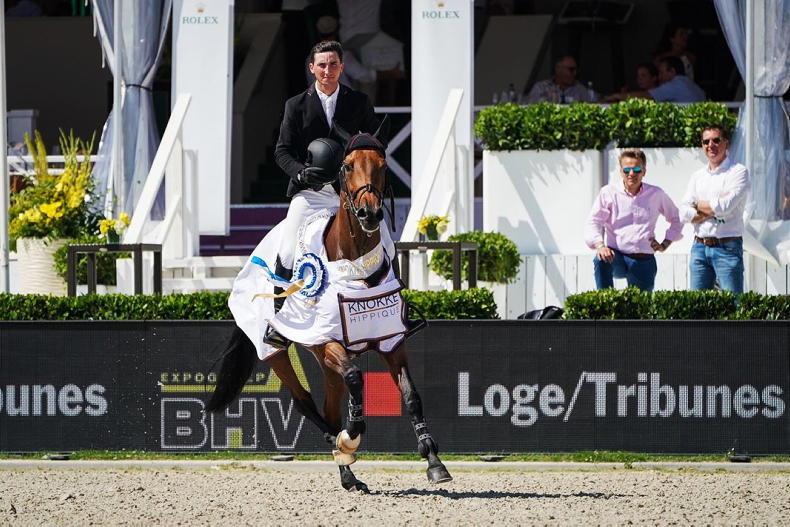
Jordan Kilkenny
Go west
Jordan and his siblings, Dylan and Pharmaceutical Science graduate Katelynn, all competed - although it could have been a different story.
“My parents asked me and my brother, ‘Do you want quads or horse riding lessons?’ We got lessons and that was the mistake of their life! Cost them a fortune!” he said.
“We started off hunting with the Longford Harriers, my mother and father running beside us and then moved into show jumping.”
Drumaclan Flight is rated as his best pony. “I had a few, but I won a lot with her; the Millstreet Derby, national championships, a qualifier for the Odyssey when it was still on in Belfast.
“Castle King was another, we jumped the Home Ponies International in Cavan with another Longford person: Aisling McGreal, who won the five-year-olds in Balmoral this year.”
Surprisingly, while working with horses in America is many young equestrians’ dream, it wasn’t quite so for Jordan in the beginning.
“If you asked me in October 2019, if I would ever end up in America, I’d tell you ‘No’! I was working for Cian O’Connor at the time and we sat down at a horse show in Valencia.
“He said, ‘Look, the only advice I’ll give you about how to find a way to make money in this industry is: go to America. That is where the money is.’
“I go, ‘Do you know of any jobs?’ And he goes, ‘No, I’m not a job agency! The rest is up to you.’”
Taking his mentor’s advice, Kilkenny moved to the States, where he first worked for Gary Kenny for a year until he met Don Stewart, who “invented leasing horses in America”.
“It was torrential rain in Traverse City, I’m sat in the bleachers trying to understand American equitation classes after jumping in a three-star ranking class that morning. This fellow in a mustard-coloured pontoon jacket comes up, sits beside me and we got talking.”
That initial talk ended up with the pair doing business together, through lease agreements for 127 horses and ponies, since that rainy day in Michigan.
Different angle
Interestingly, while other producers bid to supply the 1.60m Grand Prix market, Jordan is more focussed on other alternatives: American hunter and equitation classes.
“The people I work for in California make for an interesting story. Carlton Brooks is the guy’s name and he has won everything you can win in hunters in America, whether it’s riding or training. Like, this man is an encyclopaedia.
“I’ve done business with them for five years and then, two years ago, his wife rang me and said, ‘Look, Carlton is going to start stepping back, will you come over and help us?’”
Their business model entails breeding, finding and producing horses and ponies in Ireland until they’re shipped to America.
“Another aspect is the “huge market for Irish Gypsy Vanners and cobs in America. It’s really huge. That part of the business is based in New Jersey. I have 36 horses and ponies all over America.”
How does he keep track of them all? “Good notes on your iPhone! I’ve got a spreadsheet, I know where every horse is, when its lease is up, when it needs to be wormed. On top of that, I ring people every Monday, ‘What’s the plan for this week?’
“When I went to America, I knew nothing about hunters, equitation horses and hunter ponies. And that is now 90%, 95% of my business.”
“I think a lot of people sort of get stuck on one thing,” Jordan continued. “When I went to America. I knew show jumpers and then realised me and everyone else were trying to do the same thing. We’re all trying to ride the jumpers, to find that one owner and that one client, whereas I was, like, if I do the opposite; don’t focus on the career, focus on business. And that’s what I learned when I went to work for Cian.
“He always said to me when I worked for him, it’s always Nations Cups. Everybody else focuses on the Grand Prix class. He focuses on the sport, but if you look at him, you know he is a man to come from a different angle than everybody else.
“He focused on championships and that’s why I think he’s the best anchorman in the world, because when it comes down to it, you need someone to get results.”
Worlds apart
Jordan continued: “I learned a lot from that. There’s no perfect route, it’s the route that gets you the direction you want to go. What I learned from him set me up to do what I did, because I said to myself, ‘If a man like Cian O’Connor is giving me advice, if you don’t take this advice and it comes back to bite you, are you going to be okay with that?’”
Describe a typical American hunter class?
“So, basically, it’s a 36” or 1.10m course. The horses will be braided up, sewn-in braids [plaits]. You don’t get to walk the course, the course plan is on a board.
“Usually, there’ll be eight jumps in a course and, as soon as you walk in that gate, you’re judged. If you walk across the ring and the horse flicks his head, you’re going down in the marks. You’re supposed to get a lead change directly in a straight line or at the point of turn, if you go late.
“If you’re a stride late, you’re going down the marks, if you knock a jump, you’re an automatic 45 [score]. I think there’s only ever been seven perfect 100 scores in the the history of these classes.”
It’s back stateside on Monday after an 11-hour flight to Los Angeles “and a horse show on Tuesday”. Is the Golden State now home?
“I wouldn’t say it’s home, but it’s somewhere to step up.”
And not all glamour either, as his brush with the Californian wildfires back in January tells its own story.
“The people that I work with... their house has a swimming pool and the fire burned right down to the pool. They had to dump water from helicopters on top of the houses and 97 horses and ponies were evacuated from there.”
It’s a different world away from a wet May afternoon in Co Longford discussing the changes in Irish country shows and gymkhanas to the US scene, where children jet in to compete in shows at weekends. No doubt it was the same culture shock when a young Eddie Macken relocated to Germany and another thing in common between he and Jordan Kilkenny is their grounding at their local shows. Has his experience with the US hunter scene influenced Kilkenny’s interest in sponsoring the hunter classes at Longford Show?
“I’d say it is a big thing behind why we did this class for our grandfather.”
So many characters to choose from in another county brimful with stories. However, there’s one more who has to be visited this time - the man whose name has cropped up over and over that day: Brian Gormley.
Next week: The mentor.