A SPECTACULAR sight that most people attending the Dublin Horse Show miss is the pageantry surrounding the arrival of The Lord Mayor of Dublin on the opening day of the Show in the ornate 235-year-old coach, gilded in gold and drawn by four black coach horses dressed in pristine harness complimented by hand crafted brass fittings.
The coach has often been described as an ‘art gallery on wheels’. It was built in 1789 and arrives at mid-day just outside the RDS Main Hall on the first day of the Horse Show. Each year The Lord Mayor of Dublin is greeted by the President of the Royal Dublin Society and invited to officially open the Dublin Horse Show.
History
The story of the Dublin Lord Mayor’s coach is steeped in social history and is very relevant to the RDS and the Dublin Horse Show. The coach was built in 1789, the same century that the RDS was founded (1731).
It is an example of superb craftsmanship, a value that the RDS recognises with prizes and bursaries awarded each year, it requires horses to draw it through the streets of Dublin, an animal that the RDS has fostered since their first Dublin Horse Show in 1864.
Ironically the Mayor of Dublin, an office founded in 1229, did not have a carriage of their own and had to resort to follow the wealthy landed gentry on foot behind their carriages. With the appointment of a very wealthy gentleman, Humphrey French, in 1732, he provided his own coach which was manned by footmen in full livery, but unfortunately when his term finished, he withdrew the coach.
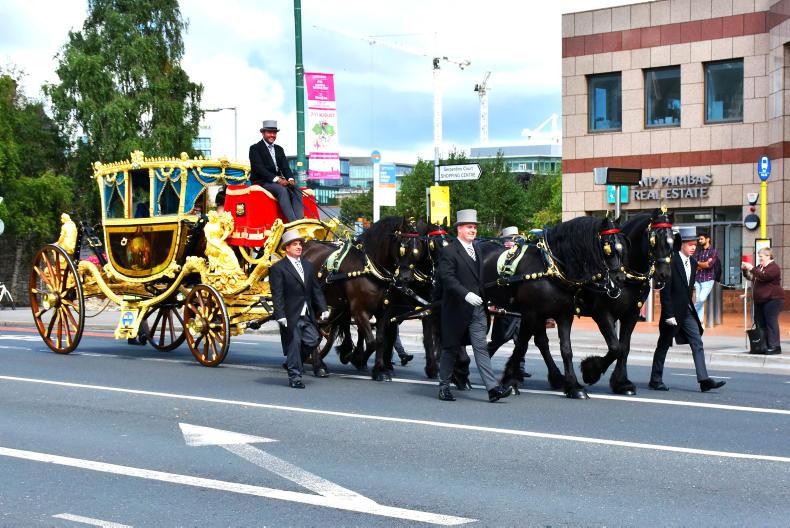
David Mulreany, coach driver in the box seat of the Dublin Lord Mayor's Coach arriving at The Dublin Horse Show \ Noel Mullins
Subsequently for two decades, the Duke of Leinster provided the Lord Mayor with a coach until it was decided that the office of Lord Mayor deserved a coach of its own. The Lord Chancellor Lord Clare caused a stir much to the annoyance of Dublin Corporation as he had not consulted with them on an elaborately designed coach built by William Whitton, a well-known coach builder in Dominick Street in Dublin and put on display at his residence just off St Stephen’s Green.
At the time, there were more than 40 coach builders in Dublin employing some 2,000 of the most talented craftsmen whom excelled in coach construction, upholstery, carvers, gilders, iron workers, and harness makers.
Commissioning a new coach
Dublin Corporation commissioned its own coach that was built on a grand scale by William Whitton in Dominick Street in Dublin. It stands 23 feet long, nine feet wide and nearly 12 feet high costing many millions in today’s money. Built by master craftsmen, it features wood carvings by Frenchman Charles Francs le Grand who also worked on the ceilings in Dublin Castle.
Figures such as the Dublin City Coat of Arms of three Burning Castles, two female figures signifying justice and law with the City Motto ‘Obedientia Civium Urbis’.
Also to be seen are a sword and mace, symbols of The Lord Mayors Authority and Sculptors of Cherubs on the roof, in addition to two ladies holding a cornucopia representing money in and money out.
The historical scenes painted on the coach doors and finished with a lacquer are attributed to an Italian artist Vincent Waldre, and the door handles are finished in silver. The traditional wooden wheels are also enhanced with gold decorations.
The new coach made its first appearance on the streets of Dublin on November 4th, 1791, and was used for ceremonial events up to the Eucharistic Congress in 1932. It was put into storage for over 40 years until 1974 when the Dublin Corporation decided to restore it in their Mechanical Divisions Workshop in Stonybatter.
It was next seen in the St Patrick’s Day Parade in Dublin in 1976. Its only time to leave Ireland was in 2015 by special request when it travelled to London on the 800th anniversary of the Magna Carta.
Maintenance
Since 2004 the coach has been in the tender care of Walter O’Malley who works for the Waste Water Division of Dublin City Council where the coach is based in a secure facility, temperature controlled, and monitored 24 hours a day on CCTV. Walter, aside from his day job in the Council, takes on the responsibility for looking after the historic coach and treats it like one of his family.
He is assisted in the team by Jimmy O’Neill who on the day of my visit, along with Jimmy Clarke, was wetting the wooden wheels to allow them to expand and contract in preparation for the imminent visit to the Dublin Horse Show. To have the coach ready for display, because of its age, every aspect has to be checked and rechecked and that requires up to seven weeks of preparation.
At the RDS, the public will see perched high up in the driver’s seat (box seat) David Mulreany of Mulreany Carriages and his brother Brendan acting as whip who are contracted to provide and drive the team of horses.
They run a specialised coach business from The Liberties in Dublin servicing all the top hotels in the city. The team of four horses are Dutch Friesian, all black in colour and standing about 15.3hh. Three of the horses are home-bred. Romeo and Sheila are at the back and the closest to the carriage. They initiate all the turning and are known as the wheelers; they do the most technical work at the back, while horses Rick and Jasper are at the front which is looked on as the fancy role!
Remaking
In 2015, the Council needed to have all the harness and leatherwork on the coach fully remade. They were fortunate to be able to avail of the services of master craftsman Jerry Crowley. He had trained with master craftsman Sam Greer who traded as Sam Greer & Son Saddler and Harness Maker whose father and grandfather’s workshop were based in Poolbeg Street beside the famous Dublin landmark, Mulligans Pub.
The business thrived as there were so many coaches and delivery drays operating in Dublin in the 1900s to a decline in the 1950s due to the popularity of the internal combustion engine.
But Sam still had a healthy business doing repairs, making saddles (and side saddles) and bridles for the hunting, leisure and overseas market.
With the development of high-rise buildings and apartments in the city centre and limited parking in the 1990s and, as Sam was by now in his mid-80s and had no family to continue it, he decided to close the business.
Jerry Crowley is based in Co Wicklow and is master craftsman in saddlery and harness making having learned from the master Sam Greer.
The project involved sourcing suitable leather and patent leather in Europe as there are no tanneries left in Ireland. Jerry was assisted by his nephew John-John still a teenager who is also the youngest steward at The Dublin Horse Show. His father, John Crowley, is 37 years serving as a steward at the Dublin Horse Show and 17 years as Chief Steward of showing.
It took one year to remake all the harness from patterns and buckles that were centuries old. It had to accommodate horses with longer backs and the bits had to be widened as they were probably more suitable smaller horses that originally pulled the coach than for modern Friesian horses.
For the coach, strong straps of three-ply leather connect with the thoroughbraces and swingle tree braces attached to the leaf spring suspension system that the gondola (body of the coach) is suspended from for ride comfort and structural support.
Jerry stamped the harness with his own stamp and as a mark of respect to his mentor he stamped the other side with the stamp of Sam Grier.
I highly recommend watching the arrival of The Dublin Lord Mayor’s Coach at the Main Entrance of the RDS at 12pm on the opening day of the show, as you are in for a treat and an opportunity to look back at nearly 250 years of master craftmanship and coaching history.