WHEN the Army Equitation School was established in 1926, few could have imagined that it would still be thriving a full century later. Its story is inextricably linked with the decision taken by the RDS to add an international military team competition to Dublin Horse Show’s already busy programme, and the subsequent birth of the world-famous Nations Cup of Ireland for the Aga Khan trophy.
It’s a rattling tale of heroics, tenacity, foresight and intense national pride. Just a decade after the 1916 Rising, five years after the War of Independence and just three years after the end of the Civil War the newly-established Irish Free State agreed to provide a team to take on some of the biggest showjumping stars of their time.
It must have seemed like madness to many. No riders, no suitable horses and a new country struggling to find its feet and still deeply divided after years of turmoil. But Swiss Colonels Ziegler and Haccius persuaded Judge Wylie of the RDS that the competition had the potential to expand Ireland’s all-important horse market, while also placing the spotlight on the brand new nation. Free State President, W.T. Cosgrave - whose death sentence following the 1916 Rising was commuted on appeal thanks to Wylie - gave the Army the go-ahead, and so the story began..…
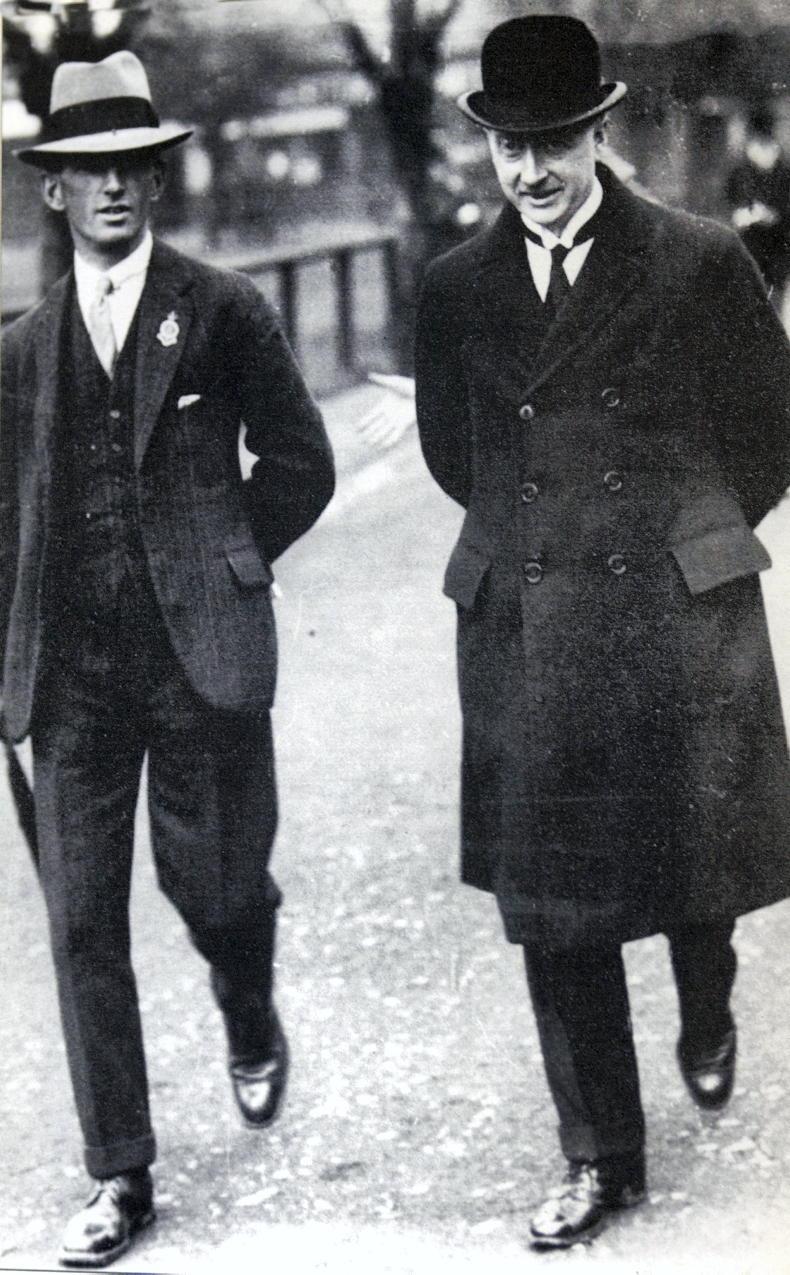
Judge Wylie and W.T. Cosgrave in 1923 \ RDS Archive
Called up
Horses were purchased, and called up were Captains Ged O’Dwyer and Dan Corry who were life-long horsemen along with top National Hunt jockey Captain Cyril Harty. When the show began on Tuesday, August 3rd, 1926 O’Dwyer sensed that “at least half of the packed stands were hoping for a win by Britain”, but by Friday afternoon all that had changed.
Something stirred in Irish hearts when O’Dwyer riding Oisin, Corry riding Finghin and Harty partnering Cuchulainn battled hard to finish second in that inaugural Aga Khan Cup, bettered only by the crack Swiss team that included two Olympians from the 1924 Games. A sense of nationhood bubbled up around the RDS arena, and that swell of Irish pride continues to this day.
That success against all the odds however proved something of a false dawn when the following year the team found themselves completely out of their depth at shows at Olympia in London and Lucerne in Switzerland. By the time they arrived at Dublin Horse Show in 1927 it was clear that the future of the school was in jeopardy. But Colonel Michael Hogan made the inspired decision to hire emigre White Russian cavalry officer Paul Rodzianko as trainer and, although it was a painful process for the riders, his advanced coaching methods transformed them into the most formidable force in international show jumping.
Return to Olympia….
Winning the Aga Khan Cup in front of an ecstatic crowd in 1928 was a huge achievement, and they put the disaster of 1927 to bed when returning to Olympia in 1929 where they collected 34 top-three placings over the eight-day fixture. In Dublin that summer they were just pipped by a single point for the Aga Khan trophy won by France, and they then set sail for shows in New York and Boston.
Throughout the 1930s the Army teams were near-unstoppable, winning over 20 Nations Cups and hotly-tipped for Olympic gold in Berlin in 1936 only to have that dream dashed by an Irish boycott of the Games. Their successes brought not only sporting recognition to Ireland but played a vital role in establishing the country’s identity internationally while showcasing the quality of Irish-bred horses to a global audience.
Amongst those horses were the great Limerick Lace, Miss Ireland, Ireland’s Own, Blarney Castle, Gallowglass and Red Hugh. And caring for them were the greatest asset to all Irish teams right up to the present day, the grooms, one of whom played an unusually significant role in the winning of the prestigious High Score Cup in New York in 1933.
With the Irish economy in the grip of a depression the purse strings were tight and only three riders travelled to North America that year with Captain Corry in charge. However a change of format for the three-day Military Competition required four riders on the final night, so Corry called up groom Private William Finlay to step into the breach and compete in the first horse show of his life. And, with Ireland’s Own - described by Ged O’Dwyer as “the most difficult horse in the School” - “Juggler” Finlay fulfilled his duties with courage and determination to join Corry, Fred Ahern and Cyril Harty on the victory gallop. The New York newspapers couldn’t get enough of the epic tale.
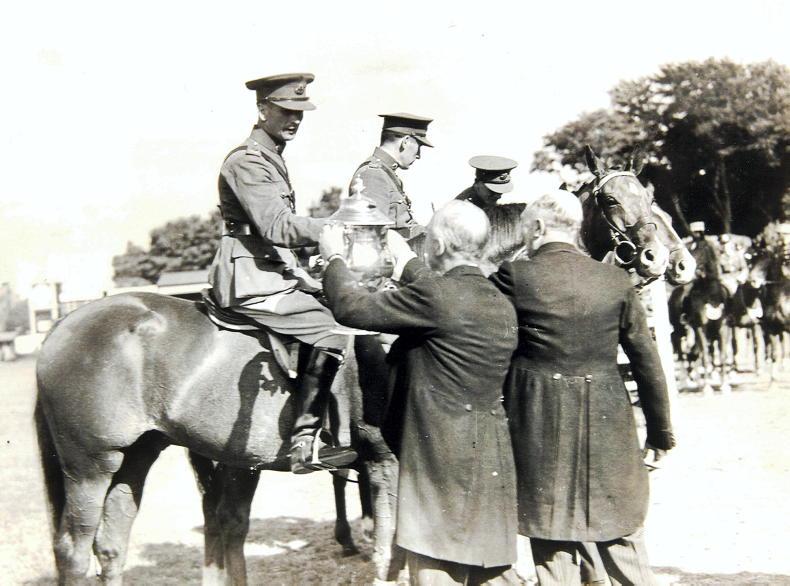
Ireland's riders reached four-in-a-row Aga Khan Cup victories up to 1938 and have never been bettered \ RDS Archive
Unquestionable
By the outbreak of World War ll in September 1939 Ireland’s status as a show jumping nation was unquestionable. The disappointment of the 1936 Olympic Games was somewhat alleviated when pinning the newly-crowned gold medallists into runner-up spot on Ireland’s first visit to Germany’s hallowed ground in Aachen in 1937, and the four-in-a-row Aga Khan Cup victories up to 1938 have never been bettered.
Following in the hoofprints of Limerick Lace and Ged O’Dwyer in 1934 and Blarney Castle with Fred Ahern in 1938, Dan Corry ensured that last pre-War Dublin fixture would be memorable when steering Red Hugh to take the Grand Prix title in 1939.
The School was reconstituted at the end of the war in 1945 and new recruits included Bill Mullins, Louis Magee and Michael Tubridy. A few of the pre-war horses were still available along with new purchases, and the Army team won the Aga Khan Cup in 1946 when former Clare GAA star Tubridy also won the Dublin Grand Prix with Kilkenny. After seven runner-up placings in Nations Cups in 1947 there was an upbeat mood going into the Olympic Games in London in 1948, but elimination for Jack Lewis and Lough Neagh put paid to Irish chances.
Polish Major, Severyn Kulesza, was hired as trainer in 1949 and two years later was replaced by Colonel Rodzianko who returned on a 16-month contract. Meanwhile Corkman Kevin Barry won the King’s Cup in London, and the extraordinary Dan Corry was still in winning form in his 26th year of international competition in 1951 when the team posted a glorious fault-free victory in Toronto in which Tubridy partnered the former gun-carriage horse Glandore.
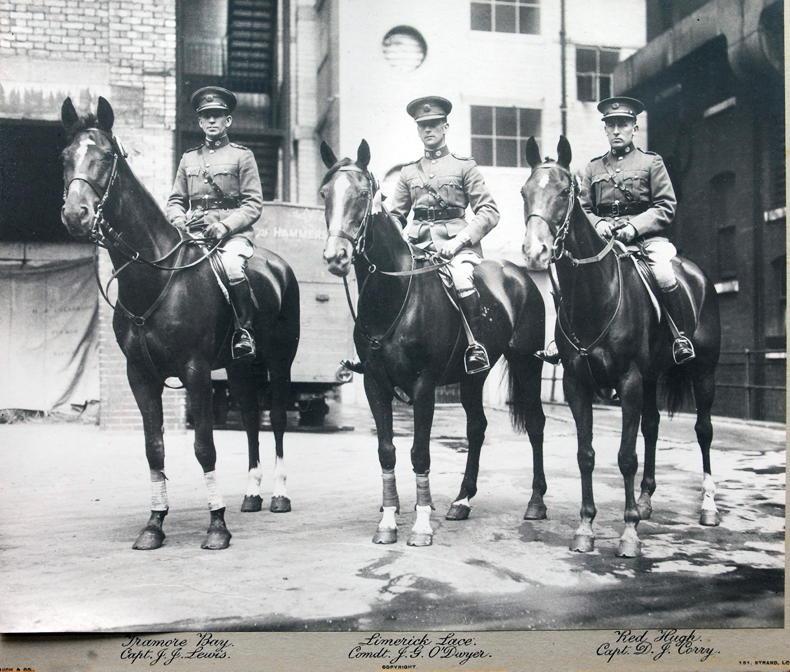
The winning Army Equitation School team at London's Olympia in 1937: Tramore Boy (Capt Jack Lewis); Limerick Lace (Comdt Ged O'Dwyer), Red Hugh (Capt Dan Corry)
Stole the show
Colm O’Shea posted five wins with Ballyneety on the North American tour in 1952, and Tubridy stole the show in Dublin in 1953 when steering Ballynonty to victory in the Grand Prix. He was on the winning team in the Nations Cup in New York that autumn, but sadly, aged 31, he died in a riding accident in April 1954 shortly after retiring from the Army.
By now the recruitment policy had changed, so young men with no equestrian experience who were commissioned as 2nd Lieutenants in the regular army could apply for a cadetship at the School. One of these was young Billy Ringrose who appeared in 1954 alongside Patsy Kiernan and Tommy Moroney.
Kiernan, Barry, Ringrose and Brendan Cullinane won the Nations Cup on Ireland’s debut in Rotterdam in 1954 where Barry and Hollyford won the Grand Prix, and in 1955 Kiernan won the Grand Prix in Nice with the irrepressible Ballynonty and the Dublin Grand Prix with Glenamaddy. Then it was on to the North American circuit for a win in the Nations Cup in Harrisburg.
Barry with Ballyneety, Kiernan with Ballynonty and Ringrose with Liffey Vale competed at the 1956 Olympic Games in Stockholm, finishing seventh of 20 teams and Bill Mullins was on the Irish eventing team, finishing a very creditable 10th individually with Charleville.
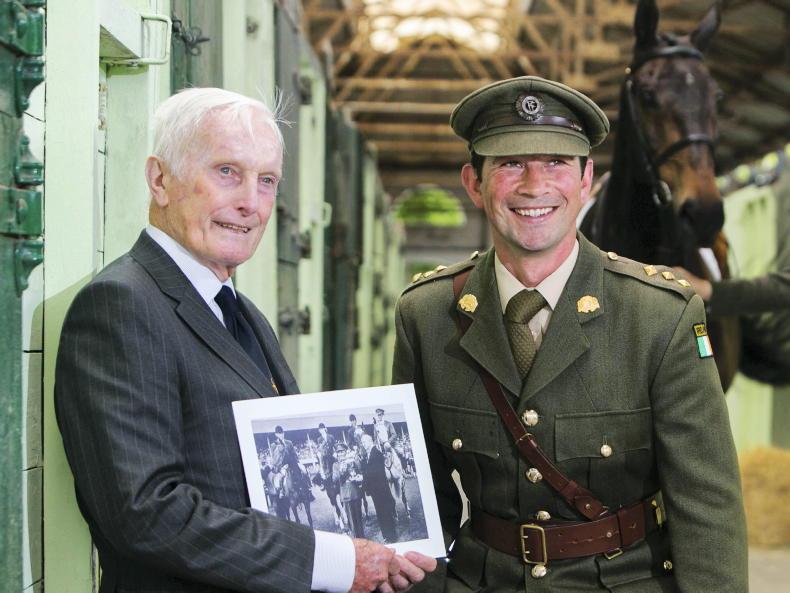
Colonel Billy Ringrose and (then) Captain Geoff Curran celebrate 90 years of the Equitation School in 2016 \ Orla Murray/ Ark Photography
Star of the future
Seamus Hayes signed a two-year contract as trainer, and in 1959 another star of the future, Lt Ned Campion, appeared at the Spring Show while in Dublin Billy Ringrose partnered what would be his horse of a lifetime, Loch an Easpaig.
They competed at the 1960 Olympic Games in Rome alongside Sean Daly and Eamon O’Donoghue but the team was clearly out of its league, and that increased pressure to combine forces with civilian riders who were consistently stealing the headlines. It would, however, take a little longer….
Ringrose burst onto the international stage in 1961 winning the Grand Prix at Marseilles with Ceanannus Mor before partnering Loch an Easpaig to victory in the Nations Cup and the Prix de Monaco in Nice. He filled the top two places in the Grand Prix in Rome with Loch an Easpaig and Cloyne, and went on to win the Manifestation Stakes in London, the Pembroke Stakes in Dublin, the Martin Trophy in Washington, the Democrat Trophy in New York and the Goodwill Trophy in Toronto with Loch an Easpaig.
So this army pair were chosen for the very first Army/civilian side to line out in the Aga Khan Cup in 1963 alongside Diana Conolly-Carew and Barrymore, Tommy Wade and Dundrum and Seamus Hayes with Goodbye. The result was the perfect one, with the first Dublin team victory in 14 years followed by a double of wins for Ringrose when joined by Ned Campion and Conolly-Carew in Harrisburg, USA that autumn.
Blaze a trail
Ringrose and Loch an Easpaig would continue to blaze a trail through 1966, and in 1967 were joined by Wade and Dundrum, Hayes and Goodbye and Campion with Liathdrum to win a dramatic edition of the Aga Khan Cup. However celebrations were short-lived when the 16-year-old Loch an Easpaig dropped dead after jumping a clear round in Ostend a few weeks later.
The spotlight turned to eventing when Lt Ronnie MacMahon was given the opportunity to ride San Carlos, one of 13 horses given to the Equitation School by American businessman Sir John Galvin. Third on their first outing at the Home International in Punchestown in 1969, the pair were runners-up at the prestigious Badminton Horse Trials 12 months later, won Punchestown in 1971 and competed at the Munich Olympic Games in 1972.
All the riders at the school took a turn at eventing in the early 1970s when retired Household Cavalryman Jock Ferrie became the School’s instructor. Highlights of the Army’s history in the sport of eventing include the long and successful career of three-time Olympian David Foster who helped win Ireland’s first-ever European Eventing team gold in 1979 riding Inis Meain, and Brian MacSweeney’s sensational individual bronze medal at the European Championships in Horsens, Denmark in 1981 riding the same horse.
Gerry Flynn would successfully alternate between eventing and showjumping throughout the 1990s, and crowned his show jumping career with victory in the Grand Prix in Dublin in 2007 partnering the brilliant mare Mo Chroi. Current 2IC, Comdt Geoff Curran, has competed in Eventing European Championships, World Championships and Olympic Games but is now focused on show jumping and hailed as a popular Derby specialist.
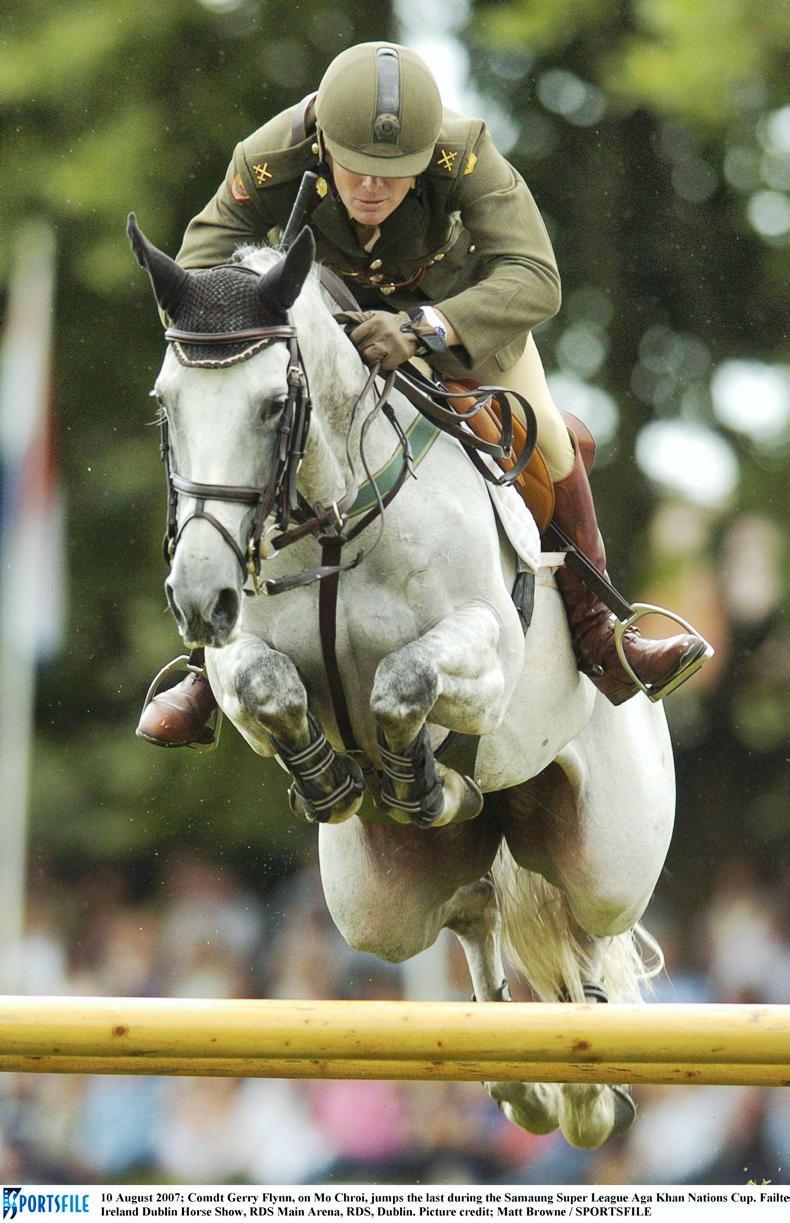
Commandant Gerry Flynn lines out for the 2007 Nations Cup with Mo Chroi \ Sportsfile
Returned
Billy Ringrose returned to Ostend in 1971 as chef d’equipe with the three-man winning side of Captains Ned Campion and Larry Kiely and a young Eddie Macken, and a full Army team of Kiely, Campion and a young Con Power won again at the Belgian fixture four years later. Power was the show-stealer through the late 1970s and joined Macken, Paul Darragh and James Kernan on the dream-team that won three Aga Khan Cups in a row between 1977 and 1979. He rode Rockbarton at the last of these, and with Gerry Mullins in the saddle the great horse won the Grand Prix at La Baule before finishing fourth at the World Championships in Dublin in 1982 after which he was listed number one horse in the world. The pair went on to win the Grand Prix in Dublin in 1986.
Mullins and John Ledingham shared the podium numerous times during the early 1990s, and Ledingham forged an exceptional partnership with Kilbaha. In a spectacular year in 1995 this Army duo followed the first of two successive Hickstead Derby triumphs with Nations Cup victories at Aachen, Dublin and Calgary.
Danielle Quinlivan became the first-ever female riding officer at the end of the 1990s, and David O’Brien and Shane Carey successfully flew the flag through the early 2000s.
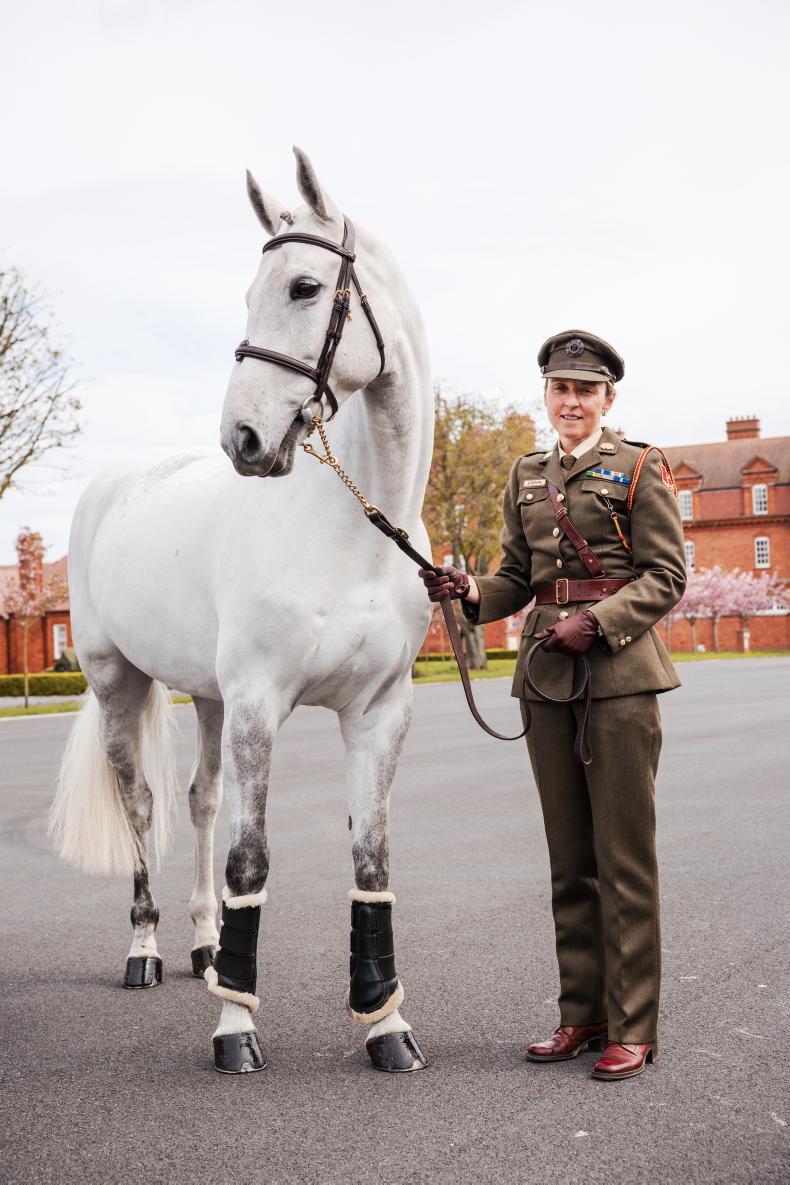
Lt Col Sharon Crean, current Officer Commanding of the Army Equitation School / Claire Nash
First-ever
In April of this year Lt Colonel Sharon Crean made history when becoming the first-ever female Commanding Officer at the Army Equitation School. Commandant Curran, who is chief instructor and riding officer, continues to compete at the top level and, also amongst the latest cohort, Lieutenant Michaeli Byrne has been on cracking form with jumping clears in two Nations Cups so far in 2026.
Other key figures throughout the history of the School have been the grooms. From the legendary Paddy Dunne back in the 1930s to Paddy Gately, Denis Horgan, Jimmy Doyle, Dee and Des O’Sullivan and so many more up to the present day, the care and management of the horses and their support for the riders has been essential to success.
A century after its foundation, the original mission of the Army Equitation School endures - to serve Ireland through sport, to uphold the highest standards of horsemanship, and to promote the Irish horse on the world stage.
Our ambassadors on horseback have fulfilled that mission with pride and conviction for 100 years. So here’s to the next 100.
This article is taken from The Irish Field’s Dublin Horse Show Magazine 2026. Order your copy HERE