THE 2026 Dressage Ireland judges’ gala, held at Kildalton College last Saturday, was a sold-out affair with 120 attendees present to benefit from the knowledge and experience of host Katrina Wuest. Wuest is a German FEI 5* judge and course director, who was President of the Ground Jury at the Tokyo Olympics and who has spoken at this event on two previous occasions.
The opening theory session was entitled ‘Principles in practice’ and Wuest began with a discussion of the ’50 shades of 6.5’, aiming to help judges find the correct mark within what she referred to as the 5.0-7.0 grey zone. She said: “6.5 should be a deliberate decision rather than a compromise when we can’t make up our minds.”
Referring to research, which has identified that 80% of the marks awarded in a dressage test fall between 6.0 and 7.0, Wuest noted that 6.5 is “rarely completely wrong and feels safe” from the perspective of a judge, but she cautioned that safety should not be the goal.
Instead, she encouraged an awareness of inevitable biases including the anchoring effect, suggesting that judges should always be ready to award high marks for a single well-executed movement, even when a combination has been receiving lower marks up to that point in their test.
Wuest then described the triple-pronged system she uses to arrive at a mark for a specific movement. First, she considers the quality of the horse and its training before looking at the precision of the execution of the movement. Then she takes into account where she is sitting around the arena. To elaborate on this, she used the example of marking an extended trot from M, when the horse is moving away from her. There is no opportunity to evaluate the lengthening of frame, but the quality of the transition back to collection and of the trot on the more visible short side can inform the mark she gives.
Importance of suppleness
In a video posted on Dressage Ireland’s social media channels prior to the gala, Wuest put forward a question for attendees: which element of the training scale is most important and influences all others? The next part of her presentation offered a comprehensive answer to this, as she discussed the importance of suppleness and its influence on rhythm, contact, impulsion, straightness and collection. She also emphasised that it has the most impact on the wellbeing of the horse and that suppleness helps the rider to establish harmony.
The last concept Wuest discussed before proceeding to analysing videos of specific movements was the idea of complexity. While an extended trot might be a relatively simple movement to mark, she offered a centre line as an example of a more complex movement. It can be broken down into five constituent parts; the canter, the transition to halt, the halt itself, the transition to trot and the quality of trot to the end of the centre line. As such, the judge must identify the most important part of the movement (the halt), but also wait until it is concluded in full before arriving at a mark.
The remainder of the morning session was devoted to video analysis of specific movements, including canter pirouettes, the aforementioned centre lines and tempi changes, with Wuest encouraging questions from the attendees.
Presentations
Before a break for lunch, Bernie Foley made a presentation to six judges who had successfully passed their upgrade exams recently, namely Rita Naughton, Barbara McMurray, Mark Robinson, Lisa O’Brien, Bernie Webb and Michael Moore. Moore is now one of just seven List I judges affiliated to Dressage Ireland.
Action in the afternoon moved to Kildalton’s indoor arena, where Gerald Bloomer was the first rider to come before the audience with his own five-year-old KWPN gelding Ready to Shine AVO (Las Vegas x Ronaldo). Rather than marking a test, Wuest provided a comprehensive and positive analysis of the horse’s conformation and gaits, praising the “indestructible rhythm” of the horse’s three paces.
She said: “You could not praise such a horse enough.” She proceeded to demonstrate what she would work on in terms of the horse’s training, focusing on stretching and varying the horse’s frame, as well as developing further collection.
Recurring themes
The next combination to enter the indoor was Sonya McCormack and her own mare Sosha Jakama (Taurus x Sarkozy), also a five-year-old. Attendees had a chance to arrive at their own comments and marks, as McCormack rode through DI Elementary 51 before Wuest identified some areas for improvement and offered ideas on how to achieve this improvement in training.
First, she encouraged the development of the horse’s ability to be more swinging and supple over her back, asking McCormack to ride her in a longer, lower frame and then to ride canter-trot-canter transitions from this position.
Wuest then offered her advice on improving Sosha Jakama’s walk pirouettes, an exercise which would become a recurring theme throughout the afternoon session. She began by emphasising the importance of controlling the line and positioning ahead of the movement, before asking the rider to start by turning the horse’s shoulders with an open inside hand. Only then should the outside leg come into play. As the rider left the arena, Wuest called out her marks for each movement through the test and invited comment and discussion from the attendees.
Rebecca McGrath rode the 14-year-old mare Summersong Caledonia (Sandro Hit x Blu Hors Don Schufro) through the FEI junior team test, and afterwards Wuest once again spent time improving the walk pirouettes. However, while she acknowledged that the combination produced two good flying changes on the short diagonals (for which she awarded 7.0s), she identified that others were behind the aid and that, in general, McGrath needed to ride them more from her seat and less from her inside leg to avoid blocking the new canter.
Wuest addressed the walk pirouettes once again after Lexi Frei performed the Prix St Georges with her 10-year-old Belgian-bred mare Quibelle Vanda De Vlidervallei. She reaffirmed the importance of turning the horse’s shoulders before framing the quarters in with the outside leg, but first she asked Frei to improve the quality of the collected walk, simply by shortening her reins and asking her horse for the “raised and arched” frame that is required in this movement. These adjustments produced obvious improvements, and Wuest used the same principles with the combination’s canter pirouettes.
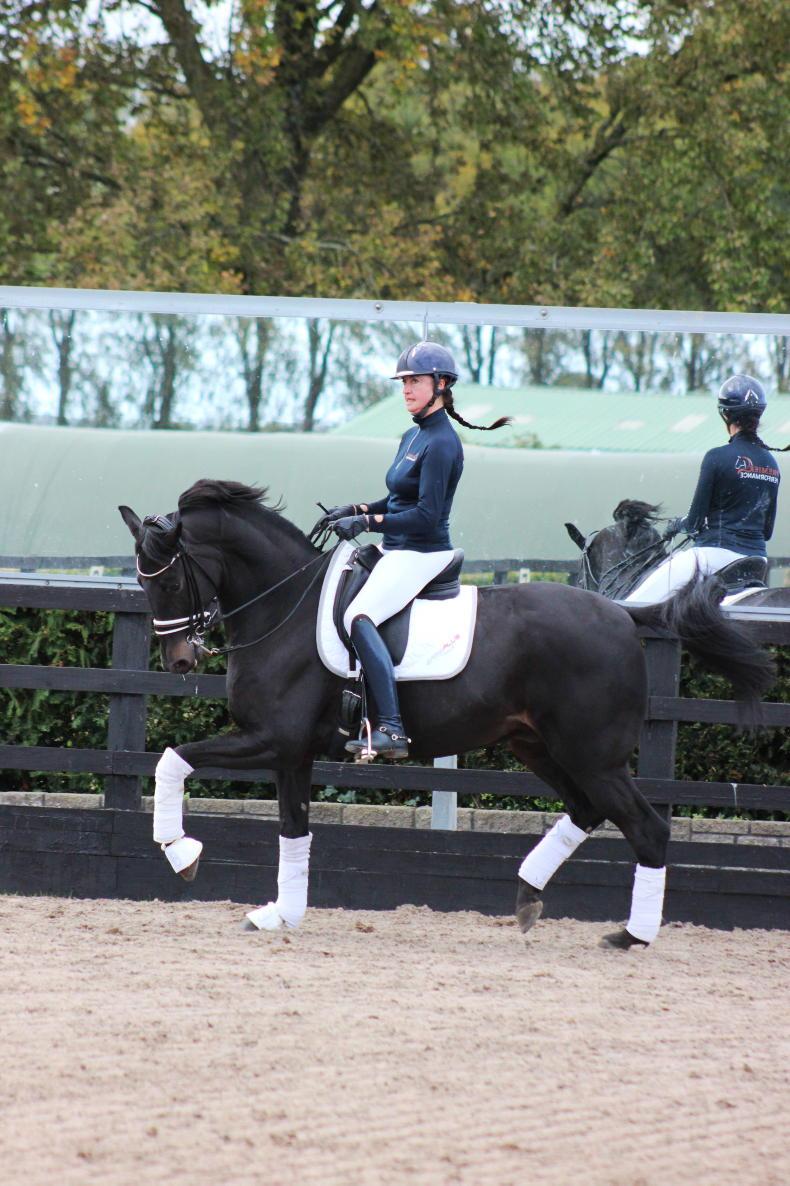
Sorrell Klatzko riding her homebred 10-year-old Gladiator at the Dressage Ireland judges' gala held at Kildalton College \ Tom Sweeney
Tempi changes
Just as McGrath did, Frei achieved some good marks for her flying changes, including a 7.0 for her four-tempis, but Wuest wanted to show how they could be improved in general after some mistakes in the threes. Initially, she asked Frei to ride them more forwards, before having her ride them on the long side without flexing her mare in each new direction to improvement their straightness. Wuest also encouraged precision in all aspects of training, asking Frei to repeat simple exercises like canter transitions if they were not executed to a sufficient standard.
Sophia Doheny performed the Inter I aboard the 17-year-old gelding Jackson Van De Lettencouter (Lord Leatherdale x Fiderhit) for a mark that Wuest suggested would work out at approximately 67%. Diverting momentarily from the recurring themes of pirouettes and flying changes, Wuest began her analysis of their test by highlighting the halt and rein back as one of their weaker movements after it was crooked, with too many steps in an unclear rhythm. Having produced a prompt improvement in that movement, she then addressed the contact.
Wuest asked the rider to keep an even contact between her curb and snaffle reins, saying that her marks would be slightly reduced for every movement in which she sees a curb rein hanging completely loose. She also asked Doheny to shorten her reins generally to improve the level of collection in the horse’s canter before returning to familiar territory by asking her to ride tempi changes more from her seat with smaller leg aids.
The final combination of the day at Kildalton was Sorrell Klatzko riding her home-bred 10-year-old Gladiator (Sir Sansibar x Hohenstein), who performed the Grand Prix. Afterwards, Wuest didn’t offer her marks for each individual movement, but instead provided a more general assessment.
The first thing she highlighted was the need for a clearer diagonal rhythm in the piaffe, which was then demonstrated to the audience when Wuest asked Klatzko to ride some piaffe steps from a very collected walk without letting the balance drop onto the forehand. She also addressed the quality of the tempi changes, asking Klatzko to ride three-time changes to give her more time to prepare each one, while encouraging her to sit deeper and do less with her leg.
The day at Kildalton concluded with the chairperson of the judges’ committee, Bernie Foley, thanking both the riders who took part and Katrina Wuest for her time and expertise.