WHEN Sally Corscadden took on the mantle of eventing’s High Performance Director back in 2017, her mission was to build a world class squad to be proud of, and to gain podium success for Ireland.
It was imperative to her at that early stage that the riders would share her goals and dedication, and indeed just one year later, she had achieved both feats, when Ireland gained team silver medal at the World Equestrian Games in Tryon, North Carolina, USA.
Fast forward four years and hopefully heading for Tokyo this summer, Corscadden, like team managers globally, is juggling the challenges of the pandemic and, for Ireland, the complications posed by Brexit are an added hindrance.
There is no doubt that Ireland’s national event squad is in a much stronger position than it was at the start of her tenure, and this is in no small part due to that success in Tryon. It was a dream start for Team Ireland, and one that even Corscadden, as an optimist, would have been hard pushed to envisage.
“I knew it was going to be tough to win medals, and I didn’t think we could do it in the second year,” she admitted this week. “However, the squad were posting real successes at four-star level (now five-star) prior to Tryon, and I felt – just as long as everything went right, we were in line for a top-five finish.
“For the first time, I was armed with a team with impressive individual success, and I also knew that some of the fancied teams were having problems with their selections. We never actually talked about having a great chance of winning a medal, we talked instead about our chances of being really, really competitive – and confidence was high.”
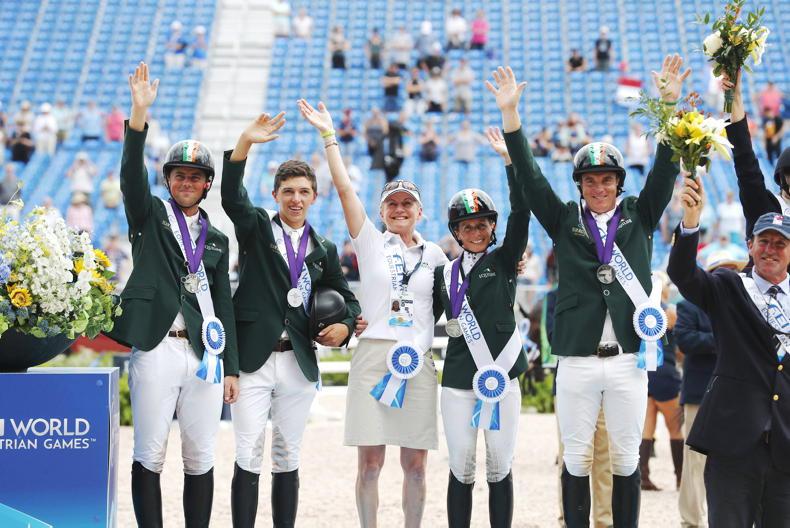
The silver-medal winning Irish team at the 2018 World Equestrian Games in Tryon. (L-r) Sam Watson, Cathal Daniels, chef d'equipe Sally Corscadden, Sarah Ennis and Padraig McCarthy \ Tomas Holcbecher
Boost of morale
Importantly, and looking to the future, the squad’s achievement in Tryon opened doors in terms of morale, prestige and potential sponsorship. “From my own point of view it was just something to be very proud of. It had been an ambition of mine, and to do it in year two was very satisfying.
“Also, the way we did it – on own merit – and with the people that we had in place behind us, just really made it happen. I knew from then that I had to keep the team behind the riders and to build on it for the future.”
For the riders themselves as silver medallists, the Tryon feat raised their own profiles and built-up respect. As a result, they were able to promote themselves and Irish sport, and it certainly made people sit up a take notice. Sponsorship has been another valuable spin off, and one that has really helped in the preparations for Tokyo.
“We are now considered real contenders for a medal, because no one can argue with a team silver medal at a World Games,” explained Corscadden. “We’ve done it once, and the job is to do it again. Our success has had a lot of bonuses, but also extra pressure as well. There are now a lot of expectations, we have to keep doing it and that is the hard part. Numbers wise, we are still a relatively small nation and are up against nations with more numbers and ones that are much better funded.”
Indeed, eventing strongholds such as Germany, Great Britain, America and New Zealand, to name just a few, would have far greater depth in term of funding and this presents another major challenge.
Never daunted, Corscadden and the riders decided to be proactive, and last year staged various events to raise funds. The resulting road shows, ‘Team Ireland on Tour’, not only secured extra money but pulled the squad together, garnered great goodwill and kept them in touch with the grass roots members of Eventing Ireland.
With help from Vina Buller and the Horse Sport Ireland team of Sophie D’Alton and Triona Connors, there is now a much-improved engagement with the owners. The staging of hospitality events, is one popular feature that will be ongoing, while equally important is making sure that owners are kept informed and connected.
Owners want to enjoy being part of team Ireland, and while the winning helps, there is so much more too it. It’s about having the camaraderie and supporting each other.
New team member
One of Corscadden’s strengths has been her ability to gather around her a very strong back up team. Towards the end of last year, it was announced that long-time dressage trainer Ian Woodhead would be stepping down. He had always planned to leave after the Olympics, but the postponement, and the added risks of Covid to his extended family expedited the decision.
“Ian did so much to raise the standard of our dressage, to show the riders what was needed to compete at the highest level and will be missed.”
As his replacement, and in a timely coup, Corscadden has secured the services of the former British team trainer Tracie Robinson. A stalwart of the British eventing operation since 2001, Leicestershire-based Robinson has since coached the national squad at four Olympic Games, as well as the various European and world championships in between.
“She knows what it takes to make it happen. We have already had a few introductory training sessions, and she has fitted in extremely well. She shares the management ethos, is a very positive person, is willing to give things a go and will compliment all the good work Ian has done.”
Robinson is equally enthusiastic, and speaking to The Irish Field, she commented: “I’m excited to have been asked to join Team Ireland as dressage coach and to be working with the group of very talented horses and riders. It’s a new challenge for me which is great, and I’m looking forward to enjoying it and to a positive future.”
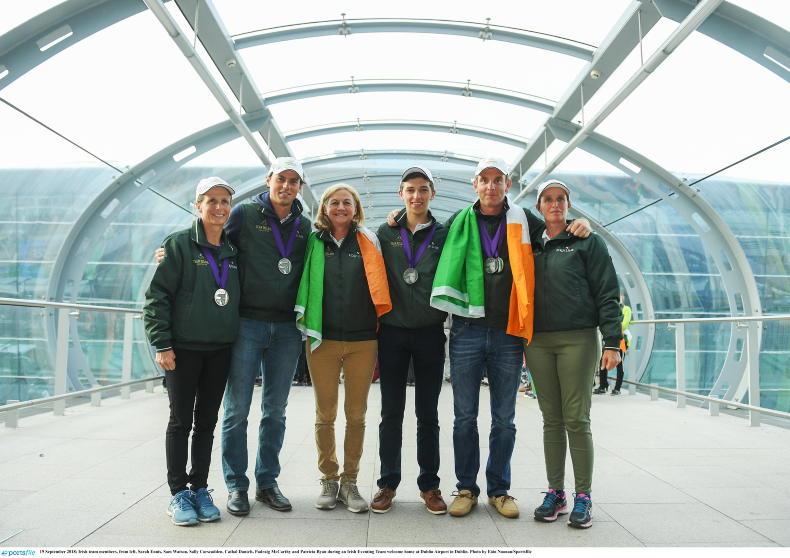
Completing the coaching staff, Grant Wilson continues his role as show jumping trainer, while the maestros Yogi Breisner and Andrew Nicholson will remain on board as cross-country advisors.
Working on the premise that the Olympics will go ahead (the IOC have said that they won’t be making any decisions regarding its status until the end of March, beginning of April), Corscadden has named 13 riders as her designated Tokyo squad, all which are specifically named with horses that are qualified and have been targeted for the Olympic Games.
In alphabetical order they are as follows: Susie Berry (Ringwood LB and John The Bull), Aoife Clarke (Celus D’Ermac Z), Cathal Daniels (Rioghan Rua and Sammy Davis Junior), Sarah Ennis (Horseware Woodcourt Garrison), Aidan Keogh (Pride of Tredstep), Padraig McCarthy (Fallujah and HHS Noble Call), Brian Morrison (Global Daenerys, Global Mentor and Global Orchid), Joseph Murphy (Cesar V), Austin O’Connor (Colorado Blue), Elizabeth Power (Soladoun), Camilla Speirs (Lukas), Fred Scala (Everon Vivendi) and Sam Watson who is named with both Imperial Sky and Tullabeg Flamenco.
Tokyo logistics
Having been to Tokyo on a reconnoitring mission, Corscadden is fully up to speed regarding the venue, as well as the not inconsiderable logistics of moving both humans and horses from one site to another.
With strict Covid-19 restrictions in place, it is likely to be a sanitised, controlled environment in that everyone will be very restricted in their movements. “There will be a lot of sitting around. There will be long days and a lot of travel. The everyday logistics of just getting to and from the Olympic village, to the equestrian park and to the cross-country at Sea Forest City will be challenging and it’s certainly not going be like any other competition.”
As regards selection she will have to juggle many factors, and any rider in contention needs to be mentally strong.
“We have to have people who can cope with all the curve balls that will be thrown at us. So, the temperament of the rider, as well as their proven experience will be taken into consideration.”
As regards the suitability of the horses, Corscadden reveals that the cross-country track will be of a maximum eight minutes, and will be very intense. “It’s going to be twisty, technical and undulating and will be rather like a very long, short format for the cross-country. I believe they are taking out some of the hills, but there will still be the up and downs and twists and turns that will make it tiring very quickly.
“It will suit a horse that is more of the CIC short format horse and one that is quick and nimble and not tire itself out too quickly. With the new format [of three riders] in place, the cross-country will be the key – 20 penalties or not finishing the cross-country is going to be very, very expensive.”
Summing all these factors up, it appears that Corscadden will be favouring a very sound, very good and consistent cross-country performer. “It will be a very high-risk competition, but it will be the same for everyone. If we want to compete for a medal, we have to be clear across country and we have to trot up sound on the final day. We will have a three-person team, plus a ‘P’ combination, who as travelling athletes and under Olympic rules, could be called upon to compete at any time.”
Fractured season
I asked Corscadden about the morale in the camp, in light of the Olympic postponement and following such a fractured season. “Some have found it harder than others,” she said.
“They have missed the competitions obviously and it has been a challenge to keep the focus. It’s been hard and frustrating for everyone, but luckily we’re a non-contact sport and for those based in this country it was great to have the three internationals at Ballindenisk and Kilguilkey to aim for and compete in.”
Just three weeks into 2021, and all the listed horses are back in work. Training has already started and the focus is to keep preparing. Dressage lessons have been held via video, and with the coach’s voices in their ears, the riders have a session every 10 to 14 days. There has been very positive feedback from the riders, who are just about to begin similar sessions with show jumping coach Grant Wilson.
Further back up support is provided by regular pilates zoom sessions, as well as monthly telephone calls from the athlete physiotherapist Clare-Maria Currie and sports psychologist Ciara Losty.
Competition plans for the season ahead are understandably fluid. Covid-19 aside, the logistical problems of post-Brexit travel is another headache, and one that Corscadden feels will add hugely to the cost of competing abroad.
“We have to plan as if we are going to make it happen. Some riders are hoping to go to Barroca in the early spring if at all possible and we have to hope that by the end of February things will have improved a lot. The numbers are starting to go down, and by then some of the travel logistics will be ironed out as well.”
Depending how the situation pans out, riders will discuss with Sally how they want to prepare for the season, working backwards from Luhmühlen in June. “I have to nominate 12 combinations for Tokyo, and those 12 will travel to Luhmühlen to compete in the four-star short. We will make our final selection of three riders (plus the travelling P reserve, and two further reserves) following Luhmühlen. One of those reserves will join the others in quarantine in Aachen before the four horses fly from Liege.”
Welcome news
One bright and welcome piece of news to emerge in recent weeks is that, in line with show jumping and dressage, the previously cancelled eventing European championships may now go ahead.
Responding to the requests from a swathe of high-profile riders spearheaded by Germany’s Michael Jung, the applications to host the fixture were positively reopened just before Christmas, and closed last week. It has since been revealed that three venues have come forward, all proposing dates either in late September or mid-October.
The trio, namely Avenches (Switzerland), Montelibretti (Italy) and Boekelo (Holland), are all established venues, but favourably promoted by Jung, Avenches (September 22nd-26th) has emerged as the likely candidate, having the finance and the infrastructure to host an event of this calibre. The final decision will be made in March, prompting Corscadden to comment: “We will have to wait and see, but I would be optimistic that it will happen.”
With six places up for grabs, the European championships will give Corscadden a valuable opportunity to trial some of the lesser experienced riders in preparation for the world championships in 2022. With a likely date of the end of September or mid-October, Corscadden said she is keen to field the best team that’s available at the time, and she would not rule out a horse that had competed in Tokyo, or indeed the travelling ‘P’ reserve.
“I will never rule anyone out, and there is no reason that if a horse comes back well from Tokyo he wouldn’t be selected.” That said, Corscadden now has a welcome depth of talent at her disposal.
Olympic horses aside, a glut of riders have plenty of good horses coming through and indeed the future looks bright.