IN racing circles, the Monbeg prefix is associated with the phenomenally successful Doyle family, most notably leading point-to-point trainers Sean, Donnacha and Cormac, who have made such an impact on the sport.
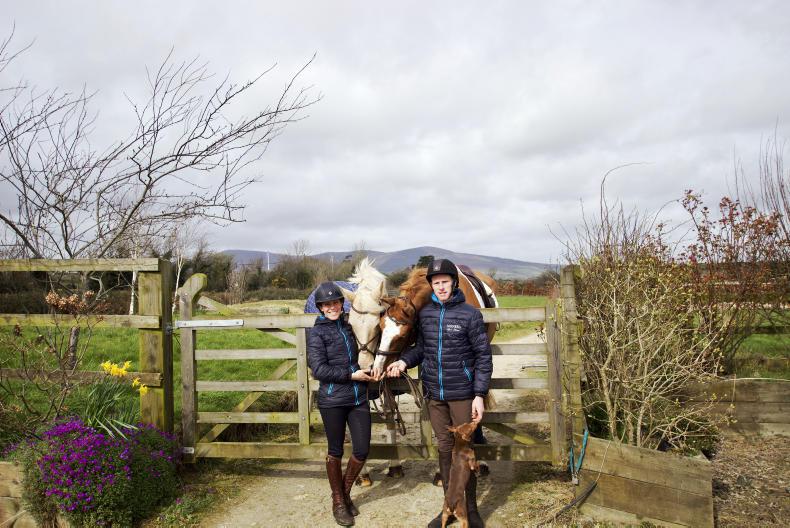
It’s not all about racing at the Doyle base in Ballindaggin however, as two other members of this enterprising family are notable players in the sport horse industry. Tomas Doyle, together with his wife Marti Rudd, are the driving forces behind Monbeg Sport Horses, a business specialising in the production and selling of high-end event horses.
At the time of writing, there are 55 Monbeg prefixed horses registered with British Eventing alone, as well as a further number in America and here on home turf. Among them is the double Le Lion d’Angers medallist Cooley Moonshine (formerly Monbeg Cartel), together with the highly rated four-star Monbeg Senna, the three-star horses Monbeg By Design (Susie Berry) and Monbeg Medlar (Harry Meade).
The promising Monbeg Hendricks (Kitty King) is another smart prospect as is Monbeg Shelby who was runner-up in the British four-year-old championship last year. The 2019 European pony individual gold medallist Midnight Dancer also passed through their hands early in his career, as did the long-format specialists Arctic Soul and Fernhill Fearless.
Other notables include Aoife Clark’s dual Le Lion d’Angers mount Wasting Light, the British seven-year-old champion The Soap Dodger and Suzanne Hagen’s OBOS Take One.
Started young
Both enjoyed childhoods steeped in horses. Tomas, who is the third eldest of nine children born to Mick and Marie Doyle, rode from the age of 10 and traded for almost as long as he can remember. Ponies were sourced unbroken from places like Baltinglass mart before Tomas and his brother Donnacha broke them, hunted, jumped them and sold them on.
“It was fashionable at that time to put SJI points on the ponies, so we competed them and later sold them in Goresbridge,” explained Tomas. “I wasn’t that brave to start with, but within a few years, we were flying and soon we were asked to jump other people’s ponies for them. These were just handed to us at the shows – we would hop on and for three, or four euros a round, we jumped away.”
The brothers were so successful, that in no time at all, the yard at Ballindaggin was full of liveries. As a result, young Tomas opted to leave school at 14, while elder brother Sean followed suit the same year. “We were just so busy,” he recalls.
“We were sent lorry loads of ponies and horses to break. Colin Bowe was big in half-breds at that time, and anything he couldn’t take we did.”
Life at Monbeg quietened down a little when Sean opted to follow the racing route, and later Tomas took a job with his cousin Brendan Doyle. More experience was gained with Austin and Thomas Quigley at Kellistown before he returned home to Monbeg.
British-born Marti grew up in the south of England and following a more conventional path, had her ponies largely as a hobby. A keen event rider, and British team-listed junior, she represented the pony club at varying levels, both in show jumping and eventing.
On leaving school at 16, Marti grasped the opportunity to join top event rider Lucy Jennings as a working pupil, and through her was given the ride on Jennings’s former Badminton partner On Spec.
This proved to be a valuable learning experience, but it was not long before her life took a completely different direction. Having always had an interest in sailing and never one to let an opportunity slip, the intrepid Marti applied to join crew of three to sail across the Atlantic. She probably overestimated her sailing skills when taking up the position, but undaunted, she completed the voyage without incident. This grit and determination probably stemmed from her late father Ken Rudd, who was a legendary racing driver of his time.
Retuning to England, the lure of horses became too great, and on the advice of the Jennings family, she answered an advertisement to become stable jockey to Shaun Parkyn, who ran a busy dealing and event yard in Shropshire. She remained there for over two years, during which time she helped produce numerous good horses including her own High Havoc who, in later years, competed at Burghley with Kitty King.
When the Parkyn family moved to Co Kilkenny in 2004, Marti remained in England to run her own dealing business before rejoining them in Ireland a year later.
Business model
It was through the buying and selling that Marti met Tomas, and indeed she bought several horses from him before relocating to Ireland. “The first two horses I bought off him at Goresbridge both bucked me off and we had to complain!” remembers Marti, “although they turned out okay in the end.”
The pair renewed their friendship again through the sales, before teaming up as a couple in 2007 and marrying six years later. They initially rented a yard together at Rosemount, just outside New Ross, but within their first year they were met with a setback when Tomas broke his leg.
The decision was then made to return home to Ballindaggin, where having built an American barn and an arena, they set up the business. At first the main source of income came from sale liveries but they soon decided that it was not a commercial enterprise.
“We realised that there wasn’t any money in it,” explained Marti. “At that time too, the recession hit and horses were making less than the livery bills. We had a job to get paid and were in the process of building the yard – it was difficult. In the end, we were owed tens of thousands for liveries and never got paid – it nearly broke us.”
Starting out afresh, the main focus was centred around the purchase and production of three-year-olds with the event market in mind. These higher-end horses would be produced and competed in their four-year-old year before being sold on.
The bread and butter horses meanwhile would be sold at the sales every six weeks or so, leaving the couple to stock up in between. “We used to buy fields of horses,” said Tomas. “We’d sort them out when we got them home. We had a far better strike rate then – we had some really good horses bought that way.”
The Monbeg prefix was first used years earlier with the Doyle family’s original jumping pony Monbeg Dot Com and again when Sean (Doyle) used it on some of the point-to-pointers. It became particularly well known through the Mike Tindall-owned racehorse Monbeg Dude, and it was at that time the couple first considered adopting a prefix themselves.
“We weren’t that keen to do it initially as I always enjoyed picking original names myself,” remembers Marti. “I do think that nowadays though if you’re serious about selling lots of horses you almost have to do it – it’s too competitive not to.”
Although producer/commercial prefixes have had mixed press recently especially from breeders, the couple have no doubts of their rights to use their own. “We buy a lot of our horses as foals, nurture them, and produce right through their early lives,” explains Tomas. “I am the customer. Sometimes it feels as though the breeders don’t want producers to buy from them.
"I think if someone buys a horse to produce then they should be allowed to call it whatever name they like. The breeder’s name always remains on the passport in perpetuity.”
The buying of foals started about four years ago as, in common with fellow producers, the couple were finding it increasingly hard to source the stock they wanted. “We couldn’t find enough three-year-olds – you can’t buy them all at the sales, while in the country, they were getting too expensive,” added Marti.
“I actually think it’s easier to judge them as a foal than it is to judge a three-year-old at the sales. The way things have gone I don’t think you really know what you are buying (in terms of prepping three-year-olds) and it takes a long time for them to get over it. Okay, the good ones stand out, but if they are trained to the grid then they all nearly look the same.
"Most of the good horses we’ve had out of the sales have jumped badly on the day, and vice versa. We often buy three-year-olds and don’t even see them jump. We go on the pedigrees a bit and if we can see canter somewhere then that obviously helps.”
Continuous search
The search for stock is unrelenting as Marti explains. “Every weekend we’re at shows, asking about horses. I also ring people every week. I have a list of people who I pester and pester, and as soon as something comes in, they ring me. We never stop looking. I don’t want them to forget we are always on the look-out and I try to be first in line.”
It is interesting to learn that conformation and blood percentage influence their buying habits less than they used to. “Within reason, I will forgive a horse defects in its conformation if its an athlete and light off the floor,” said Marti, while Tomas points out, “I would have loved a straight mover, but I wouldn’t be so fussy about that now.”
Referring to blood, Tomas adds: “Everyone wants blood don’t they, but there are less around by thoroughbreds these days. Many eventers might not be blood on paper, but they are blood in their brain and blood off the floor – that is the new modern. However, the more blood they have the easier they are to sell and the longer they stay sound.”
As regards X-rays, Marti comments: “We would sooner not do so, but the horses are expensive – so yes, we do X-ray most of them. If we’re the first to see them, then most pass okay. We also find that our foals X-ray well. Our oldest crop are four-year-olds and only one has not been good.”
The couple also point out that soundness and good X-rays follow in the damlines. Among their mare herd is the prolific broodmare Nancy Broone, who has produced a plethora of good event horses. Now 17, Nancy has bred five international horses, including OBOS Take One, who under Suzanne Hagan, has represented Ireland at Le Lion d’Angers for the past two years.
“Everything she has bred has had perfect X-rays,” added Marti. The same applies to their other broodmares including Ballycapple Mist (1.45m), that Tomas jumped throughout her career. She’s due to foal to HHS Cornet this year, and has two four-year olds (Diamant de Semilly and Kannan) ready to produce this season. Nancy Broone meanwhile is in foal to Luidam and has a three-year-old by Emperor Augustus. The latter-named thoroughbred stallion is a personal favourite for the duo, and has been lucky for them. Other rated sires would include Luidam, Harlequin du Carel and Pacino – the latter they termed is a “massive loss” to the breeding industry. They have five broodmares at the moment whose progeny, together with other bought in stock (they sourced 14 last year) are stored in a big shed, while anything older than three lives out.
Jumping for joy
Despite the demands of dealing and breeding, both Marti and Tomas show jump at a Grand Prix level, as well as producing their youngsters through the grades. Marti and her eye-catching palomino Monbeg Sunny Spells jumped at the RDS two years in succession and were placed third in the Breeders’ Classic finals as a five-year-old.
“We bought him from his breeder Nick Cousins as a four-year-old,” said Marti. “He’s such a little dinger – I just love him. Someone tries to buy him at every show he goes to but I’ll never sell him – to me, he’s priceless.”
Tomas meanwhile has a rare gift of feel and an abundance of talent. A total natural in the saddle, his empathy with the horse and presentation to a fence is flawless. In 2018 he produced the smart Monbeg Thunderball, jumping him up through the levels to 1.40m before he was sold to Trevor Breen last year.
Thunderball was owned partially by Co Wicklow coach and producer Peter O’Toole, who Tomas cites as having a big influence on his riding in the ring. “When he explains something to you it’s like a penny drops,” he said.
While at least 90% of their horses will head off to an eventing career, most will be produced through the jumping arena, and to round their education occasionally at riding club events. Marti aims to have two for the age group series and is not alone in preferring the show jumping route to the event young horse classes.
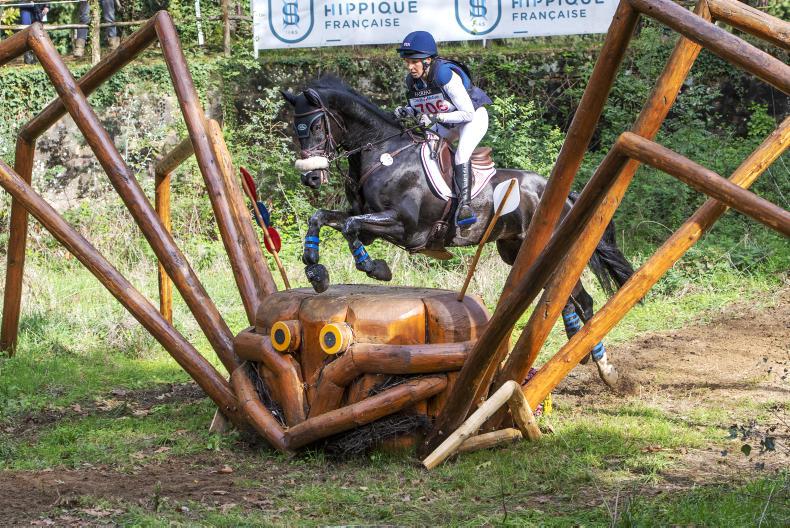
Cooley Moonshine (formerly Monbeg Cartel) and Elizabeth Halliday Sharp at Le Lion 2019 \ Equus Pix Photography
Good reputation
Tomas breaks all the horses himself, driving them in long reins for weeks. He patiently takes them through rivers and over ditches, while Marti educates them further when they’re at the hacking out stage. Otherwise, the pair split working the horses between them, but will always have their own pre-selected bunch.
Over the years, the couple have developed a strong customer base, enhanced by regular activity on social media. “It’s a good advert,” Marti explains. “I love taking photos and videos, so it’s not a big deal for me to do that. We don’t rely on it however, most of the people who get in touch through social media are friends or friends of friends.
"We don’t sell our horses off Facebook. Again, if you don’t do it you get left behind and people forget you’re there.
"However, it’s definitely not any replacement for a good reputation and word of mouth, and there is also no shortcut to picking up the phone and having a chat with someone.”
Being part of the Doyle family in Ballindaggin means that there is always support on hand. “We are so lucky,” concluded Marti.
“Although we don’t have staff, there is always someone to help when we’re away. All the brothers’ yards are within walking distance of each other and we’d be lost without them, Marie (Tomas’s mother) feeds everyone every day, while Mick (father) helps with the foaling in the summer.” Another keen supporter is Marti’s mother Linda who comes over whenever she can.
Bright future
Looking forward, it is interesting to learn that the pair are not tempted to follow Tomas’s brothers in the thoroughbred world.
“We always have a thoroughbred foal and every now and again a share in a horse, but it’s not for us,” added Marti “The two of us love riding. We genuinely love jumping and that’s what we want to do at the weekends. We don’t see it as work. We love our racing, and will go to point-to-points on a day off, but as long as we continue to love jumping and producing these sport horses, going up the gallops is probably not going to do it for us.”
Any other downtime is spent travelling. Aside from sailing the Atlantic, Marti has always been a globe-trotter, and since teaming up together, the couple have travelled to Madagascar, Brazil, South Africa, Tanzania and Spain. Safaris are a big favourite for the duo and a horseback adventure could be next on the list.
The lure of horses and Monbeg will always ground them however, and with their combined enthusiasm and skill in what they do, the future looks bright.