WHEN Horse Sport Ireland (HSI) embarked on the Microsatellite (MS) to Single Nucleotide Polymorphism (SNP) DNA transition journey in 2022, the ambition was clear: to transform how equine genetics are understood and managed in the Irish sport horse population using the existing, straightforward hair sample submitted during the registration process. Although MS testing served breeders well for many years, its limitations became increasingly clear, particularly during the delays breeders experienced during the Covid-19 pandemic.
Traditional MS parentage testing relies on approximately 17 markers, whereas SNP technology assesses almost 80,000 genetic markers. This additional data supports much greater accuracy in parentage verification but also offers sophisticated research and development into the equine genome. The transition project, funded by the Department of Agriculture, Food and the Marine (DAFM) through National Breeding Services (NBS), promised faster and more accurate insights that would benefit breeders, studbooks, and the national herd. It has certainly felt like both a long and short three and a half years!
In the early phase of the work, HSI collaborated closely with other passport issuing organisations to benchmark the breeding population, gather samples at inspections, and build the foundations of a national SNP reference library. By the end of 2022, more than 10,000 horses had been genotyped, providing the initial base for the transition to SNP-based parentage verification.
A change in funding criteria in 2023 created fresh challenges. In addition to genotyping parents, it became necessary to ensure that foals were added to the SNP platform so that parentage could be fully validated on using this new method. This would also ensure that in future, when the class of 2023 foals began breeding, they would already have SNP profiles. The organisation responded with breeder information sessions, nationwide roadshows, and explanatory features discussing how the technology worked and why the transition mattered, and the transition process graphic became a much more familiar sight.
Scientific publication
In parallel, HSI’s geneticist, Dr Jennifer Doyle, led the research project aiming to validate a method for equine SNP-SNP imputation, a tool that was at the time unvalidated for equines, but commonly used in bovine and ovine sectors. This research led to the scientific publication ‘Imputation of single nucleotide polymorphism genotypes in ungenotyped sport horses from the genotypes of their progeny’. The HSI-Teagasc team investigated whether a stallion’s genotype could be accurately reconstructed, or “imputed”, using the DNA of his offspring and their dams.
The study clearly demonstrated that this is possible and, importantly, having the DNA of the dam also improves the prediction accuracy. This study marked the first scientific validation of SNP to SNP imputation in equines and became HSI’s first peer-reviewed publication as lead author, confirming the organisation’s commitment to supporting science-based breeding.
The practical benefits are already being felt. Imputation allows HSI to reconstruct the SNP genotype of stallions that have passed away unexpectedly, cannot be sampled, or whose stored or submitted hair samples fail DNA extraction. This means that breeders no longer need to rely on older microsatellite testing for these cases, and foals by such stallions can still be validated entirely on the SNP platform.
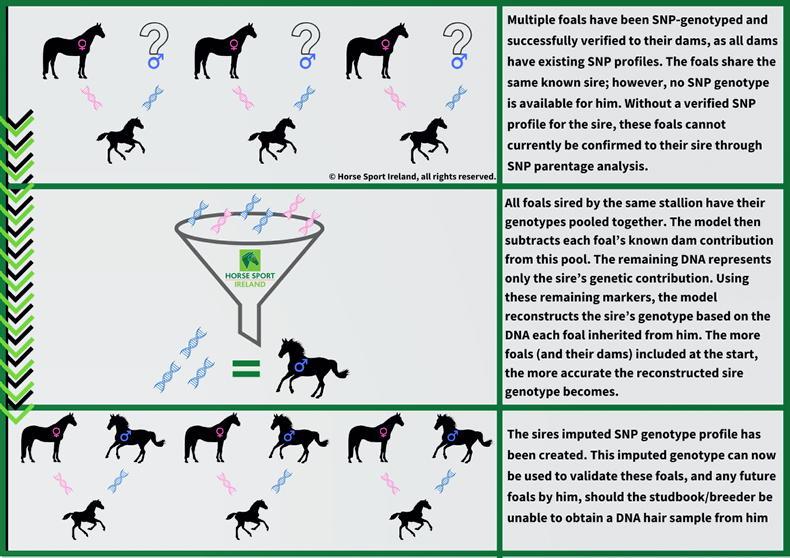
The stallion imputation process \ Dr Sonja Egan
Using DNS for detection
The impact of SNP technology expands well beyond parentage. In 2024, HSI collaborated with researchers across Ireland, Poland, and the United States, led by Dr Clíona Ryan of Teagasc, to explore whether SNP data could identify rare genetic abnormalities in the horse population. During this work, two young horses were diagnosed with trisomy of chromosome 27, a condition where an animal carries three copies of the 27th chromosome instead of the usual two. These abnormalities are known in many species to cause developmental issues, reduced vitality, and infertility. In humans, trisomy of the 21st chromosome is associated with Down Syndrome.
Detecting trisomy at this early stage gives breeders vital information that can prevent years of investment in an animal that may later prove infertile or unsuitable for breeding. The research titled ‘Two Cases of Chromosome 27 Trisomy in Horses Detected Using Illumina BeadChip Genotyping’ outlined that the prevalence detected was extremely low; 0.01% across over 13,000 horses and 0.03% in the juvenile population tested that year. Yet the study has enabled the introduction of annual genomic surveillance for Chromosome 27 trisomy across HSI operated studbooks.
In 2024 HSI partnered with Helical, the genetics operating system, which allows HSI to host all SNP genomic profiles in a cloud-based server and carry out in-house parentage verification, health trait testing and research. This tool allows us to support breeders with parentage designation, discovery and the rapid resolution of sire and dam exclusions during the foal registration process.
This technology has added a new layer of quality assurance and integrity to studbook parentage verification, improved passporting turnaround times and resolved accidental sample mix ups during the horse-side completion of foal DNA kits. HSI are currently validating the health traits for Fragile Foal Syndrome (FFS) testing and will carry out a review and consultation with breeders on the publication of these traits in foal passports from 2027.
Introduction of the Genomic Screening Scheme
Another major development in 2024, delivered under DAFM funded National Breeding Services, was the launch of Horse Sport Ireland’s Genomic Screening Scheme. This initiative has been used primarily to support the Connemara Pony studbook by enabling the screening of ponies for Hoof Wall Separation Disease (HWSD) without the need for owners to provide any additional hair samples. HWSD is a serious genetic condition that can cause chronic discomfort, lameness, and in severe cases can be life-limiting for affected ponies.
The genetic markers for HWSD are already contained within the SNP testing chip, meaning that the genetic markers generated from a single hair sample can provide both parentage verification and health information. This simplifies the process for breeders and reduces overall costs of this genetic test.
Since the scheme began, almost 4,000 Connemara ponies have been screened. The results have been consistent across both years: 0.4 % of ponies tested are affected by HWSD (HWSD/HWSD), 19.3% are carriers (N/HWSD), and 80.4% are non-carriers (N/N). These figures allow breeders to plan matings responsibly while preserving the long-term genetic health of the breed with regards to HWSD. The scheme also demonstrates how genomic tools can be used to support breed conservation, enhance breeding decisions, and reduce the burden of inherited conditions.
Genomic identification of the Irish Draught
In March 2026, HSI announced another landmark initiative: the introduction of a genomic grade-up pathway for Irish Draught mares and stallions. This is the first initiative of its kind within an Irish sport horse studbook and represents a significant step forward in safeguarding and restoring Ireland’s native heritage breeds.
The genomic grade-up rule in the Irish Draught breeding programme allows horses, whether or not they have pedigree documentation, to be assessed for Irish Draught genetic signature based solely on their genetic profile. Using tools such as genetic clustering and admixture analysis, HSI can now determine whether an animal carries the core genomic signature of a pure-bred Irish Draught.
This provides a scientifically robust pathway for identifying rare or long-absent bloodlines and strengthens efforts to expand and protect the breed’s genetic base. Work is already underway to explore the use of similar genomic methods for the Traditional Irish Horse (TIH) designation in the Irish Sport Horse Studbook.
Looking ahead: 2026 and beyond
The year ahead promises to be equally significant. HSI continues to investigate sex-chromosome abnormalities associated with infertility and is working to establish clear pedigree-based and genomic inbreeding indices to guide responsible breeding decisions. Thanks to the support of Claire Babington, the organisation also expects to conclude the validation of several genes relating to coat colour soon.
Although this article follows several years of updates on the transition to SNP technology, it feels less like a conclusion and more like a deep breath at the end of a challenging but transformative journey.
With much of the Irish sport horse population now on the SNP platform, Ireland is operating at a standard that many countries are only beginning to consider. An adapted line from Tolstoy often comes to mind: everyone wants change, but few want to change. Yet the Irish breeders have embraced this new era with great excitement for the potential insights the future holds.
The commitment shown by passport-issuing organisations, the team at Horse Sport Ireland, and breeders across the country has been remarkable - and it is thanks to this collective effort that Irish equine breeding now stands on the strongest genomic foundations in its history.