A FULL house in attendance at the Irish Draught Horse Breeders’ Association (IDHBA) seminar last Sunday heard a range of Irish Draught inspection topics.
Guest speakers at the Athlone meeting included Jim Tempany, two members of the current Horse Sport Ireland (HSI) inspection panel: Charlotte Moore and Chris Ryan, plus IDHBA chairman Brian Murphy.
One of the meeting’s main intentions was to gather feedback from Draught breeders and owners about the inspection process for an upcoming meeting with HSI.
“We have a meeting coming up in a month’s time with HSI and it’s [seminar] just totally dedicated to inspections and we want to hear, as an organisation going forward, what the breeders and the grassroots people out there are looking for, what their thoughts are and to strengthen our case, going back to HSI on December 1st,” said Murphy.
Kicking off the presentation was Sligo vet Jim Tempany, who outlined the two-stage veterinary inspection process for Draught mares. The primary goal of vetting them is to ensure the soundness and suitability of animals for classification within the HSI and Draught frameworks.
“A picture paints a thousand words,” and, in this visual era, Tempany had also prepared a handy video of a mare being vetted as he ran through the procedure. Inspection day vetting starts with identity confirmation, through microchip and passport verification, measuring height (highest point of the withers) and bone circumference (halfway between the knee and fetlock) and working through heart, limbs, joints and movement assessments.
Hocks were noted as a common area for issues, while vetting for wind (respiratory soundness) is not part of the two-stage vetting process required for mares. However, if inspectors detect a suspicious noise during the arena phase (e.g., during cantering or jumping), a vet may be called to adjudicate. If deemed due to laryngeal paralysis, the mare does not pass.
Owners can appeal a failed veterinary examination and appeals are referred to UCD’s veterinary college. Some appeals are determined by x-rays, particularly for internal issues like joint chips or arthritis (e.g., ringbone), where there is “zero tolerance” for such issues.
“While we’re working on behalf of the Draught breed, every owner likes to know what they’ve got,” he added.
The importance of having a mare well handled beforehand for vetting and inspection day was emphasised.
Gold dust
Chris Ryan, a member of HSI’s sport horse stallion inspection panel, was next.
“The Irish Draught is the traditional breed I’d have a huge soft spot for. My dad [Thady] was a promoter for the Irish Draught and we are so lucky to have them. It’s nights like this that are trying to progress Draught breeding. I’m passionate about what I do, like you are with your horses. We have a hell of an industry here and it’s based on high quality stock,” was his typically upbeat opening shot.
A keen supporter of the inspection process, he recalled the bombshell delivered at the 2015 Horse Board AGM in Cavan that the following spring’s stallion inspections would be shelved. One of the primary reasons he was and is keen to retain the inspection process is vetting.
“If a horse isn’t sound, especially breeding stock, I suggest we’re in trouble.”
Chris cited John Osborne’s philosophy of “If you can’t measure, you can’t improve”, and felt that linear profiling provided an objective method to assess and measure horse conformation, compared to subjective visual assessments.
“Good conformation equates to soundness, equates to good longevity, a trait long associated with the Irish-bred. It takes a lot of time and money to produce a horse from a young store up to a top performance animal and, when he gets up to the top, you want him there a long time.”
Long shins and pasterns and more tubular types have become a noticeable feature in recent years amongst sport horse and Draught phenotypes, so it was interesting to hear Ryan’s thoughts on conformation.
Shorter cannons and tendons are generally preferred for reducing stress and injury risk in performance horses. He also noted that Irish breeders traditionally place a higher emphasis on good feet, compared to some continental studbooks, which he viewed as a significant advantage for the Irish Sport Horse’s longevity and soundness.
Adequate girth/barrel depth is essential for heart and lung function, which he felt is lacking in some modern European lines.
Amongst his insights was KWPN data unequivocally showing a strong correlation between a good quality canter and jump, underlining the importance of assessing canter in inspections.
Another KWPN finding he considered “gold dust” was a study that tracked 500 KWPN foals. One common linear profiling measurement amongst horses that went on to jump at 1.50m-1.60m level was a raised wither.
Ryan commended the Selle Français studbook for incorporating more thoroughbred blood, believing it contributes to a “forward-thinking” mentality in performance horses, enabling them to “outrun the lion” (his metaphor for confidence and drive).
Chris regarded the RDS performance class for Irish Draughts and Connemaras as a monumental step forward, seeing them as the “Epsom Derby” for these breeds and ensuring the preservation and progression of desirable traits like the Irish Draught’s exceptional temperament.
Seamless exchange
Charlotte Moore, one of the most experienced inspectors on the circuit, provided an in-depth look at the inspection and linear profiling system for Irish Draughts.
She explained its purpose, evolution, the inspection process, and how to interpret the resulting linear profiles.
According to her, amongst the main purposes of Draught inspections was to ensure horses aligned with the established breed standard; screening for heritable defects; to offer transparent feedback to owners, through detailed inspection sheets and linear profiles and to safeguard the breed, now classified as endangered, through informed breeding programmes.
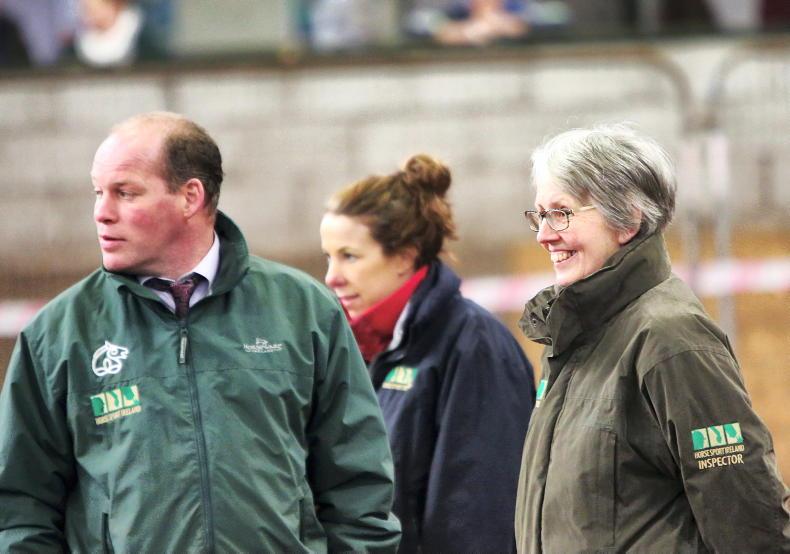
The highly-experienced Charlotte Moore on duty with fellow inspector Andrew Gardiner \ Susan Finnerty
The Draught’s renowned temperament and cross-breeding contribution, particularly to the Traditional Irish Horse, were also highlighted, while her pragmatic stance on the native breed’s performance qualities was that Draughts must be athletic enough for today’s market, suitable for pleasure, leisure, or performance markets up to a certain level (“We’re clearly not expecting them to go and jump at the Olympics”), while still conforming to breed standards. Prior to the introduction of the new classification, linear profiling and performance elements of the central inspections at their new base at Cavan since 2010, past inspection systems were based on a veterinary exam and scoring system (e.g., mark out of 10 for each aspect).
Rightly, wrongly or a hard luck story on the day, some failed animals were lost to the breed.
The shift to the current classification system introduced Class 1, Class 2 and Class 3 (vet failures) categories. Class 2 allows animals that previously would have failed to still contribute to the gene pool in a recognised way.
It has to be said that well-intentioned grants led to increased numbers, but potentially diluted quality, an issue she addressed.
On the harmonisation of international studbooks, that also adopted the same linear profiling and classification system, the fact that Irish Draught societies in Britain, Canada and North America are now on the same page allowed seamless exchange of genetics.
Charlotte echoed Jim Tempany’s advice about having a mare well prepared for inspection day; that the mare be well handled, can both lead and be shown loose and be accustomed to travelling. Mares can be presented for jumping, however it’s an assessment for additional Irish Draught merits and wasn’t to be regarded as a schooling session opportunity.
She went down through an inspector’s sheet, originally derived from sport horse profiling but adapted for Draught-specific traits, such as barrel (depth of girth), cannon bone length and breed type and noted that a rectangular body shape (“standing over plenty of ground”) was typical for Irish Draughts.
Minimum scores are required for Class 1 classification (e.g., 70 for conformation, 65 for type, 70 for movement, 65 for athleticism for stallions).
Cream of the crop
IDHBA chairman Brian Murphy’s presentation focused on his extensive experience with Irish Draught horses, particularly in the showring, alongside a broader discussion on the breed’s future, inspection processes and data management.
His successes as a rider and producer include the Dublin supreme hunter championship in 2016 on the pure-bred Fort Knocks [the 2008 champion Darragh Classic Prince is the other pure-bred Draught in recent decades to have won the supreme] and The Peaky Blinder, “a maxi cob who was a natural showman” and Gortfree Lakeside Lad, a dual winner of both the Dublin performance finals and working hunter championship.
The last named, according to Brian, was also the first Irish Draught stallion to qualify for the HOYS (Horse of the Year Show) working hunters, appearing there twice and was the supreme ridden champion at the national show for five consecutive years.
On his judging and production philosphy, he emhasised the paramount importance of a horse’s walk, saying “if a horse can’t walk, you’re going nowhere”, as this cannot be improved, unlike trot or canter.
Temperament and showmanship are crucial for showring success in his book and he also raised the difference between flat bone and round bone, noting that horses can appear light but still measure well.
Brian is not a fan of the Dublin rule preventing performance horse champions from returning, as he felt “the cream of the crop” should be on the biggest stage.
As well as his IDHBA chairman and producer hats, he also judges. One judging tip he had was to walk to the edge of the ring to closely observe horses at walk to ensure a consistent picture and spot subtle details.
When the discussion was opened to the floor, topics included the low attendance at the stallion inspections compared to Sunday’s meeting and whether inspections could be held at weekends to increase interaction. Holding Irish Draught performance classes in the RDS main arena and to reintroduce flat ridden Draught classes were other suggestions, although both naturally require dovetailing with Cavan and Dublin schedules.
In reponse to a query on why mare vetting is not as stringent, the response was the high cost of veterinary checks for stallions, combined with a stallion’s ability to produce many more lifetime progeny, led to a practical balance. Mare owners have a degree of responsibility, and some schemes offer assistance for procedures, like x-rays.
There were also concerns about limited and out of date data on Capall Oir/Horse Source and for the introduction of links to performance records, inbreeding and kinship within the herd data (including harmonised overseas Draught studbooks) and for showring performance at Dublin and national level to be available, similar to eventing and show jumping results.
A call for new and younger individuals to get involved and become inspectors was also made and applications are now open for an upcoming judge’s assessment (November 22nd).
Colin Doyle was the perfect choice as MC for an amicable, well-run evening, which ended with a raffle, including stallion nominations.
What they said:
“A curb is a definite no.” Jim Tempany
“There’s an old saying that ‘Every day is a school day’, but we would like to think that the mare has had the knowledge at school before she arrives into the centre!” Jim Tempany
“If you can’t measure, you can’t improve. With beef cattle we measure weight gain. With dairy cows we measure milk yield. How do you measure conformation? Is it this ethereal thinking that everybody’s eye is different? You can measure conformation through linear profiling.
When the cannon [bone] is overlong, that tendon is overlong. One of the biggest problems is the front tendon in a sport or performance horse. Its put under a lot of stress and if that tendon is extra long, you want to be careful. If my mare is a fraction long in the cannon measurement, I can look at my linear profile score and put her to a stallion that is a little bit shorter to help offset any shortcomings. And that’s the value of this.” - Chris Ryan
“A little hint for you; what are you looking for when a horse is walking away from you? You’re looking for the full use of the hind end and the hindleg getting right underneath them, etc but you can’t actually quite see the kind of ground cover they have.
Watch the horses tail, it’ll tell you what that horse is doing. I guarantee that every time you see a horse with his tail swinging from side to side, when he comes broadside to you, he’ll be over-tracking by eight, 10 inches which is what I’m looking for.” - Chris Ryan
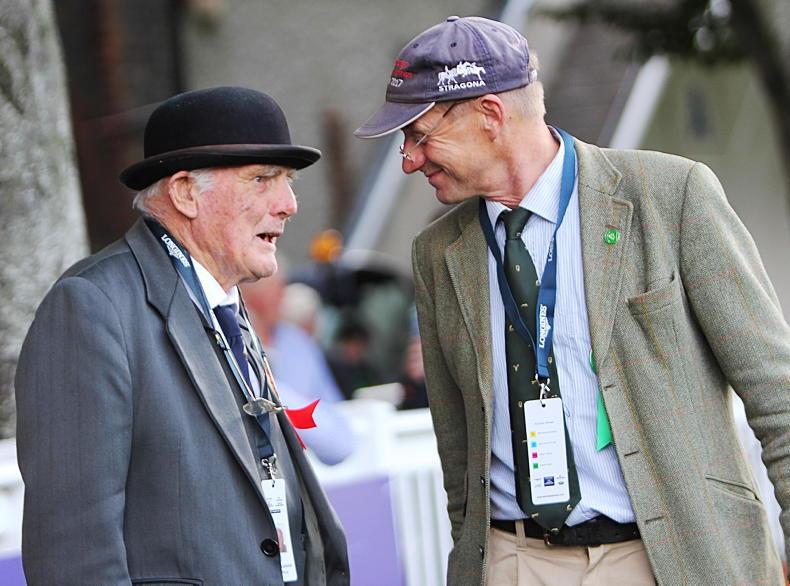
Hugh Leonard and Chris Ryan at Dublin Horse Show, where Chris keeps a close eye on the native breed performance classes \ Susan Finnerty
“Linear profiling has been used now for 15 years, so there is a body of information gathering up and collecting and it would be great if we could start to see some more analysis of that information being made available to us by those who hold the studbook. And of course, it has potentially an important role to play in breed preservation and breed improvement programmes.
I can assure you there have always been a wide range of Irish Draught types. If you look at the literature that was put together by the likes of Colin Lewis, you’ll see that there were very different geographical differences in the types of Irish Draught mares in different parts of the country, very often associated with the land type in that area.” - Charlotte Moore
“There was a time when if an animal was seen advertised as an RID, it was worth getting in the car and driving the length of the country to go and see that animal. But then there was a period of time when the numbers in the country had been very low and grants were introduced to encourage the breeding and the production of Draughts.
During that period, yes, there was a considerable increase in the number of Draughts but I think, right or wrong, at that time, virtually every animal that was presented as an Irish Draught became classified as an RID-registered mare. I do feel that we’ve paid the price for that over the next 20 years and with the breeding generation of Draughts, it takes quite a while to work your way back out of that situation. But, hopefully, classification and linear profiling is something that we can use to help us through that process.” - Charlotte Moore
“When Fort Knocks won his heavyweight championship, we never thought he’d go all the way. What happens to a lot of horses in the Dublin main arena is they’ll sink or swim. It’s a lovely feeling when they start swimming but when they start sinking, you just want to cover your eyes and get out of there! But that morning, there was a lot of carnage and I think what won it was his temperament. He stood like a rock all morning and we counted up afterwards, he’d galloped 19 times around the main arena, so he had stamina as well. His gallop and temperament did it for him.” - Brian Murphy
“I was privileged with some of the horses I’ve had and it was just a coincidence and by chance that a lot of them tended to be Irish Draughts. And that’s how we came across them. You can have the nicest, most correct horse in the world but if he doesn’t want to show himself, you’re on a losing battle. If you haven’t got that ‘Look at me’ factor from the minute you walk into the ring, you’re on a hiding.” - Brian Murphy