I grew up in Grangemockler where my father was a local policeman. We had no real horsey background but my sister always wanted a pony so when I was about 10, we got our first pony from Tim Beecher, a cousin of my father.
An ex-racing pony, so not really a child’s pony but got us hooked. That was the start of buying and selling loads of young ponies, which we rode on the front lawn of the Grangemockler Garda station or up and down the roads.
I had a university place to study Psychology and instead went to Sweden for a year to work for showjumper Rolf-Göran Bengtsson and also met a good friend, Paul O’Shea there.
The following winter, I went to Max Hauri’s yard, which was a very good experience, followed by a year riding a a nice bunch of horses for the Burchers at Belline House Stud, a short stint in America and from 2001, Switzerland for around four years, working for Jürg Notz and Niall Talbot.
At that point, I decided I was kind of missing out. I went back and got my Business and Finance degree, including a year in Germany, and 18 months in a Berne university. I finished my education out in Waterford where I got my PhD.
I was always buying and selling horses and horseboxes, just to fund my education. I had a couple of nice horses, one of which I advertised on the internet. My now wife Lucy [Wiegersma] came to look at one and that was the beginning of the relationship. I moved to England and started helping her with buying and selling horses, which progressed into her stepping back a little when the children came along.
1. Why did you start breeding horses?
Eddie Macken was my role model growing up and Boomerang, bred in Grangemockler by Jimmy Murphy, was undoubtedly the horse of Eddie’s career. He inspired generations of Irish riders and breeders. Including myself. The Murphys didn’t have a big breeding operation and the fact that they could breed a horse like that gave me the encouragement to start breeding horses from a young age.
2. Tell us about the breeding side of MGH Sport Horses?
There was always a little bit of breeding at Warren Farm. We had bought and sold some nice horses, like MGH Grafton Street and MGH Bingo Boy. Kitty King’s Vendredi Biats did his first event with me; Oliver Townend’s Cillnabradden Evo was another we found in Ireland.
I was always interested in breeding horses so we changed the mares to ones with performance records or from very good families in Ireland, including some bred by Ronan Tynan and Jimmy Ryan.
We’ve also bought mares in Holland and work with Trevor Breen and Jack Ryan who have shares in some horses. We like sporty, light-footed types of mares and have used stallions such as Chacco Blue, Ermitage Kalone and Armitage.
3. Horse for courses – how has the event horse type changed?
Show jumping and eventing are becoming closer together, which began with getting rid of the steeplechase out of eventing. Championships have been downgraded to four-star, so the modern event horse is like a horse that’s bred to showjump but has very good movement and rideability.
Sometimes we’ll make a cross and if it doesn’t make a top level showjumper, that horse can now also be an eventer. I do think that a good horse can excel in any discipline. That’s a perfect situation and sometimes you see horses changing sports from high level eventing to go jumping and vice versa.
An athletic horse is always going to have a good chance to be a successful horse. Try to be as objective as you can about what you have bred. Be critical but have faith in them.
4. Prefixes, your view?
Very useful to help create brand awareness and identity. Its certainly been a very useful thing for us and takes time to build up. Some earlier bought-in horses would have the MGH prefix but now, we only put the prefix on home-breds.
It happens a lot that breeders prefixes are removed by producers and given a different name. I think that’s very unfair and that the FEI need to work harder to make sure that doesn’t happen.
Breeders don’t get enough out of breeding and the least that riders, producers and owners can do is recognise who bred the horse and let the breeders prefix be seen.
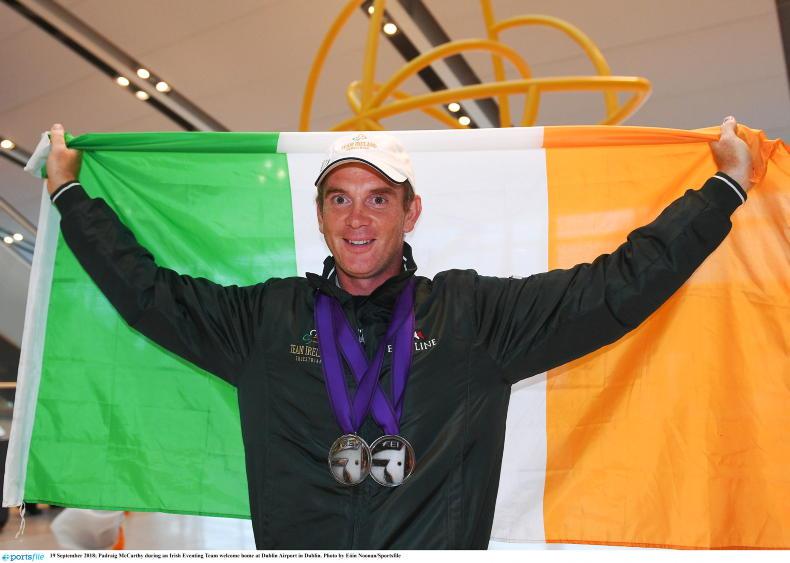
Padraig McCarthy with his team silver and individual silver medals from WEG 2018 \ Sportsfile
5. “Fools breed foals for wise men to buy.” Agree/disagree?
There are times when I definitely think that’s true! That it would be a lot easier to buy the foals and young horses that you want. Breeding horses is a huge passion for me and I think for most breeders too and while it has to pay its way, its not an easy enterprise.
It can quickly add up to a lot of money, especially modern breeding techniques, but its great satisfaction to ride a homebred at high level.
So a potentially foolish endeavour but we’re probably luckier than some breeders in that we can do the full cycle and take them from the beginning right up to higher level eventing. Hopefully from my contacts, I can put them in the right place too.
6. That famous horse you’d like to have bred?
I hope if you ask me in five years time, I would say MGH Zabaione, winner of this year’s CCI-L 4* at Ballindenisk. A lot has to happen before he can earn an accolade like that!
The current horse I would love to have bred is Colorado Blue. He’s one of the standout five-star horses of this era, a terrific credit to his breeder Kate Jarvey and rider, Austin O’Connor. Pippa, my mother-in-law, sold Salty’s grandmother to Austin when he worked for the Wiegersmas. I’ve always enjoyed watching Colorado Blue, he’s been an unbelievable horse for Austin.
And Boomerang too of course!
7. The standout stallion on the current international circuit?
It would have to be Ermitage Kalone. He’s an unbelievably consistent show jumper and looks like if the fences were 10 centimeters bigger, he could jump them. He jumps a lot of clear rounds and has great rideability. The other horse is Harrie Smolders’ Uricas vd Kattevennen, more blood and a really modern type. I have foals from both stallions and I really like them, so they’re ones I’d use again.
8. Best advice you could offer?
?I feel when you get to nearly 50 year years old, you’ve got a lot of advice and help from different people. From that accumulation of advice and experience, I would say that you need to give horses time. Sometimes the flashiest four-year-olds aren’t always the best 10-year-olds and vice versa. Don’t be under pressure for age classes if they’re not ready and hopefully they’ll repay you with a longer career.
9. It takes a team - who’s on yours?
It certainly does. Lucy is the important person in the team in organising the administration stuff, entries, billing and a plan at the beginning of the year where the horses should go.
The yard mananger is Kira Schmidt from Michigan, then there’s full and part-time staff: Shelley Gilbert, Sophie Rainbow, who groomed for me at the World Championships in Tryon, Louise Tucker, Dutch girl Valerie Pool, Gemma Watt and Emma Egan from Ireland, as we have nearly 100 horses between all.
The Brexit situation has made it a little more difficult for foreigners to stay more than a year or two, which is a pity.
10: That special experience in California?
When I spent three months riding in California, I got to know Eddie Macken quite well. He helped me with the horses and we had a few beers togethers. Having looked up to him all my life, it was really surreal to spend time getting to know him.