WE live in Upperchurch, Thurles, in the Slieve Felim hills, (approximately 600-700 feet above sea level), the home place where my parents Toby and Annie and eight children – four boys and four girls – grew up.
My father always kept horses and I recall early visits to the RDS with mares, foals and three-year-olds. They were taken to be sold and, at the time, they were always sold. It was a long week at the RDS, Monday to Saturday and living on the show grounds. My father sold a four-year-old horse there in the late 1960s and bought an outside farm with £20 to spare. So, horses are in our blood here.
Two of my brothers live locally and are also farming and breeding horses. My brother, John, spent some years in America and, on return, settled in Roscrea, where he keeps stallions. He stood Woodland Boy (ID), the Grand Prix sport horse Boherdeal Clover, In Seclusion (TB) and now has a newly-approved Class 1 Irish Draught, Expresso Vision.
We have over 15 mares between us, with five mares here on the home farm; three Draughts and two sport horse mares. The Draughts are bred pure-bred every year, with the sport horse mares for breeding event types. Red Valley Lady (Nash Me) produced Ballarin For Joy (Castlecomer Q), the RDS champion hunter mare last year.
1. Tell us about Tipperary Liadhnan?
My father bred Tipperary Liadhnan, an international event horse (Fast Silver – Gypsy Star, by I’m A Star).
I’m a Star was one of the most sought-after stallions in the country at the time, a 16.2 bay thoroughbred with presence and movement. Fast Silver was a recently-passed young Draught by Silver Hunter and his dam Fast Woman was the three-time All-Ireland champion mare.
We qualified the combination for the RDS Breeders’ Championship. They were not for sale, as the breeding line produced very few females. Gypsy Star died foaling the following year, when in-foal to Ballinvella.
Gypsy Duff, Gypsy Star’s dam, was by Sunny Light, a 16.3hh chesnut thoroughbred stallion that produced show jumpers and show horses. Gypsy Duff only produced two other fillies: a Heather Breeze, which won the All-Ireland Irish Draught foal championship and one by Cream Of Diamonds. The grand-dam Runaway produced the Draught stallion, Tobias Corbett, by King of Diamonds’ full-brother, Slyguff Hero. Tobias Corbett produced Hillviewfarm Superstar, a Class 1 Irish Draught stallion standing in Roscommon, who sired a winning foal for us last year.
Tipperary Liadhnan was produced as a three-year-old for sale, but didn’t make the Goresbridge September sale, as we failed to load him on the day! He always was a horse with a mind of his own and, if he didn’t want to do something, there was no way around it.
His future owner, Kim Severson, said he always had that trait. He remained on the farm for two more months until we had American buyers looking for Irish Draught geldings. They spotted him, a deal was secured, so that’s how he ended up on the opposite side of the Atlantic.
2. Proudest breeder moment?
We always followed Tipperary Liadhnan’s progress and were delighted when he was on the London Olympics shortlist.
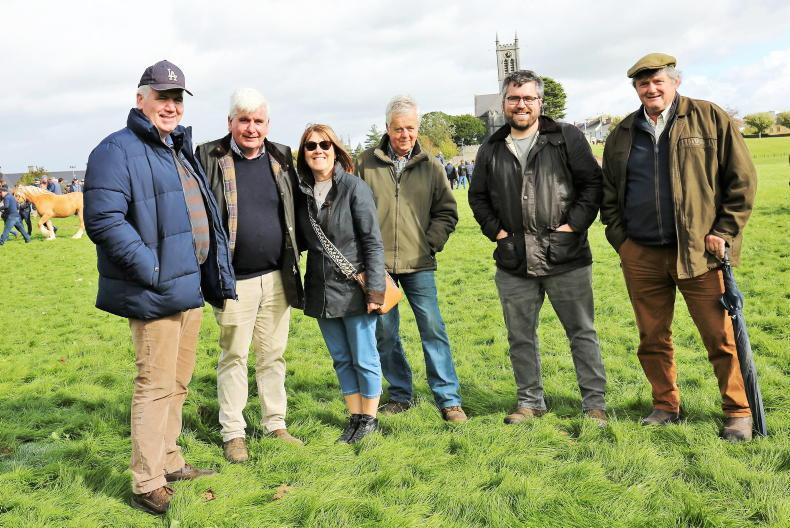
Day Out At Ballinasloe Fair: Eddie (left) with brother Paddy, Cathy and Ned Griffin, William Clancy and Matthew O’Meara \ Susan Finnerty
3. Favourite mare?
Of the present mares, my favourite is Upperchurch Diamond (Flagmount Diamond) a 14-year-old, 15.2hh bay Draught mare. She has an excellent temperament and was responsible for my kids getting into showing, as she’s so easy to handle.
She has produced a foal every year since she was three, none of which failed to sell. Each had a lovely temperament like hers. Her 2022 foal by WRS Sunshine won five championships, including the Munster Irish Draught Foal championship in Bantry. He also brought home my parents’ memorial trophy from our local show – Nenagh – which I’d say was my proudest showing day.
While we’ve been lucky to win at the RDS, there’s nothing like that feeling of winning at the local show, as the local rivalry between breeders in the area is great. I enjoy showing foals, as it’s great training for them. Also, its one area of showing where the farmer-breeder can still produce a winner, ahead of the professional showmen.
4. Describe your regime for keeping stock?
All mares are housed for the winter months in loose sheds, fed haylage and some meal from early February. They’re turned out two/three times a week to a hardcore area.
Mares foal in March/April, as we sell all the foals, are foaled inside and let out as soon as the weather permits. We’d assess the foals in early June and choose one or two for showing. We could visit 10-12 shows from July onwards. All foals are fed from early August onwards to prepare for selling in September/October.
5. Your Irish Draught template?
For me, a good temperament, four good clean legs, with a leg in each corner, with some feather but not too much. They must have a nice head, in proportion to the body. I’m not fussy about height, anywhere between 15.1hh to 16.3hh, as long as everything is in proportion.
6. Greatest challenges facing Irish Draught/traditional breeders?
To me, it’s getting the youth involved. Young people today, with social media and all the fast news, like fashionable things. They can see more reward/promotion for breeding show jumpers and eventers and want a slice of that. This isn’t as easily attained, breeding Irish Draughts and traditional breeds. Breed societies need to do more to promote young handlers and promote their involvement in breeding.
7. Best advice you ever got?
My father always told us that, “You know a lot about horses, if you know you don’t know enough”. In other words, you are always learning and always listening to other people, as advice can come in many ways. Also, he always said that you don’t always have to agree with the judge’s decision, but you should always respect it.
Judges travel in good faith to the show and set out to do the best in their opinion and we, as exhibitors, should accept that and move on to the next venue, where results could be the same or different.
8. It takes a team – who’s on yours?
I work full-time in a pharmaceutical factory in Limerick, as well as breeding sucklers and four/five foals every year. My wife, Noelette, looks after all the paperwork and keeps us all ready. My children, Toby and Emma, are still in secondary school and, when not hurling or playing football, they enjoy working with the horses and getting foals handled for the summer months.
Emma does all the plaiting and getting animals ready, while Toby relishes showing and is becoming an expert in this field.
I couldn’t manage without my brothers, Paddy and Michael, and nephew, William, as they live locally and are forever only a phone call away to pop in and calve a cow or check the mares when I’m at work. Our blacksmith, Gerry Caplis, always turns up, even with very little notice and gives solid advice, while our vets are Brittas Veterinary in Thurles and Tom Burns’ equine practice near Holycross.
9. Breeding horses – would you do it all over again?
Yes. I love breeding horses and especially in the spring, when the foals arrive. You make great friends that last a lifetime. We bought a foal from Martin and Kathleen O’Neill in Ardrahan over 30 years ago and we’ve probably bought over 30 more since. When my brother first went to the States, it was to Florida, to a man who’d bought three-year-olds in Dublin from my father.
It does take time and sometimes isn’t the best paying game, but there is nothing like seeing an animal you bred doing well, being in the line-up or winning at the local show and stopping off at Kennedy’s Bar on the way home, to fill the cup or drown our sorrows, as the case may be.
10. If you weren’t breeding horses?
I would love to be a travel writer. I adore travelling to new and off-the-beaten-track places. Europe, Africa and the USA are all completed, next stop is Australia!