How did you get into ownership?
My family always had horses on our farm at Ballyday, near Gorey, Co Wexford. We are dairy farmers and we breed and train a few horses as well.
I started into racehorse riding at a very young age of 16, and rode in points as J.P. Walsh.
We have a gallops at home, put in about seven or eight years ago, four furlongs straight up a hill with 12 fences – banks, tyres and hurdles.
I built a fence for the Shillelagh Hunt into my neighbour George Stacey’s land as well.
It’s hard to determine why horses do or don’t take to the banks. I remember with Ballyday Dazy, a mare I had, I wanted to enter her for a mares’ maiden at the Tinahely point but she wasn’t eligible. I was riding her along the field and popped over a few ditches and I thought, ‘by God you’re not bad at this’.
I’ve tried other horses over the banks and they are all over the place, landing the wrong way and all sorts.
What was your best day at the races?
My best day was at the Punchestown Festival in 2002, when our family-bred and owned horse Ballyday Dazy was second in the Ladies Cup and the La Touche Cup. We had a few enquiries to sell her after that but the family all said to keep her. I bred Ballyday Dazy and her sister Ballyday Dawn, Ballyday Snow and a few others.
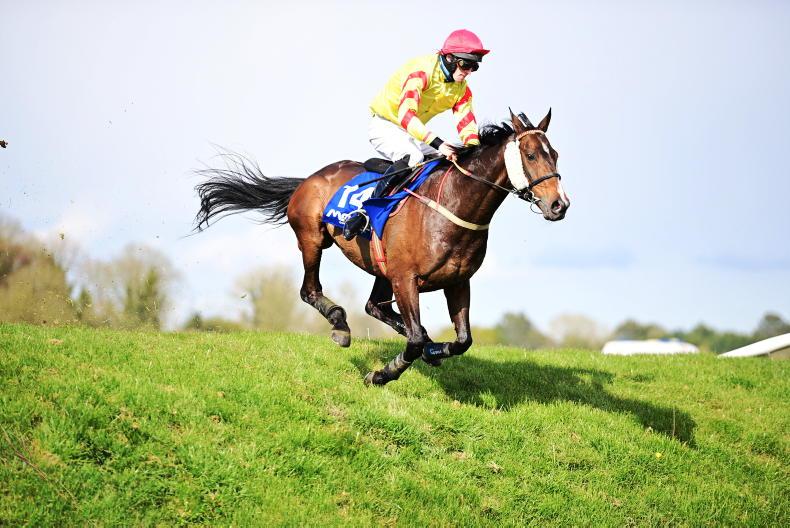
Punchestown this year, with Singing Banjo winning both races when ridden by our son Barry, would have topped it if we were able to attend. The Ladies Cup was Barry’s first winner on the track although he had ridden point-to-point winners. Singing Banjo had finished third in the race in 2019.
Barry did some massage sessions on Banjo between the two races making sure he was in top form for the La Touche after his win in the Ladies Cup. He is currently doing an Equi-Ed equine physiotherapy course and hopes to be completed by September.
Karen Moore, Barry’s girlfriend is a veterinary nurse in Athy and gives a big hand with the horses in the yard. She won the charity race at Punchestown in 2018.
Another son Aaron had a lot of success in points especially at Tinahely on our horse Loggan Lass.
We’ve been second many times to Enda (Bolger) and he rang me on the Tuesday after Singing Banjo won the Ladies Cup and said “you’ve tried long and hard enough, you deserve to win”. And then he rang me back on the Thursday after the double. I thought it was very nice of him.
What is the biggest drawback about being a racehorse owner?
The expenses of keeping a horse in training and all the extras like shoeing, clipping and transport to the gallops.
Which racecourse in Ireland treats owners the best and why?
Punchestown, especially at the festival as it’s a lovely family day out.
Flat or jumps which do you prefer?
Always with the jumps! I would look at the flat on the television.
What do you look for in a trainer?
You must have someone who keeps you updated on your horse, that’s why we picked a local trainer like Philip Rothwell. It’s brilliant to have him so near, we can be in and out seeing what’s going on.
Our family has long associations with the Rothwell family, I used to play with Philip’s uncle Derry, well known for his Greenhall stock, and we rode our ponies together.
I remember Philip riding in point-to-points and he would ask me for advice.
What improvements would you like to see racecourses in Ireland do for owners?
Allow owners back to racing safely and as quickly as possible.
How do you think the current crisis will impact on racing in general and on ownership in particular?
Funding will be a struggle and owners could lose interest because of not being able to go racing. Some people possibly have saved money during the pandemic but I have friends through football who were in a syndicate. They are out of work and the extra training charges caught them out and the syndicate is gone.
What can trainers or HRI do to encourage owners to keep horses in training at the moment?
Trainers could send videos of horses working to owners who cannot make yard visits due to Covid restrictions to keep them up to date and involved.
HRI could provide more races so that horses get a run and are not continually balloted out.
What significance do your colours hold?
Yellow was always the Walsh family’s racing colour. My father Pat Walsh, who hunted the Shillelagh hounds, raced his pointers in yellow with a black cap. I couldn’t get those colours so I went for the yellow and red.
When buying a horse, what do you look for?
A good looker with a good walk, with a pedigree.
In Singing Banjo’s case Aaron bought him at Tattersalls Ireland in 2014 for €1,600. He is his horse although runs under my name. What made him stand out was that he was a smart walker, he’s proud looking, shows himself off. He’s a little looker with a good step on him.
What horses do you currently have in training?
We have seven horses at the moment for point-to-pointing.
What’s next on the agenda?
The four-year-olds are out on a summer break now and we are planning to bring them back for the autumn pointing. You are always hoping to sell on a few if they are good enough.
There was an idea that we would send Singing Banjo to France for a cross-country race but that came too soon.
We are aiming for the cross-country race at Cheltenham in November. We had hoped to run him at this year’s Cheltenham Festival but his handicap mark was too low.
The two Punchestown wins won’t affect his handicap mark but hopefully he will run in a few banks races at Punchestown in October and be able to qualify. He just loves the banks, he’s so nifty over them.
Have you horses to look forward to?
Yes we have a nice three-year-old Policy Maker filly to be broken in summer and a Doyen yearling gelding.
We also have a three-year-old filly by Ol’ Man River who we will bring in to be broken.
What would help to make Irish racing more competitive for the smaller owner/trainer?
If the handicap mark was lower it would give lower graded horses a chance to compete.
What advice would you give to someone thinking of becoming a racehorse owner?
It’s expensive and disappointing some days but the good days are very memorable and cherished forever.
John Walsh was in conversation with Olivia Hamilton