IT was a good Budget for sport, unless your sport is horse racing.
Last week the Government announced a 26% increase in funding for sport in 2026.
The Football Association of Ireland got an extra €3 million on top of their agreed €6 million annual grant. The GAA and IRFU also got generous increases, as did sport horse breeding, all of which comes from the Department of Culture, Communications and Sport.
Racing, of course, sits under the Department of Agriculture which, in terms of funding, is 50% bigger than the ‘Sport’ Department.
There was a nice 10% increase in the allocation for the Department of Agriculture too, up from €2.1 billion to €2.3 billion. But none of that trickled down to the Horse & Greyhound Racing Fund.
Asked by The Irish Field to explain why that was, the Minister for Agriculture, Martin Heydon TD, said that almost all semi-state bodies would see a freeze in funding for 2026 and HRI was no exception.
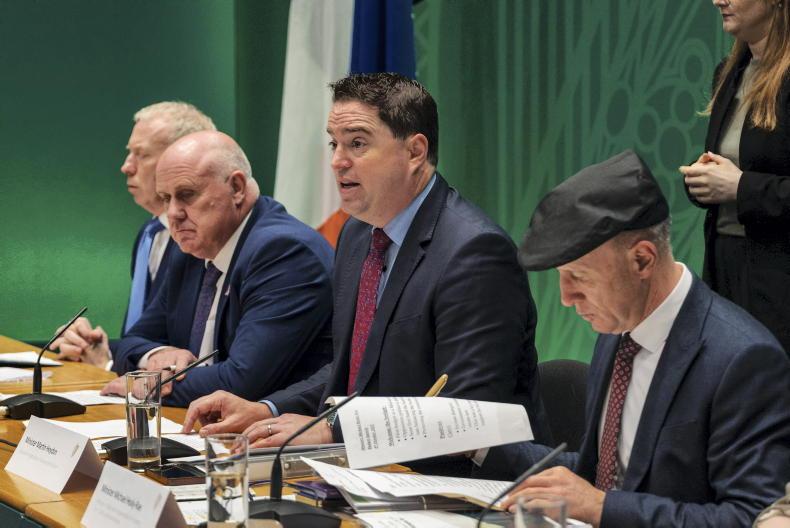
The news came as a bit of a disappointment as Minister Heydon is one of the few senior politicians in Dáil Eireann with a genuine interest in the racing world and this is his first Budget. When he was appointed last January there was a general feeling that this was good news for the sport.
This was the first of five Budgets in the term of the current Government and, at the post-Budget press briefing, I asked the Minister if he could give racing any assurances that this funding freeze was temporary and that normal service would resume next year.
He did not commit to anything, other than to say: “I’m still a huge supporter, obviously, of this sector. We’ll continue to work with them. There’s a number of projects in the mix there that I’m very supportive of and we can continue to do that. And it still is a very, very sizable allocation for what is a really important sector.”
HRI also issued a statement ‘noting’ the financial allocation, but, of course, being a semi-state body and an affiliate of the Department, they were never going to complain publicly.
The HRI senior executives now face a critical six weeks putting their own 2026 spending plans together before putting them before the Board in early December.
The Government grant represented over 60% of their income and there is not much scope to increase any of their other revenue streams. Media right/commercial income accounts for about 10% of HRI revenue and that is understood to be falling gradually.
The rest of HRI’s ‘turnover’ is funds they receive from racehorse owners and sponsors for re-distribution, mainly as prize money. Even if HRI was to increase race entry costs it wouldn’t generate a whole pile.
Cost-cutting
The other option for HRI is to cut costs.
By far and away HRI’s biggest area of expenditure is on prize money. In 2024 they contributed €42 million of the total prize money pool of €70 million but owners and trainers have argued that HRI’s contribution is actually less now than it was before Covid.
Last week in The Irish Field owners and trainers again called on HRI to put more into prize money for 2026 as they feel this is the best way to keep owners (and by extension, trainers, jockeys, stablestaff) in the game.
Before making decisions HRI might look at the most recent set of industry statistics which show that the number of runners in flat races continues to decline, while jump racing is doing okay.
When those figures were published in July HRI took the opportunity to say it remained committed to “a prize money growth strategy which is vital to underpin Ireland’s global leading status.”
Those words will make it very hard for HRI to back away from a prize money increase for 2026, so where will that money be found?
There is some leeway in that the Minister tweaked the 2026 Government funding in such a way as to allow HRI to spend €2 million less on capital projects (such as racecourse improvements) and use that cash instead on more immediate ‘current spending’ areas.
Where else does HRI spend its money? According to HRI’s 2023 annual report (we don’t have the 2024 report yet) their total expenditure was €113 million.
They spent €16 million on “integrity and racecourse services”, the vast majority of which is presumably to fund the Irish Horseracing Regulatory Board, the racing officials, the drug testing, etc.
HRI’s own administration costs in 2023 were €10 million (approx €8 million on salaries, up €400,000 on the previous year) and close to €6 million was spent on marketing (includes €2 million for Irish Thoroughbred Marketing).
So HRI faces a difficult balancing act as it prepares its 2026 budget. While a modest reallocation from capital projects may offer short-term relief, it will not resolve the structural challenges in HRI’s finances.
Cutting administrative or regulatory/integrity costs would be politically and operationally fraught, and raising charges on owners risks deepening discontent in a sector already feeling squeezed.
Over the coming weeks, HRI’s leadership will need to strike a delicate compromise between supporting the industry’s competitiveness and preserving financial stability, all without the assurance of increased Government backing in the years ahead.
How HRI plays its cards now will go a long way towards determining whether Irish racing can sustain its reputation as a world leader or find itself falling behind its better-funded rivals.