If you didn’t have 27 million to spend on yearlings this autumn, fear not. The horses in training sales are just around the corner!
Goffs stage theirs on November 2nd and of course there’s over 1,500 to choose from in the Tattersalls Autumn Horses In Training Sale, which starts next Monday.
Plenty of Irish trainers will be heading over to Newmarket hoping to pick up a bargain or two. Andrew Balding is selling 48, there’s 38 leaving Charlie Johnston, and William Haggas has entered 37. Hundreds more from smaller stables also going under the hammer. Got to be a few late developers in there who would benefit from a change of scenery.
Final Orders, winner of the Velka Pardubicka last week and also a Cheltenham Festival winner, was bought at Newmarket for 14,000gns. Alphonse Le Grande, twice a winner of the Cesarewitch at Newmarket, was a 10,000gns purchase.
Two weeks ago at Dundalk, British import Serenity Blue won easily on his first Irish start. Well beaten on all four of his previous starts in 2026, he seemed to find life much easier in Ireland, bolting up for trainer Ado McGuinness and the Total Recall Racing Club.
Racing TV pundit Fran Berry observed: “I can’t stress it enough. When you buy those horses out of England they definitely have two races in them if they have any level of ability, no matter what rating they are running off. Just back them and keep backing them.”
Could that be true? My own gut feeling was the opposite. Generally speaking, surely Irish races are more competitive (bigger fields) than the equivalent races in Britain? I tried a couple of sources to see if I could get any hard data on the strike-rate of recent imports in Irish handicaps but it’s not easily available.
I’m reliably told that in 90% of cases horses are allowed run off their ‘home’ mark when they travel across the Irish Sea to contest a handicap. If anything, the Irish handicapper is thought to be erring on the side of caution with imports, typically adding a ‘border tax’ of one pound to recent winners.
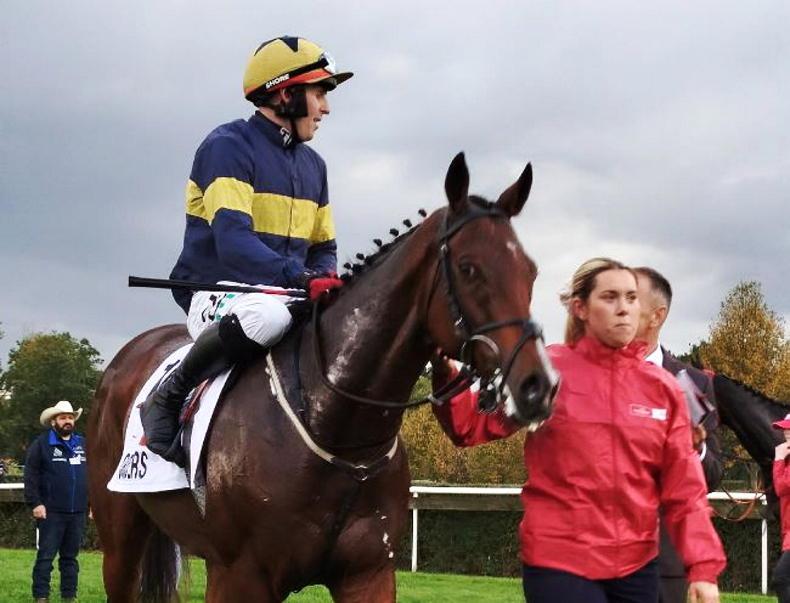
Final Orders was bought for just 14,000gns
What I did find out was that, so far this year, Irish-trained horses have a 9% strike-rate in British handicaps and the British have a 10% strike-rate here. I’m aware that there is a strong selection bias at play too – you wouldn’t send a handicapper from one jurisdiction to the other unless you really felt you have a well-handicapped horse who could at least cover costs.
Still, the stats indicated that it’s not all one-way traffic. Going back over 20 years, the strike-rates vary wildly and there is no strong trend, other than the number of British handicappers running in Ireland has about halved since Brexit, presumably due to the extra cost and paperwork involved.
You may recall Coul Angel (Mick Appleby) and Sondad (Michael and David Easterby) winning big sprint handicaps at the Curragh this year. Did they get in lightly here? I don’t think so, because they both won again off higher marks at home and in fact they both look to be stakes class now.
On the other hand, Pierre Royal (Ado McGuinness) was the sole Irish-trained runner in the Cambridgeshire at Newmarket and he won. And a couple of weeks ago Alphonse Le Grande (Tony Martin) won the Cesarewitch (again) and Dawn Rising (Joseph O’Brien) finished third.
Then again, the other four Irish-trained runners in the Cesarewitch – including a couple of well-fancied ones – were well beaten.
At Royal Ascot this year Joseph O’Brien won three handicaps (Enceladus, Green Carrera, Kizlyar) – which is almost unprecedented - but all three have gone on to prove themselves blacktype performers. So where does the advantage lie?
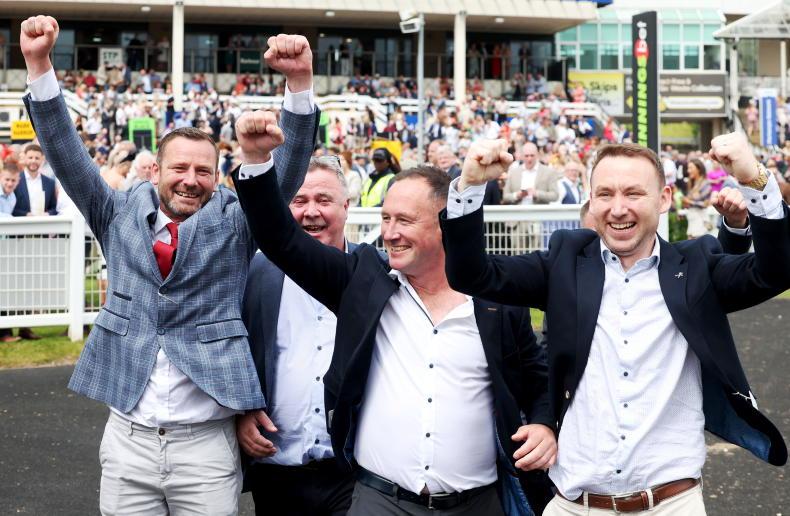
The owners of Alphonse Le Grande have had amazing results with their 10,000gns purchase
Photo: Healy Racing
Seems to me that, when it comes to winning with imported horses or new recruits from other yards, the answer might just be the trainer. Anybody who follows British and Irish racing closely very quickly learns which trainers are particularly good at improving new recruits.
My own shortlist would include Mick Appleby and David O’Meara in Britain, and Paddy Twomey, Willie Mullins and Joseph O’Brien in Ireland. I’d also give a serious upgrade to horses joining Ger Lyons, Gavin Cromwell and Gordon Elliott. Dan Skelton is not too bad either!
But maybe top of the list would be Ado McGuinness, trainer of Pierre Royal and also of Serenity Blue, the Dundalk winner whose performance sparked this piece. A few days later Ado sent over Distillate to win a class 6 handicap at Southwell off a mark of 47. The six-year-old mare had been well beaten off 49 on her last two starts at home.
I gave Ado a call to see if he would spill any secrets. I first asked him what he looks for in the horses-in-training catalogue – is it form figures, the rating or the previous trainer?
“Sires,” was his surprising first answer. “I love sires whose progeny often improve with age. There’s some sires who are very good at getting two- and three-year-olds but they don’t produce older horses. I’m not going to name them or I’d be shot by the stallion owners!”
I had a suspicion that Ado targeted stock from certain yards where he felt there was likely to be improvement in them, and he confirmed that. “The yard might have been out-of-form this year, so I look at their horses, but there are other trainers whose horses I wouldn’t touch because I just can’t see a horse improving coming from there.”
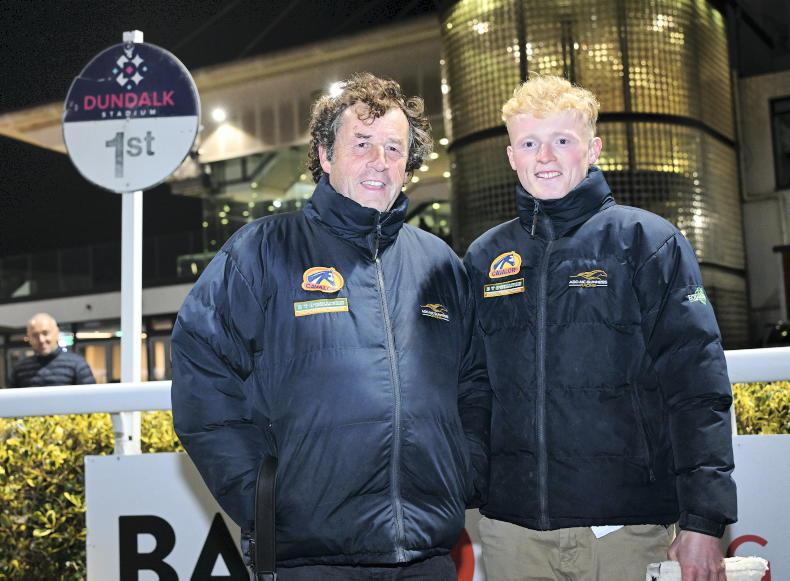
Ado and Tadhg McGuinness
Photo: Healy Racing
Ado uses talent scouts too – Ted Durcan put him on to Serenity Blue and it was Adam Potts of BBA Ireland who marked his card about Pierre Royal.
They say buying a horse in training is like buying someone else’s problems. I asked Ado if he is prepared to overlook certain veterinary issues. “Yeah,” he said, “I bought my one and only Group 1 winner (A Case Of You) on a bad vet’s report! He failed the vet twice for America and Hong Kong - they will knock a horse over the slightest thing. But I won't take a chance on something that comes up really bad.”
While Ado has undoubtedly a better record than most in improving new recruits, he admits plenty have not worked out but at least the pain is not too great, compared to what’s being spent on yearlings and breeze-up horses.
“Una Matata was a six grand filly last November in Goffs and she won four for me by March. In 2021 we bought Skontonovski for the same price and he won nine races.”
He laughs at another memory. “It was early one morning in Newmarket when I bought the wrong horse! He actually won first time out for us and then we sold him in a claimer. He turned me 17 and a half grand in six weeks!”
I finish by asking Ado for some advice for owners or syndicates thinking of taking the plunge this autumn.
“You could buy 10 yearlings for half a million and end up with nothing,” he says. “You can’t duck and dive with two-year-olds in Ireland. But if a guy wants to go racing and have some fun and enjoy his days out, and then he's got to buy a horse in training first, to get the taste for it.
“The Middle East and Australian buyers have made it more difficult but you can still buy a nice horse for 40 or 50 grand and win plenty of races. The trainer is a huge thing …”
Fran Berry may be right. British imports may well have two races in them. But only if they’re with the right trainer who knows how to find them.