THE highlights reel marking this most turbulent flat campaign, which comes to a conclusion at Naas today, will probably not feature Mick Mulvany and his admirable group of horses.
But in the rush to bemoan the concentration of riches at the top end of the tree, it is often forgotten the value such a competitive environment puts on the stock, even if they are not contending in pattern races and classics. The critics like to airbrush from the picture the success of horse people making a living from the niche they have carved out for themselves, because it doesn’t suit their gloomy narrative.
Mulvany has produced a consistent set of results in recent years, painstakingly improving quality and getting the best from the resources at his disposal, primarily with homebred stock, sired primarily by their own stallion.
The growth led to the family operation no longer standing Tough As Nails, who has been at Peter Maher’s Ashfield Stud since April. A two-year-old maiden winner for Mulvany who went on to be placed at Group 1, 2 and listed levels, it made sense to the Mulvanys to stand him, given that they were breeding at a budget from a select band of broodmares.
The increasing prosperity of the racing arm prompted a re-evaluation of the business model but Tough As Nails will continue to be supported by the Mulvany mares.
“He is a very good stallion, a son of Dark Angel,” says Mulvany. “He is not overused as we were the only ones who used him before he went to Ashfield. He is improving the mares and producing nice, winning offspring. He will cover our mares and then we would buy an odd horse, here and there as well. We would try and buy something cheap and sell it on with form.”
The Mulvanys had a pub in Dublin but the patriarch Larry also had farming land in Cavan. They bred greyhounds quite successfully before transitioning to racehorses, owning the likes of Spankers Hill in partnership with trainer Bill Durkan.
Larry bought land just outside Kells, Co Meath as a base for a breeding venture and the family, including Mick’s brother Laurence (“one of the big workers doing the graft behind the scenes”) immersed themselves in it.
“We bought mares then off Bill that he was selling and we bred them and gave the horses out to other trainers. They were coming back with injuries and this, that and the other so we decided to take a chance of training them ourselves. We reckoned we could do as good as anybody else.
“We built a yard and a shed, put in a gallop. It wasn’t always rosy but we’ve gradually grown from having one or two horses to what we are.
“We run our horses honestly all the time. That’s the principle that we work on. And that’s what people want. I think the day of pulling and juking is over.
“You learn as you go along. We were big in greyhounds over the years and it’s the same kind of principle. It’s the same as playing sport. We all played sport in our house and you only get out of a thing what you put into it.”
Before Talking Tough’s run at the Curragh yesterday, Mulvany had registered 13 winners with 47 runners finishing second, third and fourth. All from just 146 runners. In 2019, it was 14 and 53 from 143. Two years ago, they made a big numerical breakthrough when accumulating 15 winners and 41 places from 113 races. Prize money levels have remained pretty similar too, just short of €240,000 this term.
Earlier, in 2017, On The Go Again bagged the Grade B Liam Healy Memorial Lartigue Hurdle at Listowel and added the Irish Lincoln and Listed Heritage Stakes on the flat the following March and April. Lady Bolino was the first winner, in a Downpatrick bumper in 2007, and they haven’t had a blank year since.
“We had our team ready to go early and we thought for a long time we’d be coming back so we were keeping them ticking over. As it worked out, it didn’t really affect them as they’re tough horses. We would have given them two weeks off if we knew but the date kept changing so we kept working them.
“We had our team firing for the first day. Small outfits have to have their horses out early, to try to get out before the power of some of those big yards come into play. You have to play to your strengths.”
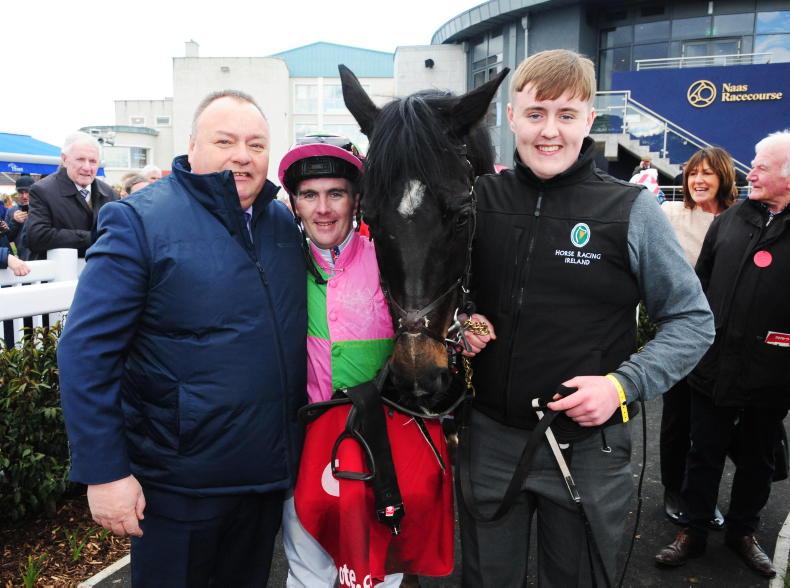
Michael Mulvany, Gary Carroll and Larry Mulvany after On The Go Again won the Tote Irish Lincolnshire in 2018 \ Healy Racing
Multiple winners
What is notable is how busy Mulvany keeps his charges. Five of them are multiple winners. Of those, Take My Hand has run 14 times. Even the Bellewstown nursery victor, The Blue Panther, has raced on 10 occasions. The way they hold their form is significant too and five of the squad are rated in the 90s.
In From The Cold prevailed at Naas last Sunday, more than seven months and 12 contests after garnering the Madrid Handicap on the opening day of the season at the Tipper Road track at the end of March. It brings to mind how Jim Bolger, another who breeds to own and race operates, albeit on a far bigger scale.
“Jim Bolger actually said it to me last week,” he says with a chuckle at the mention of the Glebe House marvel. “You know the trainers that own the horses themselves. They would be putting them in more often than trainers training them for somebody else. Training for somebody else, the gaps are six or seven weeks.
“I found it easier to train the horses, once you get them fit. Just keep them ticking by running them. It saves having to bring them away to gallop them. We work on the theory that they’re working on the race track. Once our horses start running, we run them and it does away with a lot of that galloping. They’re often doing less on the race track than they would be doing hard work at home.
Match practice
“Sometimes by running them in a race, you’re only keeping them up at their peak where the other way, you can be letting them down and bringing them back up again. So it’s training them pretty much like you’re training yourself or a team. I try not to overtrain them. There’s nothing beats match practice.
“It can take a horse five or six runs when he’s coming from a small string to realise what the thing is about. It’s a different thing if you’re coming from Aidan O’Brien, though they always improve for a run. But they’re going out in strings of 30s and 40s; it’s a horrid difference to a horse going out in twos and threes. It takes them a little bit extra time and that’s why sometimes with ours it takes a couple of runs.”
Covid-19 has impacted on the planned dispersal of some of his stock but with no homebred two-year-olds this term and five yearlings bought, the numbers he will have in training will remain in the 15-20 range.
“We were going to ship out a load of them but the way the sales worked we decided we’d hold on. The oldest horse in the yard nearly is five. We would normally move them on at the end of their four-year-old careers and bring in new stock.
But there was no point going to horses-in-training sales and there doesn’t seem to be a huge demand. The phone is not ringing off the hook. If you got any kind of reasonable offer you’d sell but you’re not going to give them away.
Better quality
“We have raised the quality of our horses over the last few years, the ratings are going up, and that’s something we want to keep doing. Having better quality than quantity.
“They’re good, consistent horses. The likes of the Tough As Nails, they’re good, solid horses. We bought a couple of Alhebayebs as well and they seem to improve with a bit of age. They mightn’t be stakes horses but they’re trainers’ horses. Good, solid horses.
“Some of the mares will go breeding. You’d be swapping a few around. We normally work around 15, 16, up to 20 and try to keep the numbers at that. We can manage that. If you go over that, it’s more staff and more everything.
“Now, if any big client came along, I wouldn’t mind going over it! But that’s roughly where we keep our numbers.
“We normally breed 10 mares roughly. Two years ago we had no foal, for different reasons. Last year we had 12. I think this year, we have seven or eight in foal. You have good years and bad years. We keep it ticking.”
The majority of the Mulvany mares will be covered by Tough As Nails and those that are acquired are done so with the former stable star in mind. But if going elsewhere, or buying stock, value is the name of the game. And it is available when the priority is not a quick turnaround.
“We’re not selling them straight away, so when you’re not selling them, we’re not that pushed that it has to be a first-season sire.
“The same when I go to the sales, we don’t necessarily buy a fashionable sire. People want to buy the first-season sires all the time but I’d rather buy out of a proven sire and a good-ish mare. I like to buy out of winning mares.
“What we do is look at the horse first and then look at the pedigree. People go with the intention of buying a first-season sire but that first-season sire could be a flop. You could get a horse that will only get a small crop and could throw good-ish horses that are steady away all the time. But lads won’t buy them because their orders are for the first-season sires. To me, that’s a mistake.
“Sometimes you pick up a very nice-looking horse for smaller money. When you’re training horses and want to train three-year-olds and four-year-olds, you have to look further down the line. You mightn’t have a Royal Ascot two-year-old; 90% of them breeding today are trying to breed this Royal Ascot two-year-old but when he goes off the boil he’s gone.”
Family
The family involvement sweetens the success. Mulvany’s own son Larry, currently studying equine science in UCD, is part of it now too, having learned to ride with his two first cousins, themselves equine science graduates, at home.
The genes aren’t made for riding work though and only one of Mulvany’s nephews, the farrier, Jamie O’Sullivan can contribute in that manner. Two licensed trainers, Joey Murray and Kevin Smith, come in to exercise the horses however. It is invaluable expertise to have at hand.
Meanwhile, the breeding and racing work hand-in-hand with the cattle. Just to keep things diverse and interesting. Mulvany is certainly satisfied with the season.
“My father over the years, he’d go to Galway and to Listowel so we would be targeting to have winners in them places. The three meetings we would target – Bellewstown, which is local for us, Galway and Listowel – this year we had winners at the three but the only pity was that we had no-one there because of Covid.
“And the Madrid was brilliant. It’s a premier handicap and it takes the pressure off for the year straight away.”
He will have a couple to run at Dundalk and the National Hunt, to give his staff something to look forward to, but in the meantime, the yearlings are being ridden and will be well advanced before everyone gets a couple of weeks off at Christmas, to recharge before another hectic term.
“We’ll be concentrating from when January starts, on March. We’d be treating the yearlings the same as if they were going to the sales. We’d bring them in at September and have them well-ridden before Christmas. Looking at them, I might only have one early but we let the horses tell us. We like to have horses running on the first day though.
“It’s a real team effort here. Everybody is pulling in the one direction. There’s the few lads coming and then the rest are all family. It’s Team Mulvany.”
Producing the goods.