IT is six months since Katie Walsh retired as a jockey on a winner at Punchestown but she hasn’t been twiddling her thumbs.“I suppose weekends are probably a bit freer ’cos you’re not going racing,” she considers, before breaking out into that familiar smile.
“I definitely summered well. I went on a good few holidays and things like that but that sales season doesn’t be long coming around and that’s been ongoing since August really.”
This is what Walsh does now, and has been doing since the turn of the decade. Although still at the peak of her riding powers when hanging up the saddle, as illustrated by that powerful drive on Antey after the last at the Kildare festival to get up by a nose and not to mention bringing her tally of Cheltenham triumphs to three by eliciting a storming run up the hill from Relegate in the Champion Bumper in March.
The groundwork had been laid on a new career. Indeed, she had sold the runner-up to Relegate, Carefully Selected, to Harold Kirk for Willie Mullins for €100,000, having purchased him as a store from Joe Lalor for €10,000 in 2015.
“I wasn’t thinking about that now going up the straight at Cheltenham,” the grinning 33-year-old related.
OLD FASHIONED
“It’s a bit old fashioned here in ways with the way Dad and I do it with the stores. We give them all the time in the world that they need. We’d have no problem leaving a horse off if it’s weakened off.
Maybe for business, sometimes you need to push on but we’d be more about giving him a chance to grow and come good. And Carefully Selected did, thankfully.”
They have all kinds of everything at Greenhills. Former heroes Thousand Stars and Rince Ri are knocking around, long removed from days giving Walsh and her father, Ted some wonderful memories on the track. Caspar Netscher is there too, the subsequent five-time group winner that established Walsh’s reputation at the breeze-ups, having bought the son of Dutch Art for 25,000 guineas and sold him for 65,000.
There are around 20 racehorses at Greenhills, including pointers, that are worked in the morning, along with husband Ross O’Sullivan’s string based next door.
Another barn houses the future prospects but while there will always be a handful of stores, it is the breezers that dominate. She is not long back from France.
“People are more selective with yearlings. A lot of people got a slap on the wrist last year. It was a hard enough sale season all around. This year I definitely tightened up a bit on pedigrees really. I was more driven by the book than the individual because there’s just a lot of horses out there at the minute.
A GOOD YEAR
“I had a good year. I sold very well with horses I got to do for clients, and that was great as it’s all under the Greenhills Farm banner. I would have loved to have had a few of them on my own but it was great to get them. I did them as if they were my own. You’re getting paid to do a job so you need to do the best you can.”
That best is excellent. For evidence, note the 500,000 guineas Godolphin spent in Newmarket on Zalpa, a More Than Ready filly sent to Walsh by David and Henrietta Egan. Turn then to Goresbridge in May, where a pair of fillies she had been sent by Prince Muteb Bin Abdullah also fetched top dollar.
A Bated Breath half-sister to Bellamy Road went for €200,000 but it was the record-breaking €315,000 Stephen Hillen splashed out for the Frankel filly that had everyone talking.
 Now named East and in training with Kevin Ryan, the chesnut was already a Group 3 winner and unbeaten from two starts before last night’s Breeders’ Cup Juvenile Fillies Turf at Churchill Downs.
“It’s like going down riding a bit of work for Willie. Why wouldn’t you want to? A lot of them are extremely good horses and there’s no better feeling than riding them. It’s like someone giving you the keys of a really good, fast car and letting it rip.”
But of course it is turning ones around that she buys herself that the real money is in. It can be difficult though when you’re on a budget.
“It’s very hard to buy the crème de la crème but you have to make sense of the pedigree yourself and hope the individual will match. And hopefully you’ll be able to buy him and someone else will miss him. Who knows? You don’t know until you put a saddle on the back of them, get them broken and get them going.
“So I was trying to tighten up a bit on pedigrees. Over the years, I couldn’t afford to buy those horses with those pedigrees but I suppose if you work hard enough they’re there and I definitely found myself working harder this year.”
You need to be wary of fashion at times.
“Something could be flying now and in six months’ time it could be the kiss of death. But that’s not the way if you can get your hands on solid sires, the ones that are tried and tested.”
Willie Browne, Norman Williamson and Con Marnane are just some of the breeze-up doyens that bemoan the primacy of the clock now. Walsh likes to trust in buyers’ common sense.
“If you’ve bred to be a five-furlong horse and you should be sharp and you’re not sharp, fair enough. But it’s unfair to expect something to come up in 21 seconds that is out of a mare that won over a trip, by a stayer. To be fair, I don’t think people expect that… well I’d like to think that they don’t. The clock is there and I don’t think that’s going to change.”
She is happy with what she has bought and work starts quickly.
“Six of them are broken already and are riding away. I’ve gotten some tack on a couple more of them this morning and they’ll be riding in a couple of weeks. At the end of the day, you can’t make a horse go faster than what it can go so, for me, it’s very important that they’re all good rides, good attitudes.
“I’d be the first person from a jockey’s point of view to get up on something and go down to the start and say ‘This is horrible. It’s no mouth. It’s not a good ride. Its eyes are popping out of its head.’
“So it’s very important to me. There are some horses that are just hot with no saddle on their back walking around as a yearling but I would have no problem meeting a trainer that’s after getting a horse from me.”
NO GUARANTEE
“I can’t guarantee anything. It sickens me to hear people say ‘This is the next best thing.’
“I suppose I’ve been in the game too long. I can’t listen to that talk, that’s not the household I was brought up in. I’m not going to stand outside any box and say the horse is the next coming of Christ. Those words won’t come from my mouth because I know how much can go wrong. I’ve seen so many horses that you thought were the next Don Juan get touches of legs and the dream is dead very early.
“I can only try to get them to the sale in the best condition they can be in, that they’re good rides, that they know their job and are very professional. After that I hope that they will go on and do what I might think but I’d like to think I’m not one to shove horses down anybody’s throat.”
Unsurprisingly, she’s hands on in this regard but there is a good team of knowledgeable horse people around. She used to ride the breezes herself but now the “brilliant” Rory Cleary has that important task.
“Anyone will tell you it’s hard to get good staff now but we’re very lucky we’ve got a good bunch out there. It’s great to have them. You need good horsemen and women and they’re a great help.”
It has been a steep learning curve. “The first year, myself and Dad went over and I bought three or four. They were all big, rangy, scopey  animals. I couldn’t sell one of them, so that was my first lesson learned.
“I ended up winning a couple of bumpers on Summer Star and a couple of hurdles, and she got blacktype over fences. She’s a mare here at home and we have a couple of Fame And Glorys out of her now. It’s great to have them. There’s a story behind them all!”
GOT SOMETHING RIGHT
Walsh explained: “Well, they weren’t sharp two-year-olds! Beginners’ chase, point-to-points – they all got jobs done I suppose.”
It was a blow and it took the reassurance provided by her parents to get going again. She is eternally thankful as she returned to Tatts the following year and came away with a Dalakhani, a Peintre Celebre and a Dutch Art. The latter was Caspar Netscher.
“It was great to have Caspar and it was obviously great for Greenhills 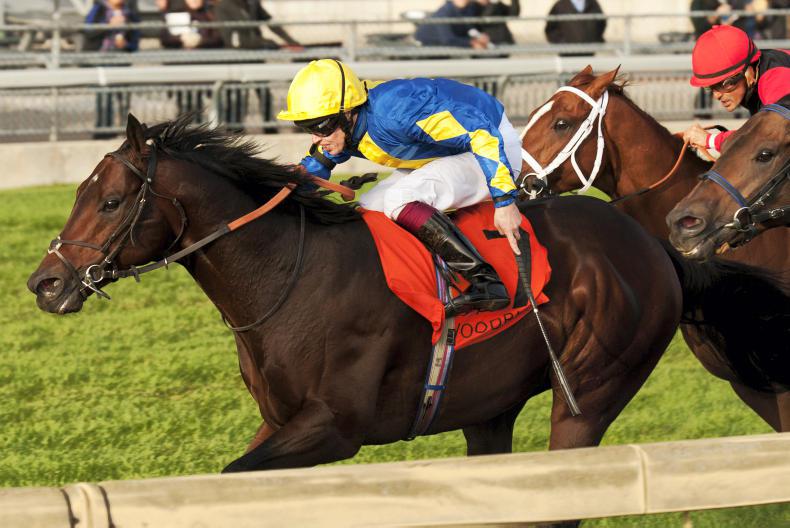 Farm to have him. He was the one that put the whole show on the road.”
Not one to be talking about ‘my horse’ and to be ‘throwing myself around the parade ring’ when one of her graduates does the business, she did travel to Santa Anita with her future husband in tow four years ago to see Caspar run at the Breeders’ Cup.
It was there they met the owners, Charles and Zorka Wenworth. So well did everyone get on that the Wentworths are now the proud owners of Baie Des Iles, the stunning grey mare trained by O’Sullivan and ridden by Walsh in the Grand National at Aintree last April.
The seven-year-old went on to claim a Grade 2 chase at Auteuil in June and returns to France tomorrow.
“She likes that ground, seems to like France, it’s very good prize money and she has the French premiums.”
National Hunt is the game she is reared in, but she is an avowed convert to the flat game now.
“I don’t know why someone wouldn’t buy a breezer. When you see the prices yearlings are making. You’re thinking ‘If he was at the breeze-ups, he’d have six months’ training fees into him.’ If he has a sharp pedigree, you should be ready to rock and roll with him. You’ve seen what he can do, he’s been vetted.
“I was in France and hadn’t even been paid when Caspar won his maiden. I don’t see why people wouldn’t use that way to get into it.
“Some trainers are for it, some aren’t. Listen, I’d be all for it.”