“If you can make one heap of all your winnings,
And risk it on one turn of pitch-and-toss,
And lose, and start at your beginnings,
And never breathe a word about your loss”
– Rudyard Kipling
JOHNNY Hassett is in a philosophical mood this week. The adjacent Rudyard Kipling quote is one of a few quotes he uses to describe his current situation, his sector and his day-to-day manner.
The Clare native is a proud player in the ever-evolving breeze-up side of the bloodstock industry, a sector that as time would have it, finds itself smack bang in the middle of the crater that is the Covid-19 volcano effect on the entire racing industry.
As fate would have it, this was the year Hassett had gone for it, upping his spend significantly. More horses, more expenses, more staff, more bills, more resources. More everything put into the project in order to take the next step.
“High class problems,” he says, given the effect of Covid-19 has ranged to far more serious levels in general life. But there are livelihoods at stake as well and that shouldn’t be underestimated, nor should the effect of the breeze-up players have on the overall sales market alone.
“I’m a breeze-up man so obviously I’m going to think it’s more important than any other sector,” Hassett says. “But put it this way, if a breeze-up man gets €100,000, he spends €200,000 on yearlings. We don’t put it in the bank. As a bunch we spent €20 million last year. If we spent €20 million, we put €40 million back into the thing.
“For every horse I buy, I get beat on probably 10. I was often underbidder on a horse at 40 or €50,000 and Richard Hannon or Michael Halford would have bought that horse for €20,000 if I wasn’t there.
“The fact that we buy 1,000 horses is one thing but we make the other 4,000 more expensive as well. That’s the yearling men and all their employees - their staff, blacksmiths and vets. The whole thing is very connected.”
In a normal year, we would be right in the middle of the big breeze-up sales now. The circus would be in Deauville this weekend for the Arqana Sale, then Fairyhouse in a fortnight’s time. The attraction for many in buying a breeze-up horse is that you are acquiring a two-year-old who is almost ready to race. But with no public sales so far this year, and more significantly no racing, vendors have been left in a perilous position.
“I had worked out that I probably had enough money to get to the Craven meeting, so, yeah, it’s a crisis,” Hassett says. “I reckoned I had two options. One was give all the staff a month or six weeks off. I have three teenagers, we could lunge the horses and just wait until things stabilise.
“Or else we go for it for a month and see can we sell horses on the conditions that we are no longer just a breeze-up yard but we are an online business and this is no longer just a farm but a shop front.
“Everyone wanted the second option of course, and to be honest I was happy with that. I have very close relationships with my staff and if I let them go, you never know if you’ll get them back.
“So with the help of my friend Katie Rudd, Sonia Miller in the office and my head lad Pat McLoughlin, who as it happens is a cracking camera man, we’ve put together a website for the Bloodstock Connection.
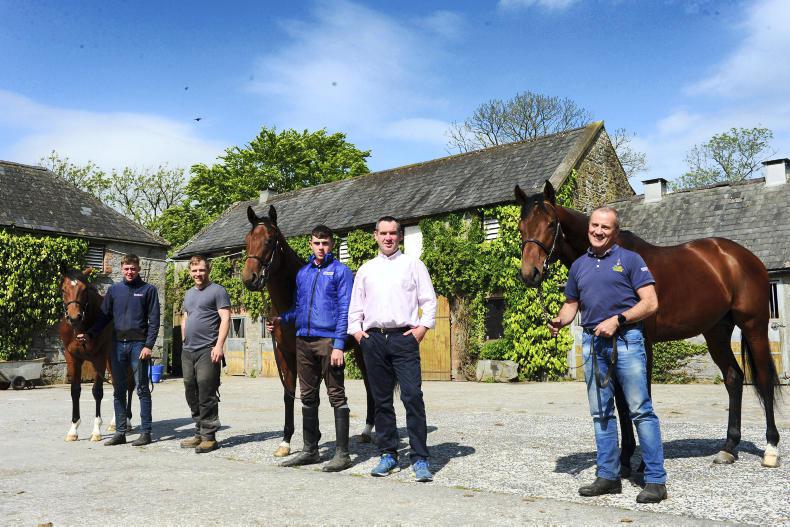
Johnny Hassett pictured with staff Patrick McLoughlin, Shane O'Brien, Evan McNamara and Dean Cawley and breeze up horses by stallions American Pharoah, Gleneagles and Candy Ride (all from left to right) ahead of this year's sales which were delayed because of Covid 19 \Healy Racing.
“Katie would usually be consigning store horses at this time of year but with everything pushed back, she had a window to help. She is very bright, she speaks four languages and she has invaluable experience from working for ITM. Cross that marketing nous with her own experience of consigning horses and she was exactly what I was looking for.
“We’re on Twitter and Facebook and the video blogs I’ve been doing have just taken off.
“Not long after we started, my phone started hopping. Now 75% of the calls were lads looking for money,” he says laughing. “The other few were lads I went to school with a few years ago that saw me on Twitter and decided to give me a call. Then the least few were people who saw the horses and were expressing interest but these soon turned into orders and we’ve now sold four horses and have orders for six more.
“And now we’re okay, we’re alive, we’re in business and we can keep going at least.”
Ballyhannon
Hassett is based in Ballyhannon House, Co Clare, the same base from which his father John L. Hassett trained Generosa to win at the 1999 Cheltenham Festival. By his own admission, he is the luckiest man he knows, to have all the facilities he has but it wasn’t always simple and he already has a fair tale to tell.
He explains: “My father was shrewd. A bit like Mick O’Toole, but not as big, but he would have paid for land with some of the gambles he landed. He was a vet and my mother was a doctor. I was the youngest of six and everyone in my family went to college and I failed the Leaving Certificate.
“I am dyslexic. At that time I was in school there was no awareness of it, nothing in place to help kids. My teachers thought I was either stupid or lazy and sure I believed them, as you would at that age.
“I actually did okay in my Leaving Cert but I failed English which basically means you failed the whole thing so it was worthless. The day after I got my results I got the Slatterys bus from Ennis to Waterloo in London.”
Hassett eventually moved back to Dublin and started working for his sister’s computer company, selling products. He moved to the California branch of the company and then got headhunted by another company over there. But having grown up in Ballyhannon, the draw for horses never left him.
“I used to go down to a trainer called Nell Study in Hollywood Park at the weekends, just to be around horses again really, back to what I knew,” he recalls.
“There was this drunk fella there that used to hotwalk. They called him Cowboy. He was the type of fella who’d have a bottle of Bud at 6am. Cowboy ended up getting cancer anyway and he had no medical insurance.
“I don’t know what it was but when someone is going to die, I guess their perspective changes and because they’re dying, you’ll obviously listen to them more. So Cowboy said to me one day: ‘Hey Irish, whatever you do on Saturdays and Sundays, you should do that Monday to Friday.’
“And I took him at his word and went back into racing. I started working for Todd Pletcher when he was just getting going in New York. I was there for six years and every year I was there, Todd would have doubled his winners from the year before. When I left he had become one of the leading trainers in America.”
Hassett came home to Ireland and began to work for Aidan O’Brien. He spent two years at Ballydoyle managing a yard of two-year-olds and then spent a year with Timmy Hyde. It was to satisfy his interest in the trading side of the game, rather than training.
The Bloodstock Connection
He set up his breeze-up business, the Bloodstock Connection, 14 years ago and that’s been his life since. As it happens, his main reason for starting his business may only come to fruition because of this current pandemic.
“The reason I called it the Bloodstock Connection was that I had envisaged that it would be an online business, a connection for people to buy horses who might not have before,”
Hassett explains.
“I’ve always felt that there are loads of people that want to go racing for whatever reason but unless you know somebody in the game, you can’t get in. You can buy a Mercedes online but how do you buy a horse?
“You need a trusted metrics system. The fella that buys a Mercedes can see that it’s a C-class, it’s 2020, it’s got 80,000 miles on the clock, it’s diesel, it’s whatever... You have known metrics, trusted metrics.
“Fair enough you might send a mechanic in to look at it but essentially you can buy that off a fella you don’t know with confidence. You can trust in the process. There has to be a connection you can trust - either the data or the person.
“Whereas traditionally at a breeze-up sale, say a horse breezes well and he gets vetted. At some stage before you get the money, the fella buying puts you up against the wall and says ‘listen John, do you like this horse now?’ You can tell him a lie but he’ll never buy a horse off you again.
“He might even be a fella who has never met you before and he has to analyse the situation himself, he’s looking at you as much as he is at the horse.
“That sort of thing can’t happen anyway this year. Necessity being the mother of invention, I think now is the time for this to develop online. The fella buying needs trusted metrics. He needs an official time, he needs the weight of the horse, the height of the horse, he needs a grade on his wind, a grade on his X-ray.
“We need a cookie cutter standard photograph of all the horses in the same place. A standard shot, a walkaway shot, a walk back video, a trot video to prove they’re sound. We can do stride analysis and heart rate analysis. None of that equipment is expensive, I have it here already. These are the trusted metrics.”
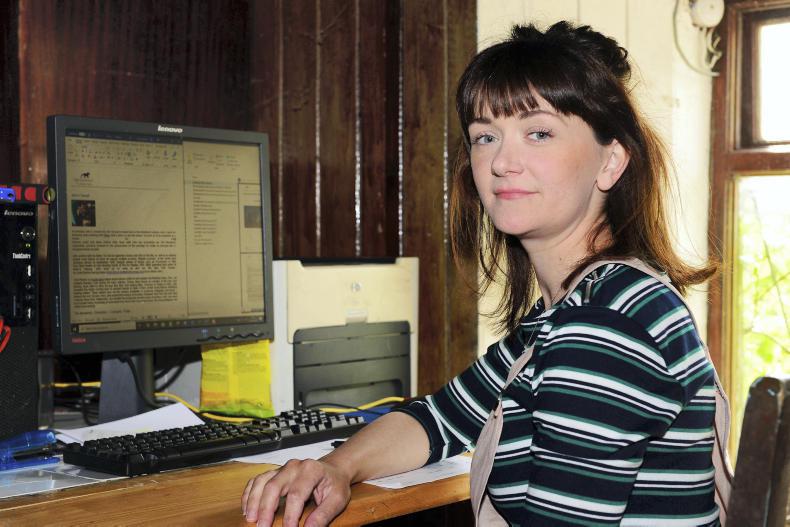
Secretary Sonia Millar is the "full back" at Ballyshannon House \Healy Racing.
Going well
Prior to this year, Hassett had been going well, like a lot of the established breeze-up group. By his own admission when he first started, he was buying horses that were breezing well, clocking well but they weren’t getting the results on the track. He had to up his spend and he has continued to do that.
This has seen him produce quality like Gallic Chieftain, a Group 2 winner over 13 furlongs in Australia, Pretty Baby a Group 3 winner for William Haggas and So Belle, placed in a Group 3 in America.
Having got on the breeze-up lift at a low level, he and the other main players have elevated it every year. He speaks passionately about his sector and everyone involved in it, where it has come from and the potential it still has.
“Not so long ago breeze-up men were near the bottom of the pile at the sales,” he says. “Like, if you had a yearling that no one would buy, you’d offer it to a breezer. But it’s different now, it evolves every year. We have produced results.
“We’ve had more two-year-old winners last year than ever before. We had 16 Group 1 horses last year. Traditionally breezers were fast early two-year-olds, like Ascot two-year-olds but we had two classic winners last year - the Preakness and the Prix de Diane.
“It goes back to what I said about the breeze-up person before - the first thing they do is put more money into them for next year. So the success has built up and up. Last year we spent 20 million. Mick Murphy outbid Sheikh Hamdan last year on a Siyouni.
“European breeze-ups are arguably the best product in the world. The Americans are really big into grass racing and they love that we have no medication and no steroids in the pedigrees and they are deciding to come more and more and buy breeze-up horses. Like Norman Williamson’s horse that won the Preakness (War Of Will), that was a big advertisement. The likes of Gronkowski as well.
“Last year’s crop were the best we ever sold and this year’s crop are a notch above them, at least on pedigree and price. I’d say there is serious value out there. I’d say we’ll get basically nothing for 50% of them. I’d say lads are going to get serious bargains this year.”
Upbeat
Hassett has a million euro worth of horses in Ballyhannon, by far the biggest amount he has ever had, during a once-in-a-lifetime pandemic that has left economies at the brink worldwide. But he is still able to refer to that Kipling quote and remains upbeat.
“The breeze-up market, it attracts a certain type of fella,” he says. “It’s high risk, high reward. If you look at the guys involved in it like Norman Williamson, Willie Browne, Con Marnane, Blarney Holland - if you left those lads on the North Pole they’d make it back alive.
“From January 1st, there is 100 days until the Craven and I don’t leave the farm. I don’t go to Cheltenham or go to the rugby or anything like that. If everything goes well, you don’t have a horse in the yard after that.”
That might not be the case this year but through Hassett’s own and his team’s innovation, he’s surviving and not breathing a word about the potential loss.“If I got a third of my money back and there is yearling sales to go back to, that amount is more than I started out with and now I have a team and I have clients and I’ll be fine.
“I have a brilliant team, I really have. I have two guys there from Southill in Limerick, Shane O’Brien and Evan McNamara. They’ve been with me since they were 16 and they’re brilliant lads. It rained solid for 28 days in February and they were wet from seven in the morning but they never missed a day.
“Stephanie O’Donnell is 20, she’s done two years of veterinary nursing. She is a top class rider, whatever she says you can take it to the bank. Pat McLoughlin is my head lad, he’s an ex-conditional jockey and, as it happens, he’s an excellent camera man. Dean Cawley is another hardy fella, anything with a door, wheel or gate he is charge of. Sonia Miller is like the full back in the office, making all the small but important decisions.
“We were going to make a fortune this year and it’s just a pity that we won’t get a proper chance to showcase what we have. But the wheel has to turn.
“You can do something with small money, but you can do nothing with no money.”