DARAGH Fitzpatrick is something of an outlier in the bookmaking field in that he is one of a handful of on-course operators making business pay.
Recent figures released by HRI confirm the continuing decline of the ring. Turnover of betting with on-course bookmakers is down 11.5% from €29.5 million to €26.1 million. That makes it most likely that the annual figure will be below last year’s €59.5 million, which would mean a decrease on turnover for an 11th consecutive year from €202 million in 2007.
This is alarming not just for the layers but for racing generally. The ring used to be a real attraction. What was once a hub of activity, the core of a race meeting, like a dance floor in the local nightclub, is now frequented by more empty crisp packets than punters.
ATMOSPHERE
The day of standing in the middle, soaking in the atmosphere of excitement and anxiety while the smell of sweat and tobacco wafts around, waiting to see where the action would unfold, earwigging on the hushed conversations, following the sudden rush towards a slightly generous price in the hope of piggybacking on what may or may not be good info, praying that the last forward lunge gets you on before the price was chalked off – like last orders in the aforementioned club – are long gone.
The upcoming Galway Festival is a rare opportunity to make hay but the numbers tell us that as things stand, there is no future for on-course bookies. Fitzpatrick says that he will do well. And while he feels he knows the reason for his success and that perhaps some of his colleagues would benefit from holding stronger opinions and not being led by the exchanges, he is anxious to improve matters on their behalf.
He was chairman of the Irish National Bookmakers’ Association while still in his 20s and has long been an ardent representative. Indeed he has been a member of the board of HRI since the beginning of the year and is chair of the betting committee.
Outside of business, he is a county councillor and enjoys that. His late father Michael was TD for Kildare North but he has no interest in pursuing a similar path. He enjoys what he does for a living too much.
Michael was a Garda who went to the odd meeting and brought his son with him. Daragh grew to form opinions and back them with his cash. At 18, took out a licence to stand at greyhound and point-to-point meetings. By his own admission, he was green. It was small scale stuff and he did a few hours in a local pub for some extra cash.
BETTING SHOP
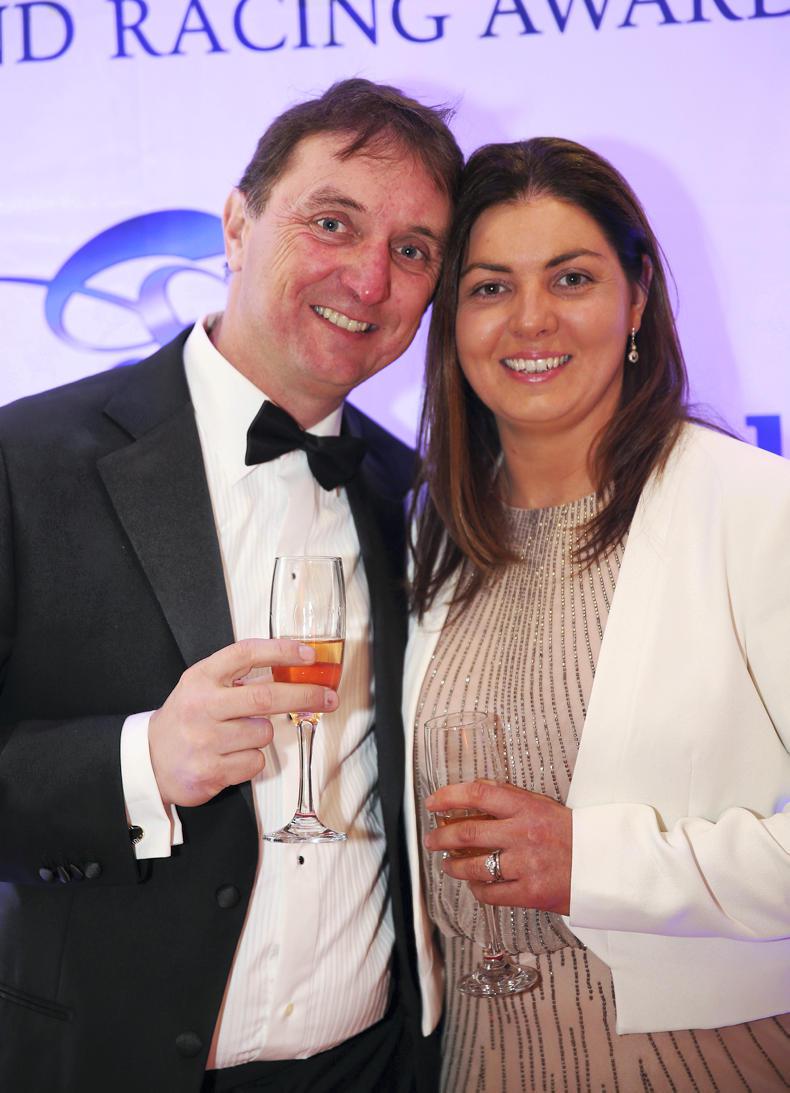 “The fella that owned the pub had a betting shop in Clane and he wanted to get out of it,” recalls Fitzpatrick in the kitchen of his home at Loughmore Stables. “He asked me was I interested in it. The price was £25,000. I had about 12 or 13 grand in the credit union. I went home to daddy and I said ‘What do you think?’ He said ‘You could do worse, take the chance’ and that’s where it all started.”
He was 20 and hadn’t a clue but Cill Dara Betting flourished. Shops sprouted up in Rathangan, Celbridge, Kill, Naas and Newbridge. He agreed to take on the latter over a pint and didn’t want to back down when realisation dawned that he couldn’t afford it.
“The estate agent says ‘I need a deposit for that unit of €26,000’ and I hadn’t got 26 pence in an account at the time. I drummed up the €26,000. But then I was thinking how was I going to fit it because it was huge, three and a half thousand square feet. But we started and got it done because I had built up a good reputation with suppliers and I was getting a good bit of credit, so I went on wings and prayers. The bank got me over the line in fairness.
“That was some shop. It was doing €160,000 a week. The very minute the doors opened it took off. It was €7,000 a week to run it, to pay the rent and pay the staff but sure I was covering it on my head. There were weeks there with that type of turnover where I was making 20 grand a week. Suddenly I had 14 shops.”
LADBROKES
His first contact with Joe Lewins was when the Ladbrokes managing director approached him to chair the new representative body they were starting for bookmakers. They wanted an independent operator for neutrality. Some time later, Lewins began increasing the Ladbrokes portfolio in Ireland and got back in touch with Fitzpatrick.
“I would have been happy to trade away but the way things worked out, I was probably lucky. It was 2007, right at the top of the boom. I’ll never forget the day they came over. I knew there was an offer coming – I didn’t know what it was but you have a figure in your head. There were two of them, Joe Lewins and Terry Leon and they looked at all the shops before meeting me at five o’clock.
“So Terry says ‘The figure is x’ and it was about three times more than I thought it would be. I couldn’t contain myself! And that was it.”
He stood for Ladbrokes for the next five years, renting out some of his own pitches to them, before parting ways. So he began to buy a few more pitches and now has a presence at most tracks in Ireland.
It is the festivals that get the juices flowing however and there are few more exciting than Galway.
In an interview in The Irish Times last year, Fitzpatrick recalled losing €70,000 when Ruby Walsh steered Oslot to victory in the Galway Plate. Such was the action at that time that he was still able to finish up on the day. That would not be possible now and he would not expose himself to that extent as a result but he is predicting a prosperous week nonetheless and will have 11 staff manning three pitches.
“I’ll turn over €600,000 next week,” he says simply. “I’ll do 3,000 bets a day. Thursday, we could click the 4,000.”
One of the main reasons Fitzpatrick maintains is that he will take substantial bets. Of course he is in business to make money and will always looking to avoid significant exposure, but he is not averse to risking losing to win. And he won’t stop taking your bets if you are a winning client. Rather than reacting to “the machine”, he studies form, gathers information from a list of contacts, makes deductions from what certain operators or insiders back and don’t back. And he prices up accordingly.
“I’m not going by what the exchanges are doing. I form a view.”
He believes that approachability and fairness are key aspects to prevailing in the industry.
NO CREDIT
“The name is there. If you back a winner with me, I pay out straight away. I take a bet. That’s a fierce bad perception for our game. A fella wants to back something and he gets refused. I like the banter but I’m discreet. We are building our private client business, which is run from the shop in Kilmeague, and confidentiality is a key element of that.
“If you’re having a bet, you don’t want the whole world to know. We’re trying to offer a unique service that you can ring up and have your bet, a proper bet and nobody knows anything about it. We’re only doing deposit accounts, no credit. We have good accounts and we’re trying to build it up.”
He is passionate about trying to help the industry as a whole and is lobbying hard for the reduction of pitch fees. At present, bookmakers pay five times the general admission fee but though this has not changed in the past decade, turnover is down 64% from 2008 to 2017. It doesn’t take a genius to work out that such numbers will lead to casualties and while the market will always dictate, there comes a point where it becomes clear that something needs to be done to arrest the decline before the profession joins the dinosaur and the dodo in extinction.
FLOURISHING
How is it that he is flourishing in such a climate then? Is it primarily because he won’t turn anyone away?
“I’d say it is. There’s no race meeting I’d go to that someone doesn’t have €1,000 quid on a horse. This year, there haven’t been too many very big ones. I laid a 30,000/10 on Melon in Punchestown.
“That was probably the biggest bet I laid this year. I laid an even 10,000 on Saxon Warrior in the Curragh on Derby day. They’re the two biggest bets I remember laying this year. You always remember laying the big ones.
“There’s a couple of good judges in Ireland at the moment. I think you’re better off to face your punter than to blind him. If you blind a punter, he’s liable to send somebody else with the cash and people will be following him in to see what he’s backing. You’re better off to have them ringing you and nobody else knows.”
And if they have a winning record, via their own knowledge, contacts or being directly involved, you are getting an immediate steer.
“Exactly.”
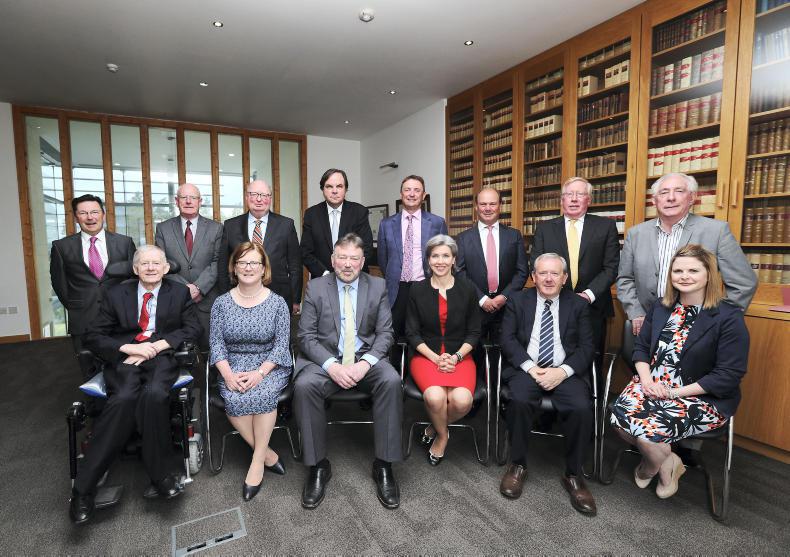
Nicky Hartery, centre, seated, incoming chairman of the board Of HRI with board members, standing: Peter Nolan, Robert Nixon, Christy Grassick, Harry McCalmont IHRB Senior Steward, Daragh Fitzpatrick, Michael Halford, John Moloney and James Gough. Seated: John Powell, Meta Osborne, Nicky Hartery, Elizabeth Headon, Bernard Caldwell and Carol Nolan Photo.carolinenorris.ie
CONTENTED
Fitzpatrick cuts a contented figure, and not just because business is good. His wife Kitty gave birth to son Michael last October. Michael made his first visit to the track at the Punchestown Festival in April. It won’t be his last.
Kitty is a bloodstock trader, primarily pinhooking foals for the yearling sales. Being pregnant curtailed her activities for outside clients this year and so she is prepping nine of her own but will build that back up again at the foal sales. She recently prepped some stock for the Derby and Land Rover Sales but for now, the focus is on a quartet of yearlings bound for Doncaster and the quintet earmarked for Fairyhouse.
“She has no background in racing either. She’s from Limerick city! But she worked for Peter Molony in Rathmore Stud for 10 years and learned her trade there. She always does well at the sales anyway.”
With Kitty and Michael spending a couple of days with Kitty’s parents in Limerick, it is time for Fitzpatrick to collect a couple of horses that were getting a bit of educating from Katie McGivern and her team at Derryconnor Stud. He is in relaxation mode before diving into Galway and is like a child before Christmas thinking about it.
Despite all that though, he is cognisant of the big picture and resolves not to take his eye off that particular ball.
“I think we can’t leave the small man behind us. We have to bring him through. There would have been huge pressure on me to move with the bigger lads on the racecourse but I’m staying. I want to progress in my business but I want to help the ring too.”
For the good of racing, you would have to hope he succeeds.
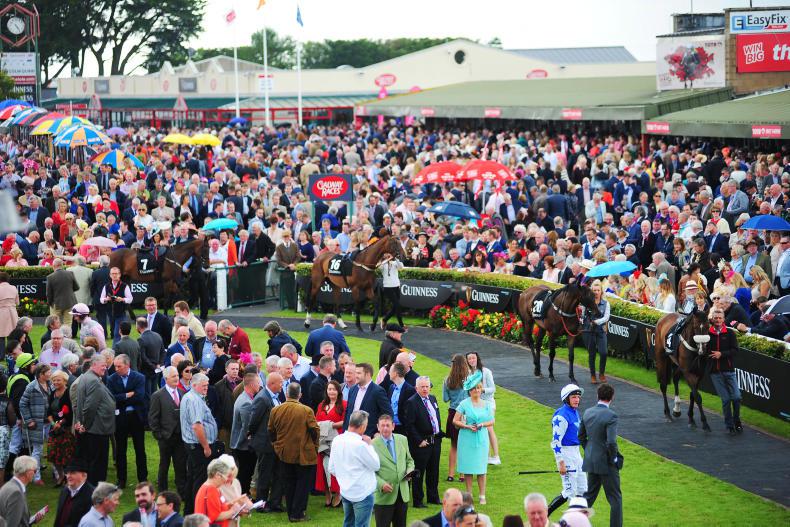
A packed parade ring and enclosure on Galway Hurdle day last year Photo Healy Racing
SMALL MAN
“It’s bleeding the small man. I didn’t go to Killarney myself but I sent the lads for the five days. On one day, three of us turned over 50% of the ring. Three of us turned over €35,000. When you take in how much it costs to stand... That model doesn’t work.
“I’m on the HRI board and I hate to see the small man failing in any game so I’m trying to put up a case in there to get the fees reduced.”
In 2007 there were 210 permit holders. That was down to 96 last year.
“And that’s well down below 90 now,” says Fitzpatrick.
The bookmakers have made proposals to the Association of Irish Racecourses in a bid to improve matters. Included is the issuing of free betting vouchers, €10 match bets at all festivals, the placing of a large television in the ring detailing each bookie’s terms and conditions, an offer to sponsor a meeting.
Another proposal was to reward bookies that attend meetings regularly, particular on industry days, by reducing their fee from five to three times the general admission. The NBA has lobbied for the 25% turnover charge to be dispensed with but there has been no progress so far.
As well as he is doing personally, he is anxious to expand what he can offer at the track.
“I’m itching to do a few things at the moment within the ring but technology is stopping me in some instances.
I want to take on the betting shops. I know the betting shop game inside-out but I’ll have to look at software more closely. I’d be looking at providing specials and the likes. I just think the betting ring in its current state is probably a little bit stale. We’re concentrating too much on win and each-way markets. I think we need to think a little bit outside the box.
“We definitely have to do double result on the racecourse. I wanted to do SP or better (best odds guaranteed) in the future. It would be fairly costly – it’s about one and a half per cent, could be up to two, but it would rattle my turnover up.
TECHNOLOGY
“So I’m talking to my software people on that now. I’m after spending a good few quid investing in pitches over the last couple of years so I think this year we might spend a bit on the technology to take it to the next level.”
That, he hopes, will encourage his colleagues to act likewise. And a revolution in terms of what is available to the punter at the track may encourage people to go racing, which would be a positive for the wider industry.
Fitzpatrick likes the proposal of Naas chairman Dermot Cantillon on these pages that a 2.5% tax be placed on all winnings in shops, and that it is ensured the tax is passed onto the punter and not assimilated by the major operators, so that independent shops don’t suffer and the punter feels the difference.
Cantillon then suggests that there is no tax on cash bets in the betting ring.
“That would help hugely. There’s no doubt the ring would come back if the shops were made charge the punter. If you’re going racing, you’re paying no tax. And that would make going racing attractive.”