THE first Cheltenham bet I remember placing was in the 1982 Sun Alliance Novices’ Hurdle, the race now known as the Neptune. I can see the betting docket from Noel Cummins’ shop in Dungarvan clearly now in my mind, my father’s handwriting scribbling the details.
Mr Donovan - 10p e/w.
Ever the big roller, though to be fair, I was just 10. The Edward O’Grady-J.P. McManus combination had always fascinated this young mind so when I was invited to make a few selections, it was a no-brainer. Who cared that Mister Donovan was still a maiden? Not I, if I even was aware of the fact. Nor, it seemed, were the connections too concerned, as the gelding went off a 9/2 shot.
“By the time J.P. was finished with him he was (almost favourite),” chuckles O’Grady in the kitchen of his home at the picturesque Killeens Stables in Ballynonty.
Tommy Ryan drove the six-year-old up the hill to a rapturous ovation, getting what would become a McManus juggernaut under way with the owner’s first Festival success. It was a repeat for O’Grady and Ryan, who had combined to win the race two years previously with Drumlargan.
O’Grady had been a four-time champion trainer already by that juncture, from 1977-1980 and was still only 31 when Mister Donovan did the business. Yet he was a 10-year veteran of the game, having taken over the licence when his father Willie passed away in 1972. He would go on to build up a magnificent CV of success on both sides of the water, including 18 at the Cheltenham Festival.
Remarkably, he managed to re-establish himself as a force over jumps having turned his attention to the flat sector for a decade and if Killeens is a little quieter now than in its heyday, it still houses talent and the boss remains as hungry as ever to unearth the next champion.
***************
LIKE most of us, O’Grady watched events unfold at Chantilly last Sunday with astonishment, as Aidan O’Brien created another slice of history to saddle the first three home in the Prix de l’Arc de Triomphe.
In an interview he gave 21 months after Mister Donovan’s Cheltenham win, O’Grady revealed that his major ambition was to train the winner of the French highlight.
“That was a dream and will remain a dream. It’s just a phenomenal race. What Aidan did is just extraordinary, absolutely outstanding. It was just wonderful.
“Yeah” he says wistfully. “One is allowed dreams and it would be the race one would love to win. It’s probably not very practical but it’s still a nice dream.”
In recent years, O’Grady and his wife Maria have turned their hand to breeding horses. Maybe if they don’t train an Arc winner, they might breed one.
The Richard Hannon-trained Law Enforcement provided them with a Group 1 victory when claiming the Gran Criterium at Milan four years ago but disaster struck when the dam Broken Spectre died three months later.
“A lot of people spend their lives trying to breed a Group 1 winner and we did. Sadly we didn’t get the benefit. It’s more an interest really for the two of us, as a couple to do together. We’re striving to get a nice mare. The mares we have, have bred winners but apart from the one that struck gold, we’re still digging.”
Fair Game and Bouquet Garni are two of the current homebred residents, while The Real Article was the most successful in the National Hunt sphere, winning two Grade 2 contests among a total of 11 victories.
Training remains the focus though and there is no cessation in the urge to compete at the highest level, even if O’Grady doesn’t travel every inch of the country like he used to source the potential.
The year has been quiet but he has had eight wins from just seven runners on the flat - Fair Game, Le Vagabond, Roconga and Prickly dividing them equally between them. Over jumps, four of his 12 runners have prevailed including Roconga and Le Vagabond, the tally completed by Sound Money and two-time victor Time For Mabel.
“I’ve never considered it work. It’s what I do but I suppose at the moment it has never been so evident that a stable needs a star. There was the extraordinary statistic where last year, you had Criquette Head with the mare (Treve) going for the third win in the Arc and yesterday (Sunday) she trained her third winner of the whole season. It was a Group 1 winner but the vagaries of training horses are such… I mean that is an extraordinary statistic.
“I suppose it just shows you that that’s the way the business is. We never like to dwell on these things but that’s the reality.”
Having housed in excess of 80 in the glory days, Killeen is now home to about 30 winter horses.
“I’ve been doing a Claudio Ranieri-type effort,” he explains, referencing the manager of unlikely, shoestring-budget English Premier League champions Leicester City. “Buying horses from the lower divisions and trying to get them to run in the Premiership.
“Over the last couple of years there’ve been a couple of horses that have been lucky.
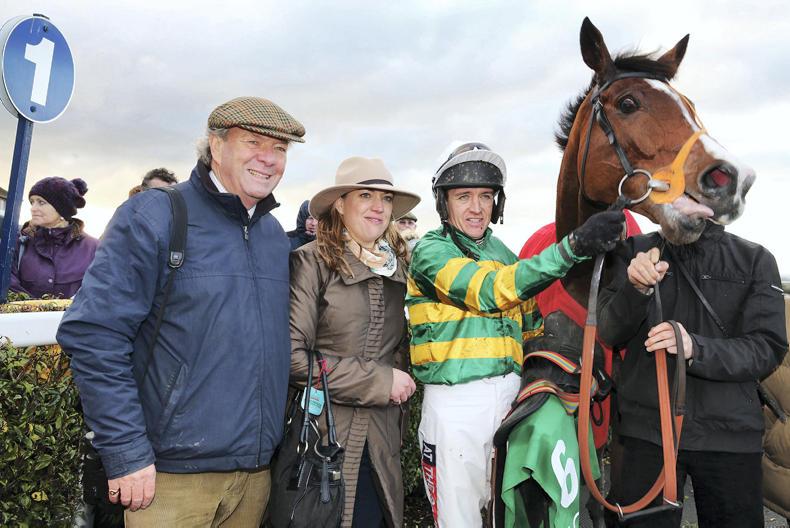
Edward O'Grady with daughter Amber and Mark Walsh and Kitten Rock
Kitten Rock has come through and he’s more a winter horse and this summer we’ve had Time For Mabel and Le Vagabond. Sound Money won his maiden in Killarney and All Souls is probably the best-bred horse I’ve ever had in the yard as his dam (Altruiste) is a half-sister to Urban Sea.
“I bought him for small money in France. They’ve come through remarkably well but that’s the sort of game we’re playing. It’s a tough game but the one we must play.”
He has nothing but the height of respect for the success enjoyed by Willie Mullins and Gordon Elliott, and for the way they can operate such a scale of operation. Racing has always had dominant figures but the difference nowadays, O’Grady argues, is not with the trainers.
“I think going back you had owners that were loyal to a stable whereas there are a number of owners now who are a bit like bees. They like to go to the flower with the most pollen. Definitely it has become a little bit of a fashion industry.”
“Daddy is still the best racehorse trainer in the world,” interjects youngest daughter Rosie May, but Daddy carries on.
“It’s whoever whoever’s wearing the mini-skirt at the moment seems to be the place to go. That seems to be a phenomenon that’s not only part of racing. It’s probably just the way the world is today. That’s why it’s important to try and have a flagship horse to keep the show on the road. Once you have the flagship horse, it’s a bit like the honey, you attract more bees.
“One must always try turn adversity to your advantage and the fact that some of those stables are getting very big, a lot of smaller owners are now becoming the fourth and fifth fiddle. Consequently there’s a fair chance that some owners will prefer to go to a more intimate operation where they wouldn’t be in competition so much to either have a runner or to win a race.
“I would like to think that with the experience I have, I am more qualified now than I ever was to train good horses. It could be good for the smaller owners and good for the smaller trainers.”
BETTING COUP
Without a bona fide money-spinner, trainers and owners must find other ways to make their involvement pay. Charles Byrnes landed a successful betting coup at Roscommon two months ago that received plenty of publicity, and a debate raged subsequently on whether or not it was good for the image of racing. Plenty of O’Grady’s owners have been known to land a punt over the years and it is no surprise that the Tipperary man sees it as a necessary part of the game.
“We went through a period in the 1990s where owners were starting to run their horses more for prize money than for the punt. It raised the standard of the races I would say.
“But right now, if you haven’t got the horse that’s capable of winning that big prize, there’s only two ways of doing it. Number one, you’ve gotta maybe have a sale, or number two, if you could, have a punt. But today, with communications, I admire anybody who can perform on the racecourse because everybody seems to be there before one gets out of bed!
“Any fella who makes a few quid at this game whether it’s punting or selling, I take my hat off to them because it’s not easy.”
**************
HE was 23 when he took over as a trainer, leaving college where he was studying to be a veterinary surgeon.
“I would have preferred to qualify and perhaps go to Australia, go to America and eventually come back but sure life doesn’t treat you like that. You go from a £300 student overdraft to a situation where you’ve a widowed mother, a wife and employees all in one week. You just have to get on with it.”
He had spent time with Pat Rohan and Michael Stoute, and been a part of the fabric at home so he was by no means clueless. Having people like Tim Finn around helped too.
They possessed around 18 horses initially and had six winners in the first six weeks. But then a broodmare got rhinopneumonitis and before long, he had nothing to run.
Displaying the determination and nous that would serve him well over the next 40 years and more, he rebuilt the team and powered on.
Mr Midland provided the first Cheltenham Festival victory, with Mouse Morris on board in the 1974 National Hunt Chase, and he was the man to follow until suddenly announcing a new departure by turning to the flat.
“It was a time when farmers went through a very bad period. At the end of the 1970s, interest rates went very high. I had a lot of farming owners and they couldn’t afford to keep horses. So it seemed a sensible thing to do. We were the first people to get involved in syndicates and while our numbers were small, it was financially rewarding. There were very good sales. We sold horses to Australia, America and South Africa.
THE BUZZ
“The winners were fewer and after a decade of it I suppose I missed the buzz of winning more races so we went back to jumping in the 1990s. The first year back (1994) we had a double in Cheltenham with Mucklemeg (Champion Bumper) and Time For A Run (Coral Cup) and it went from there again.”
Sound Man, Ventana Canyon, Nick Dundee, Ned Kelly, Sacundai, Back In Front, Sky’s The Limit and Tranquil Sea were just some to land the elite prizes in Ireland and England. It was like he had never been away.
O’Grady had never been afraid of hard work. This, after all, though you’d never believe it from looking at him, is a man who played at loosehead prop on a Blackrock College team that won a Leinster Junior Cup! He has bided his time and has plenty to look forward to.
“I think, potentially, we have the makings of something good. We had an extraordinary year last year in that I ran Kitten Rock on January 2nd in Naas and he came in lame. And I had no runner from January 2nd to February 28th, which for a National Hunt yard at that time of year is an extraordinary statistic.
“And the reason I didn’t run them is because I had young horses. We had a frightfully wet January and February. I trained them but I didn’t gallop them. I didn’t want to tear the guts out of them. Some of those horses ran in bumpers and point-to-points in March and April. The fact that they hadn’t done a tremendous amount in January and February, they weren’t really wound up when they ran and I would hope that horses like that will come through.”
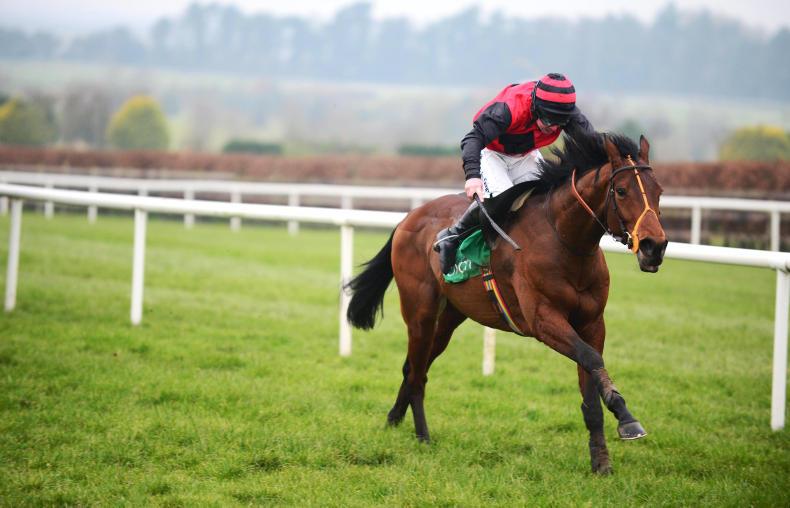
All Souls - "probably the best-bred horse I’ve ever had in the yard
Orchestral Run ran at nearby Horse and Jockey last March and won by 20 lengths. The second-placed Middlebrow has won a bumper since, while Field Marshall, who was third, won his maiden by 10 lengths. Meanwhile, Rainy Day Dylan, who was pulled-up, also bagged a bumper so the form has worked out spectacularly well.
Nerano is a big 16.3hh Milan horse who finished third in a bumper at Punchestown when clearly green and is another exciting prospect for the future.
Then there’s Allardyce. They were delighted with the name they had chosen for the Black Sam Bellamy four-year-old but will be hopeful he has more fortune than the former England manager. After finishing second in a Limerick bumper, he ran sixth in the Land Rover Bumper and is clearly promising.
O’Grady is short of novice chasers but is willing to be patient until the three aforementioned come through, among others hopefully. Apart from those, there is also Kitten Rock, for which he has no immediate plans.
“He hasn’t been beaten very often. He was beaten in his chase (when he finished lame) and he was beaten in the Champion Hurdle. The way the Champion Hurdle worked out, on another day he could have been closer. Ruby dictated the pace well but he probably could have been closer. Hopefully he’ll come through to be top class.”
Another O’Grady-McManus assault on Cheltenham?
Count me in.
EDWARD O’GRADY ON...
STAFFING
“Since the Department have put an embargo on bringing in the Brazilians, it has made life very difficult. Irish guys are the best horsemen but they tend to be heavier and to have high expectations in terms of getting rides and that sort of thing. I think it’s time they looked at it again to allow people in, be it from South America or wherever. There is definitely a staff shortage at the moment, which is a problem.”
BEST MEMORY
“One of my best days racing was actually winning the Whitbread Gold Cup (in 1983) because I think only one Irish horse had one the race officially before then and that was Arkle (in 1965). I just got a tremendous kick out of that race. Drumlargan was ridden by Frank Codd, an amateur who was with me here at the time. It has changed since but you had the top flat racing there at the same day and there was an enormous sense of occasion. That was definitely a very memorable day.”
GOLDEN CYGNET
“He sadly was the James Dean of racing. Obviously I’m biased but I’m convinced that he’s the best hurdler there’s ever been. He was just an extraordinarily fast jumper. He was also extraordinary in that most horses travel well early in a race and at the end of the race they tire. With him, the slowest was the early part of a race and he always seemed to travel fresher at the end of it. He was just a phenomenon. He used to come alive, as if he had just jumped in at the seven-furlong pole. He was pretty unique.”
BEST JOCKEYS
“I was fortunate to have some very good jockeys but they’re all different. Charlie Swan and Norman Williamson were brilliant stable jockeys. Richard Dunwoody was just a phenomenal man for the big day. They’re the three that stand out. I’m very fortunate in more recent years to have a great association with Barry Geraghty, who rates right up with the whole lot of them.”