THEY transformed a bankrupt, rat-infested venue with no roof on the saddling boxes, to a Grade 1 track selected by National Hunt trainers as the ideal seasonal or career starting point for a plethora of jumping stars, but from January 1st, the progressive management team at the reigning racecourse of the year, Down Royal will no longer be in place.
In the context of the 333 years of the not-for-profit Down Royal Corporation of Horse Breeders organising racing in Northern Ireland, Jim Nicholson’s 26 years as chairman and Mike Todd’s 22 as manager is brief. Yet their impact has been spectacular.
With the terms of the DRCHB’s lease with owner Merrion Property Group at an end and all legal avenues exhausted, they are surprisingly sanguine, committed to running another hugely successful Festival of Racing on Friday and Saturday, where Samcro, Coneygree, Don Poli, Balko Des Flos, Shattered Love and The Storyteller are just some of the potential participants.
They are also committed to a clean handover, to having their pride and joy in pristine condition when the new regime takes over.
DRCHB had 104 years of racing under its belt before settling at the Maze in Lisburn in 1789. It will be a wrench to move on but move on they will and they are already actively looking at sites with a view to creating a new custom-built track from the ground up.
Jim Nicholson is the hugely successful wine merchant who has sponsored the JNwine.com Champion Chase since its inception in 1999. The 20th year will be his last. He is in thrall to horses and owns the consistent and tough Group 3-winning filly I’m So Fancy. He was on the board of HRI for more than a decade, is a former chairman of Tote Ireland and chaired the Strategic Marketing Group that produced an in-depth report on growing attendances at Irish racecourses in 2011.
Mike Todd is a former amateur jockey who rode his first bumper, hurdle and chase races at Down Royal. His grandfather, Matt Magee, bred and owned dual Champion Chase winner Skymas. His mother was a trainer. He is a motorsport enthusiast who began driving competitively at 50 and won a Formula Ford championship.
I met with the pair at Belfast on Monday.
Daragh O’Conchúir: So how did the relationship break down?
Jim Nicholson: I’ve always had a very good relationship with Mike Roden; he’s always been very courteous. We’ve never had an argument. We tried to concoct an agreement that we would continue on the track. We did everything we could in terms of purchase offer, in terms of rental potential, so we’ve no recriminations from our committee and our corporation.
Mike Todd: When I came in, Jim pitched to Down Royal that by the year 2000, we’d want championship racing. But we were starting from position zero and it’s been a hell of a journey. I’ll never forget the night before the press launch, we’d no sponsor for the Grade 1 race. Jim had to step in and he’s still there. Ten of our 18 sponsors are there 10 years or more. So the level of loyalty – it says a lot because it’s not all about the money. It’s very much about, we had an opportunity to position the festival as one of the best in the British Isles and we’re very enthusiastic about that. We were very happy to win racecourse of the year. That was a tremendous accolade and it was thanks for everything everybody has done. We have a brilliant team. Teamwork makes the dream work.
The last six months have been completely horrendous but now I’m reflecting on all we’ve achieved because I’d never actually thought about it before, you’re always looking ahead. Then you reflect on the first time Paul Nicholls sent over See More Business – okay he was 12 but he came over, raced with us and look at his CV. He was some fella. And then that started the Paul Nicholls run as a trainer before Gordon Elliott took over that mantle.
DÓC: Are you confident about the future of racing at the track after you leave?
JN: All we can do is leave the course in pristine condition, leave everything ready for the next team to come in and it’s in the hands of HRI now. I hope there’ll be a sign-up to maybe 20 years’ guaranteed racing. It’s very hard to look beyond that but 20 years seems a good amount of time to guarantee. I think the racing public, trainers, owners and sponsors would look favourably on that guarantee.
DÓC: Meanwhile, you are looking at a new track.
JN: We’ve seen two sites, one which is too close to Down Royal and clearly there is no advantage in having a racetrack beside a racetrack. The site we’re looking at this week, we’re quite excited by. We’ve an agent appointed and that will be fed out to 20, 30 people in the property business, just to see what’s out there. We’ve set criteria of what’s required.
DÓC: Will you have HRI support?
JN: Until we have the land secured, that’s the point then to talk. There’s no point talking hypothetically. I think the model is changing and we would view that there are four or five other stakeholders involved in that kind of business. Running a racecourse for 10 or 12 days’ racing is a very hard model to sustain going forward and given media rights issues coming down the line, it might more so.
DÓC: How is the Festival looking?
MT: Our ground is in lovely nick at the moment. It’s good all over. The advance ticket sales for the Saturday are really strong. I’m struggling to squeeze people in but we always can squeeze them in! It’s a day we always look forward to. Everything that we do is all about this meeting. If we just ran 12 industry days a year – who wants to buy into that? In my world, it’s all about the Festival.
DÓC: Was it challenging growing racing in the North given the political climate?
JN: Northern Ireland is a zombie state now. There’s no-one in control. They’re even handing over some of the responsibility to the civil service now, bypassing the democratic process really. And you have Brexit coming down the line. It’s incompetent and incoherent. That sums up the political process.
MT: Or lack of it. There has never been any political support for horse racing.
JN: One of our big issues was that our Racing Fund (paid by Northern Ireland’s Department of Agriculture and Rural Development from contributions by bookmakers), by agreement of the bookmakers, was to be increased during the last two or three years. So we’ve lost somewhere in the region of a million pounds of funding simply because we don’t have a government. And while the Sinn Féin minister, Minister (Michelle) O’Neill, put the proposal forward, suddenly there was an election and then the DUP decided to put the blocks on that decision.
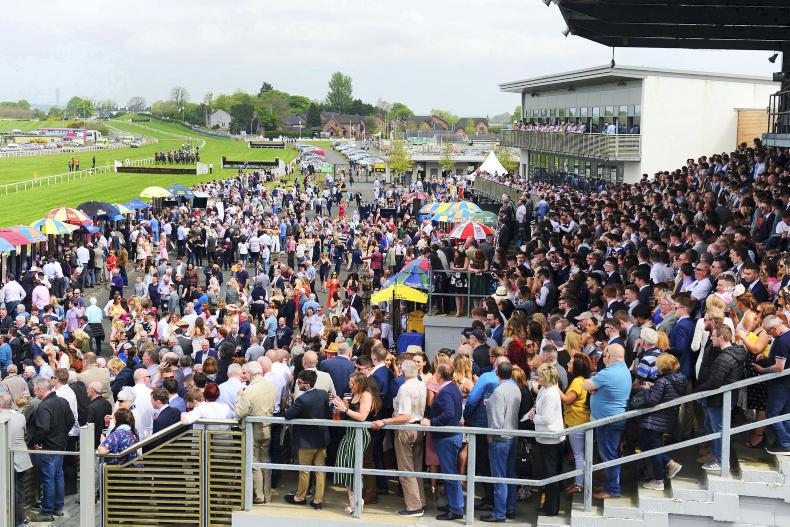
Packed stands haven't been uncommon at Down Royal Photo: Healy Racing
DÓC: What has been your relationship with HRI over the years?
MT: Jim was on the board of the HRI a long time and that made a lot of difference to how they treated us. The relationship when you were on the board was fairly good.
JN: I like to think there’s two types of board. There’s a compliant board and there’s a strategic board. I could see in my last two years on the board, the compliance became more relevant than the strategy. My last act when I left the board was to write to (HRI chief executive) Brian Kavanagh and say: ‘I think you need to have a very strong strategic review. My feel is you should bring all the stakeholders together. The industry is developing into difficult positions with trainers, with owners, right across the board and I found it very helpful when we brought all the stakeholders into HRI.’
MT: Strategically, I think racing, in a number of jurisdictions now, is in need of help. The industry in several jurisdictions need to look at what they’re doing. When you have maybe 90% of trainers not making money. It’s guys who love horses, love training horses. It’s all they know, all they can do and they can’t make a living out of it. That’s a problem. The industry needs to have a look at how they can support the small trainer, who’s probably driving the box, riding out, he’s doing everything. Racing is very fortunate to have so many passionate, engaged participants. But it’s how you support those guys.
Some people say the big owners are a problem but I don’t think they are because they’re putting a lot of money into the sport, which creates a lot of employment, creates secondary employment. It creates a whole service sector as well.
DÓC: You mentioned media rights earlier.
JN: That’s the biggest difficulty coming down the line. Okay, you’ve got a 2% increase in betting tax in the Republic but whether a 2% tax is a panacea, the jury is out. The biggest threat will probably come from the Fixed-Odds Betting Terminal reduction in the UK from 2020. There’s already a sign, a lot of those shops are closing down. There’s a floor which will affect the media rights immediately. If that floor goes below a certain level, then the media rights actually revert to where they were going back four or five years ago. I would argue that you might even see a decline of up to 50% in media rights, which would automatically put a lot of tracks out of business.
DÓC: Are we going the right way about increasing attendances?
MT: We’re about racing. Why should we be embarrassed about what we do? Horse racing is a theatrical sport. It’s a real attack on the senses for people who have never been racing before. It’s five minutes action, 25 minutes interaction. So unlike Gah (GAA), rugby, or football, where it’s a game of two halves, there’s lots of opportunity to interact and be social with your friends and people you’ve just met. It’s a very unique environment and I think that’s what we should be capitalising on. Not be embarrassed about what we do and we have to bring something else in to make it appealing to other people.
JN: I would argue that there has been a bit of asset-stripping of Friday nights. From memory, Kilbeggan, Cork, Leopardstown and Down Royal have lost four Friday nights to the Curragh. I’ve been down the M50 too many times to mention on a Friday night. It’s a parking lot. So how you’re going to migrate the racegoer, I don’t know. You should get the locals but on that Friday night, we had 4,000 people, corporate completely sold and that’s gone.
DÓC: Will the replacement Saturday fixture be of any benefit?
JN: Waste of time.
MT: Saturdays don’t work because if it’s not a feature day, nobody’s going to give up their game of golf or what they normally do on a Saturday.
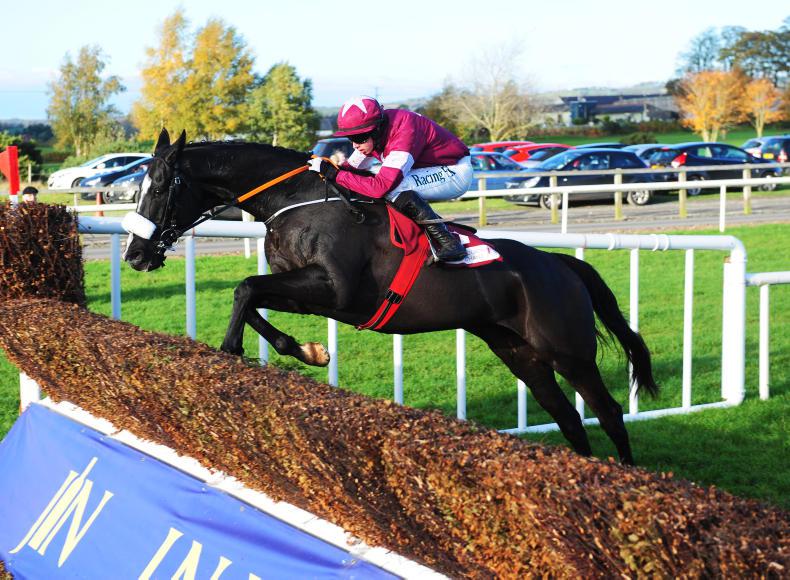
Don Cossack took the JNwine.com Champion Chase Photo: Healy Racing
DÓC: Was there any consultation?
JN: You’re not getting it anymore. That’s how it was sold.
MT: We wrote, detailing why it would cause us a problem, the impact it would have on our attendance and corporate customers. The decision was already made. I went to Sandown, I went to Kempton and had a look at the London tracks with how they worked with their racing on Thursdays and Fridays. The key thing is you need to be beside a centre of population. You need infrastructure and access, which means you don’t have to drive.
JN: When I was on the board, I said it was absolutely crucial that the train stops in the Curragh. That’s your one game-changer. There’s a railway site there. You have your race-day, race-night special. You have injured jockeys on the train, guiding people in the carriages through the card.
I’ve had a runner in Newbury, had 10 people come from London, they just walk across the track and walk back. Ascot. Cheltenham to some extent. Windsor. That’s the game changer. I was told the train stops in Newbridge and Kildare and that’s enough, but you still have to get the bus. And when you get out of the track you have to get a bus. I pleaded with the board and they said it would cost a couple of million. I said ‘Well, it’s the cheapest couple of million you’ll ever spend. You’ll get it back in a year.’ Three years ago. Before there was even a brick on the site I said ‘That’s the change.’
DÓC: The Curragh will look spectacular. How will they get people to come?
MT: The Curragh has the best racetrack and surface known to man. It’s class. Pat Webb has done some job. I went down and walked it last year with him. It’s class. No wonder it’s the home of the Irish Derby and the classics.
JN: I’m sure they have a strategic programme. I’m sure they’ll be launching wonderful initiatives and I have no reason to doubt that it would be successful. Why wouldn’t it be? It’s a lot of money. And as you say, it’s a fabulous track. It will be something that if all other racecourse managers go to, it should lift all the boats. Every manager is going to come back and say ‘Why don’t we do this?’ We had a few ideas, was it from York, Mike? There’s nothing wrong with pinching a good idea. We’re not advising the Curragh what to do. There’s a few ideas like the trains… There is presumably a lot of bright guys there, bright shareholders. They won’t be short of good people.
DÓC: What are your best memories of Down Royal?
MT: Kauto Star was probably the most successful horse since Arkle. That’s where he fits into the overall picture of the world of national hunt racing and he came and won twice with us. And he won with us and went on to recapture the Gold Cup crown, after losing it for a year. And the fact that Paul Nicholls had the confidence to send that horse over to us. Don Cossack was the most gorgeous horse ever, the most beautiful looking horse. His build and his markings. Him winning and going on to win a Gold Cup.
JN: My best memory was the first horse I owned, when I was 24, Wine Merchant winning the bumper by 12 lengths, ridden by PJ Finn, trained by Dessie Hughes. I think it was Dessie’s second year in training. My brother and his partner owned a restaurant and hotel which I worked in for quite some time. They had so many horses in training and point-to-pointers. I swore I’d never get involved. Of course I had a few too many beers one night and I bought this horse. He won by 12 lengths. He was 1/2.
MT: Somebody backed him!
JN: It was a double-edged sword because one of the committee said to me, I think you should join our committee at Down Royal. And now I’ve managed to close the Corporation down!
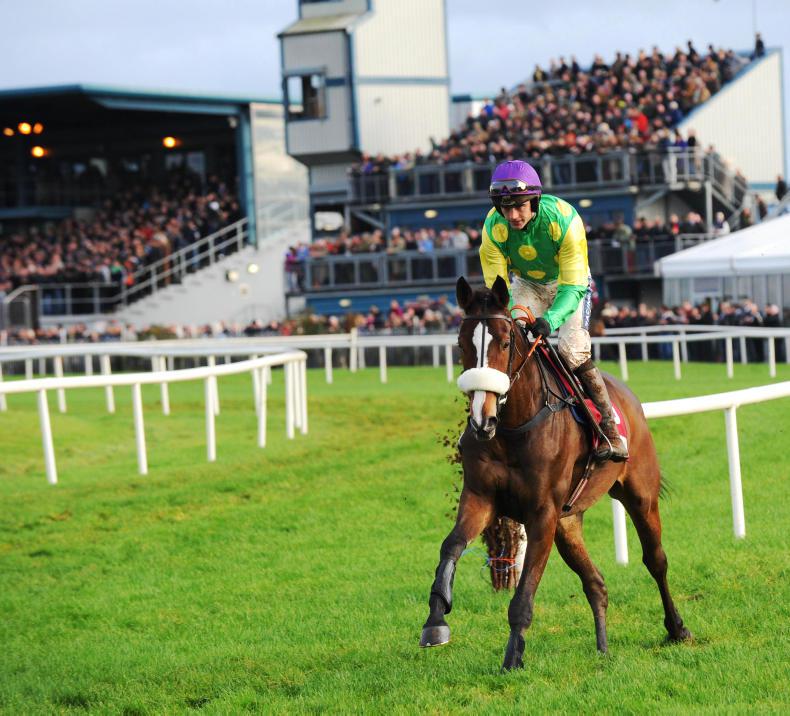
Kauto Star came over and won the JNwine.com Champion Chase twice at Down Royal Photo: Healy Racing
DÓC: Not quite, but it’s good to be able to see the humour in it I suppose.
JN: There’s no belligerence in our attitude. There’s no ill-feeling.
MT: It is what it is. The landlord wants it back for his own use. We had to exhaust the process as a responsibility to the members, the committee, the very spirit of the Royal Charter. We did that and when we were told that we had gone as far as we could go, we withdrew from the process. At the end of the day, nothing stays the same forever. So I just want to reflect and say ‘Look what we’ve done.’
JN: We wanted to go from where it is to be something a lot better. We’re always looking ahead. Our next move was to demolish the Blue Stand. We had a £1.5m project already organised. Architects had drawn the plans.
We’d be very happy to pass those plans on.