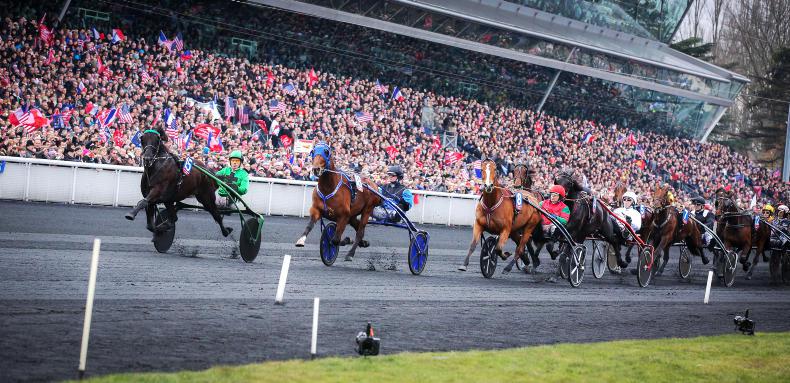
In the run up to Europe’s greatest trotting race on Sunday, January 27th – Dan Carlin looks at the career of an intriguing Irishman who rubbed shoulders with the aristocracy of Europe from the early days of the century to the early 1960s.
CHARLIE Mills (1888-1972) won this most sought after prize on the continent (the Prix d’Amerique) once as driver and trained the winner four times, amidst a life full of drama and high living where the one constant was perfect preparation of the equine stars in his famous stables.
It should come as no surprise that the island which has given the world so many top jockeys and showjumpers would also produce the most talented and talked about trotting driver in all of Europe in his lifetime, one Charlie Mills.
From the heady days of the Edwardian era, through the roaring ‘20s and two World Wars, the long-lived Irishman dominated harness racing in Europe.
He drove 4,400 winners himself and took championship races in no less than seven different countries. The wide geographic spread of his success is all the more remarkable when we consider that travel in those days was much harder, both for horses and drivers.
Thorough research has only been able to establish that the Mills family originated ‘near Dublin’ – nothing more specific but we know that Charlie Mills held an Irish passport all his life.
Just like a leading jockey the name ‘C Mills’ on the drivers’ board was often enough to make his horse favourite. Mills was popular with the press and was nicknamed ‘le cocher des dieux’ - Coachman to the Gods.
It would seem that Mills’ indoctrination into trotting did not take place in his homeland. His grandfather Richard Mills was a veterinary surgeon who immigrated to the US and was killed in the American Civil War.
Following the passing of his father, Anthony Mills, later father of Charlie, decided to return to Europe.
Trotting did take place in those days in pockets of Ireland and Britain, but Anthony Mills first saw the sport in Berlin and bought his first horse in Russia.
Remembered as a dealer and trainer, Anthony raised a family of 14, with the third born boy (Charlie) first seeing the light of day in grooms’ married quarters above the weighroom at Bahrenfield, Austria in November 1888.
PHOTOGRAPHS
There are several photographs of an elderly Anthony Mills, dressed in his colours and surrounded by six grown-up sons – each also in the silks and breeches of the time.
Charlie was to be the brightest star from the litter. Brother Johnny (1893-1980) was the closest follower in terms of wins behind Charlie, with 1500 victories. Sadly Johnny died in the true tradition of so many gifted horsemen, revered but relatively skint.
Charlie Mills’ story has more twists in the plot than a James Bond movie, and the trainer moved around against a backdrop of castles and chateaux just like Hollywood.
From his first win at the age of 15 in a monte race in 1903, followed by a win in an ‘attelé’ (yoked to a sulky) contest 12 months later, it became apparent that Charlie Mills had that mystical knack for getting the best out of a horse.
2017
By the age of 25, he was considered amongst the top drivers in Germany having won that country’s trotting Derby three times.
In pre-war Germany trotting had a better following than the flat enjoyed. It was fashionable to own a decent trotter and Mills soon accumulated wealthy owners from the elite set of Berlin and Munich.
The wealthy businessman Bruno Cassirer, was one such owner. Cassirer introduced Mills to the world of fine art, an interest which the horseman kept up for all his days.
As much as he was successful on the track, Mills twice ended up on the wrong side (as such) at the end of both World Wars. During WWI, Mills, as he was strictly a British citizen, was interned along with British soldiers. Ironically the Germans commandeered one of Berlin’s trotting tracks for use as a POW camp. Thus, Mills was held at a track where he had often won races!
By 1947, the Germans were not Mills’ main problem but rather the rampaging Red Army of Russia. He lost his palatial home Staffelde (near Hamburg) and it is also sad to note that leading horses of the day such as Walter Dear (USA), who won the 1938 Hambletonian, and his son Probst were lost forever, as well as dozens of broodmares in the closing moves of the conflict.
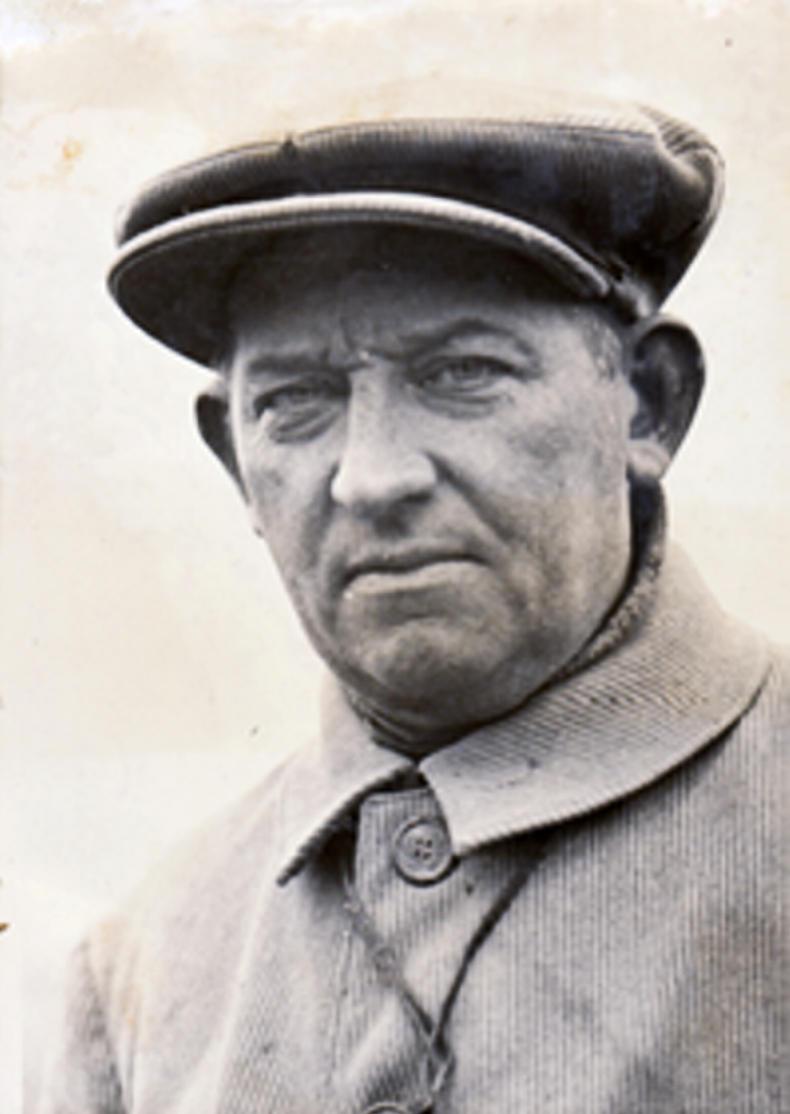
Charlie Mills (right)
Whatever Mills may have salvaged in his flight from Germany he obviously had the price of a good night’s accommodation, as he booked directly into Paris’ swish hotel, the Crillon.
With the fall of Germany and the rapid exit of principal patron Bruno Cassirer, a Jewish man who chose to flee to England, Mills had to restart his career, this time in France at the age of 59 years of age.
There followed two decades where Mills dominated trotting in France. Since the 1930s he had been a frequent visitor to the USA, buying stock and soaking in the American training methods like a sponge. In his early years in France he drove for the Greek born trainer Jonel Chryiacos before he took out his French trainer’s licence.
With the post-war feel-good factor and both Mills and other younger French trainers introducing American methods to harness racing in Paris, this was a golden age of French trotting.
CLIMAX
Charlie Mills’ career reached its climax around 1953. The trainer Marcel Parlberg, who Mills had protected from the Nazis recommended that owner Paul Karle take the wayward filly Gelinotte away from Parlerg’s yard and instead give her to Mills to train. “He is the only one who’ll be able to manage her,” said Parlberg, himself no slouch.
The patient Irishman (now 65) and the temperamental mare – prone to pacing, which is a big non-non in France, proved a dream match. Mills thought nothing of getting Gelinotte out two and three times per day and giving his charge kilometre after kilometre of slow work without ‘pushing the button’ as they say in trotting circles.
Gelinotte went in to win the Prix d’Amerique twice in 1956 and 1957. By now Mills had entrusted the race driving to the younger Roger Ceran Maillard.
The veteran kept training until 1969 when his last top class horse Vat took the Prix de Selection. Charlie Mills died in Switzerland in 1972 at the ripe old age of 84.
Pressures of space do not allow the writer to expand upon Charlie Mills love of fine wines, cigars and glamourous ladies. The late Sir Peter O’Sullivan, also a bon viveur, wrote with great affection in his autobiography about the great times he spent with the master of Chamant (yet another Louis XV mansion). Charlie Mills also accumulated works of art and sports cars. Billy Roche, dream on!
For a modern connection with our own Portmarnock Raceway it is interesting to note that one of Hughie Richardson’s earliest stallions Jousko Williams was by Mousko Willams, son of Sam Willams, a horse which Charlie Mills bought in America in 1930.
The Sam Willams line has become one of the dominant families in the modern Trotteur Français breed. Yet more evidence of Hugh Richardson’s skill when selecting a stallion!
Every year in France the Prix de Charlie Mills (worth in the region of €60,000) is staged in his honour. Surely with the current renaissance in the trotting sport in Ireland the IHRA could name a race after Charlie Mills as well.
For more information read:
Charlie Mills - Le cocher des dieux, by Jean-Pierre Reynaldo