Q. To begin back at the start, if you could tell us how your career began from a National Hunt. And then moving into the flat and why did you choose to specialise in the flat?
A. I started as you do in Ireland, everybody has a horse so they give a horse.
In hindsight, I probably should have gone off and done a few years with somebody here or there as an assistant trainer but typical me, I learnt the hard way by my own mistakes. Built it up slowly, surely, everything, every lesson I learnt cost me a great deal of money.
About 2002 I think, we won the Powers Gold Cup with Big And Bold and being a jump jockey or an ex-jump jockey, you naturally go that route but it wasn’t for me.
I loved two-year-olds, my first winner was a two-year-old and there’s no dancing around, it’s easier to train flat horses. But the turnover is quick, I’ll buy a yearling in August/September/October and they are running now March/April/May.
I felt that if I’m going to work this hard I’m going to do it the way I want to do it and I’m going to do something I like. I just love two year-olds.
Q. What could you tell the general racing fan from the time the two-year-olds are broken and when they start to come into the yard, how do you know when is the right time to bring them to the races?
A. Well, the answer to the last part of the question is experience. And I can never put it into words what I’ve seen there, the response has always been, I don’t know what I’ve seen but I’ve seen something. It’s just through experience, you are doing it year in, year out, day in, day out.
The sales start in August/September/October for the yearlings, and I buy them starting in Doncaster so whatever we buy there would be bought and sent home to the farm.
I like to give horses a month out on grass because you don’t know the prep that they’ve had and at the end of the day, they are only baby horses.
They’ll go to the farm of which we have a great facility over in Kilcock with Ronnie Boland.
Then Ronnie will say, well these horses have had enough, they can get on with it, and they’ll go into my second yard which is Gerry Kane and will start breaking them.
The cycle will go like that and that will lead us up to the first of November and Gerry will say, I’ve got Doncaster and Fairyhouse riding so I’ll say, send them on up to me because I’ll never allow a yearling in here when the season is in full flow.
By Christmas I have all my two-year-olds in here, or yearlings as they are at that stage, doing their figure of eights and then their light canters.
You are getting a feel at that stage who is going to be forward and who’s going to be backward, without drilling them, we are still in baby infants. The policy is that we are up and running everything is under saddle and riding for the first of January and we are kicking on.
Every week that passes from that moment is a build up to the first week in March and you are turning the screw, turning the screw.
If they are not up to what I’m doing with them, they’ll go to either the farm for a full break or they’ll go to the second yard for baby work.
And then as I said you are building up towards Cheltenham time, and the breezing has sort of started and you’ll know by experience who to breeze and who not to breeze. And they’ll just tell you. I’m always saying, it’s not rocket science.
Q. Is it down to you see them as individuals, personality wise? What is it that you see?
A. It’s everything, it’s all of the above. When I buy a horse it has to be a certain physical, but a good horse will never be a great horse unless it has the temperament. And you can turn a good horse into a bad horse by ruining its temperament.
As I’m always saying, it’s like your kid, like the underage footballers are naturally fit, so don’t go out galloping the brains out of them and thinking you are turning them into a Roy Keane.
If you have a two-year-old that hates his job or has this habit or bad habit, you’ve given him that habit.
You broke them, you trained them. So your job is to make sure the two-year-old enjoys it and know when he’s not enjoying it, stop start, stop start, stop start. And a couple of them will put their hands up, this is not ready. Have the experience and have the confidence to do that.
Q. Are there any golden rules that you have when you go to the sales? Are there golden rules that you would try to adhere to? How do you feel about first season sires and things like that?
A. We have a great team for the sales, or it’s our great team. It’s headed by Roger Marley who is a pinhooker in England and our mate John Cullinan, one of the nicest guys in racing.
They do the ground work, they do the hard slog. In Doncaster, they’ll be there all Saturday, Sunday and I’ll swan in on Monday and they’ll give me a list.
They’ll have knocked off a lot of horses, and invariably at the start we’ll have had the conversation, I’m not doing that sire, I’m not doing that sire. So there’ll be certain sires that we’ll have knocked off for whatever the reason being.
Then they’ll give me the list, then Kerri works with me at the sales and she’s very good at it, she’ll go ahead and have horses ready and we’ll look at them together.
I either like a horse or I don’t like a horse. I won’t be looking at a horse for any more than a minute. If I look at a horse and I don’t like it I walk away.
It doesn’t mean I’m right, but it’s what works for me. At the end of the first evening they’ll look at the disseminated list that I’ve given them and there’ll be an argument or two no doubt.
Ultimately it’s my call, they don’t know what I’m going to spend. They have an idea, but I would like to think in a sales ring, people will know don’t mess with him because you don’t know when he’s going to keep going or when he’s going to pull up. That’s the secret to buying a horse.
Because the people selling, especially these pinhookers, to me they are the smartest people in the trade. They know to the pound what you have to spend. And they are brave.
Q. Is your focus just about finding that winner, is it about finding a group horse?
A. Ultimately you have to buy to sell on, that has always been my modus operandi. But buying to sell on, you don’t sell on a non-winner. The secret to us staying in the business is being able to value your horse, so if you buy a 50 grand horse for 200 grand, you are not going to last in this sport.
The secret is to buy a 10 grand horse and turn him into a 50 grand horse. If you go out there valuing a 50 grand horse at a 150 or 200 grand you are going to go out of business. And you’ve got to know who you are buying off. Because these are the sharpest people in the business, bar none. It’s the most stressful part of my season and I hate it.
Q. When you look at individuals during that evaluation couple of days have individual horses stood out to you as in, I have something serious to work with?
A. No, absolutely not. Because if that was the case every horse I’d be buying would be a Group 1 horse. The amount of bad horses I’ve bought and anybody who is honest with you have bought, it might tick all the boxes, lovely head, lovely walk, lovely physique, and it’s useless.
The amount of good-looking useless horses – a sales horse doesn’t necessarily mean a race horse.
It’s different with pedigrees. There’s no point in me walking up to all the snobs’ barns that have Galileo and Dubawis etc. I know I can’t afford, and if I can buy them there’s something wrong with them.
When the hammer knocks and you actually have it, you are scratching your head, oh God what’s wrong with it, why did I buy, why didn’t they buy it.
There’s certain guys that you can see and they have gorgeous-looking horses, they buy a nice horse. We are all fishing in the same wee pond.
Because when you look at the results of the big races, 90 times out of a 100 they are not available to us, they weren’t for sale. So we’ve only got that other 10 and for that 10, you’ve Clive Cox, Ger Lyons, Richard Fahey, Michael O’Callaghan, Kevin Prendergast, Fozzy Stack, people like that. Not to mention the breeze up pinhookers, see how dear that horse becomes.
So then it becomes very, very important, how you value the horse in your head and have confidence in how you value it. If you value a horse at a 100 grand, you shouldn’t be paying 200
grand for it.
Q. Discussing the horse as an athlete and temperament and how the difference that can make to you as a trainer?
A. If you have a very good horse but every time you put a saddle on it at the races and it melts down, you are in trouble, you know what I mean.
You see Willie Mullins nowadays, he uses earplugs a lot. We’ve a horse here called Mustajeer and we use a hood on him and it helps him because he’s a huge ability horse.
If they haven’t got the mentality, you’ve got to guide them right, you’ve got to know when to twist them and when to turn the screw and when not to turn a screw.
Let’s discuss two-year-olds for example, I’m not a breeze-up man for the simple reason I have a yard of two-year-olds and we’ll all set out to bring them along through their stages.
I don’t have any specific date to hit whereas a breeze-up merchant has his date of the sale to hit. I go easy, the breeze-up man turns the screw. The breeze-up man hits the breeze and my horse at the same stage is only coming back from his break. So when that horse is bought and he comes to my yard, I now have this horse who started out on both levels and now I have to re-educate this guy’s mind because he’s bubbled.
So it’s a line, I don’t blame them – they have dates to hit – but I personally don’t agree with it as a process.
Q. The work rider is obviously very important, in terms of judging work pace and feeding back to yourself. Is that something that you put a lot of focus on?
A. I do the board, I feed in the morning and then I do the board and as I keep saying to Kerri when she’s sitting in with me it’s very important to spend your time on the board.
To put the right person on the right horse and especially on a work morning, to marry because we work in pairs or in three at the most so to marry the right two or three together.
It’s very, very important for a two-year-old that you don’t have a weak two-year-old going with a super star.
I’ll have an older horse always and you’ll always have an older horse that wants cuddling and it makes him feel good taking a two-year-old along. I’m blessed, on a work morning here I’ve got champion jockey Colin Keane, double champion apprentice Gary Carroll, Donagh O’Connor, and two great kids Sean Bird and Johnny Shinnick. That’s not to mention my jump jockeys who have ridden winners. They would sit on 12 or 14 horses a morning, chopping and changing just to get the pieces of work right and that’s very important.
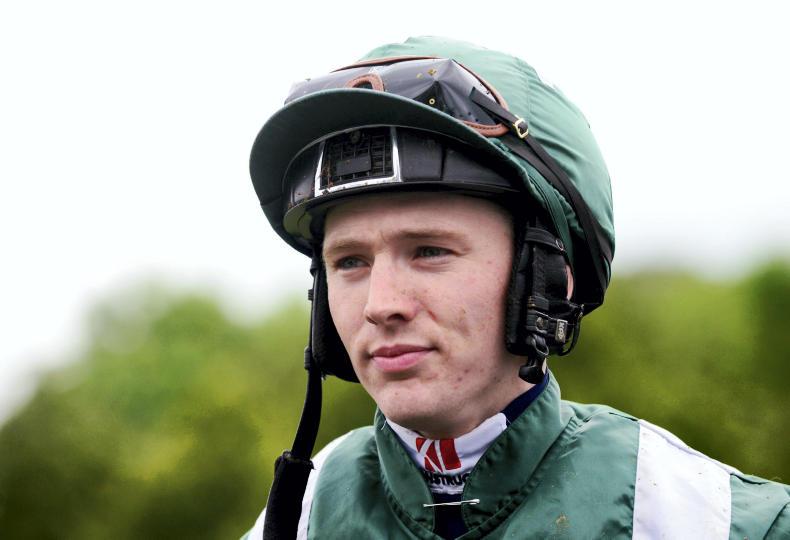
Q. Possibly one of the most talented sports people in the country at the moment is Colin Keane.
A. He’s the best in Ireland, he’s within the top five in England or Ireland in my opinion. Very seldom you meet people in the world that in your lifetime that you click with and I clicked with him. He loves his job, he is very, very good at his job, I let him do his job. And the nicest thing, apart from his talent, he’s just the nicest guy.
Q. And what attributes does he have?
A. Tactically he’s second to none. He’s first out of the box. Colin seems to be in the right place. He seems to know where he’s going. Every jockey makes mistakes nobody is infallible. But from a very early age he was able to read a race.
We don’t discuss races ever. The only time we talk about a race is he will ring me on the way home from a race. That’s the only time we’ll ever discuss a race.
If he’s good enough to ride for you then let him do his job. I learned that, you see I had a great education with Johnny Murtagh, I was very, very lucky in the sense that in my early years Johnny rode my first winner so he was attached to Glenburnie for a long, long time. I leant millions with him as a rider.
Just don’t get involved with the rider, that’s their job. And fill them with confidence, you’ve done your job, leg them up fill them with confidence and they’ll do their job.
Q. With an over-reliance on betting and the amount of sponsorships, we just seem to all the time have a betting brand involved. Is it not a bit of a shame?
A. It’s a necessary evil. They are funding the sport to a greater or lesser degree. The powers that be let the boat sail out with the media rights and owning our own brand like they do down in Australia or Hong Kong, that ship is gone so we are not going to get that back. Cleverer men than I am failed at that.
I don’t bet, I’ve no interest in betting. People do and as I said it’s a huge part of our sport. I don’t agree with trainers and jockeys being sponsored by bookmakers. I think that’s wrong, I don’t know how it was allowed happen. It gives off the wrong vibes. But it’s a necessary evil.
Q. If you were to choose a target for yourself – you mentioned Group 1s earlier in the conversation – would there be a particular race you would love to win?
A.This time last year I’d answer that question and I’d name the race. But I pulled up last winter absolutely sozzled and I worked on it and I went, that’s never going to happen again. So what I’m going to do and doing is, I get up every morning and I work hard, I enjoy my work, it’s not now a chore.
When I want time out, I take time out. I’ve got a batch of horses that I know what level they are. I will make them achieve as much as they can this season and once I achieve that I’ll go into the winter months happy again. If I’m blessed enough to win a Group 1, I’ll be good enough to take it.
I’ll do the best with what we have and if that means I’ve trained 50 winners, a 100 winners, listed winners, group winners, so be it.
As long as I can look in the mirror and say I did the best I could, that’s all I’m going to do.
The Training Forum is brought to you by ‘Sunday’ in association with The Irish Field