IT’S been 50 years.
Fifty years since the great Nijinsky won the English Triple Crown. The first horse to do so since World War II and we’re still waiting for the next.
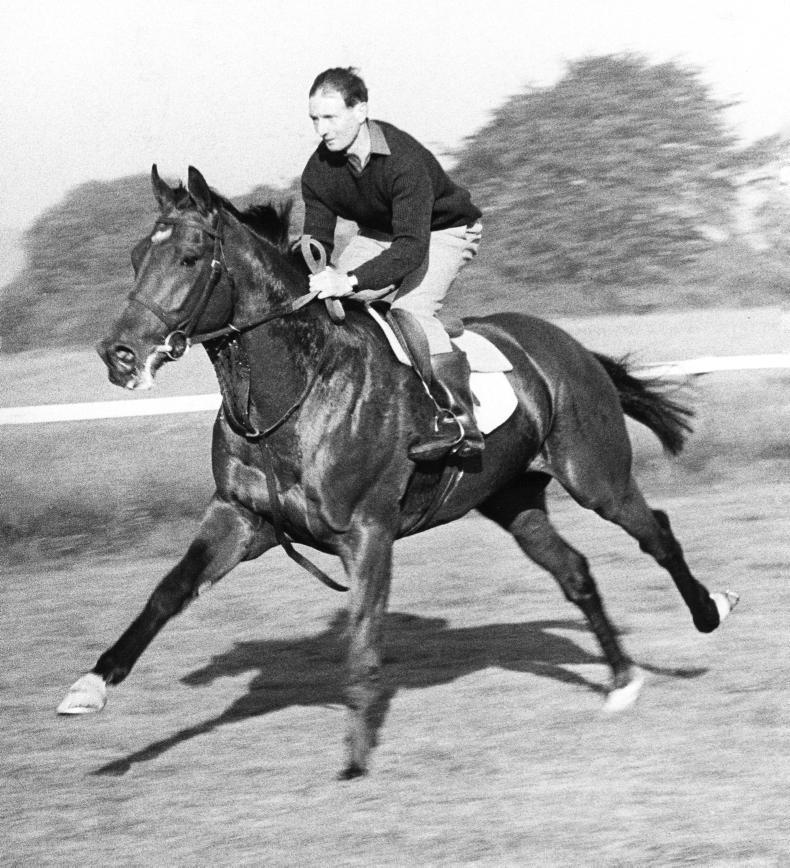
It is a story well remembered by those who were there, and even by those that were not, but few tell it better than Johnny Brabston; a loyal servant to Vincent O’Brien and the man who rode Nijinsky for nearly every day of his racing life.
“I remember well when he arrived in the yard as a yearling,” recalls Brabston. “He was big for that stage of his life. Yes, he looked a fine big horse.”
The arrival of Nijinsky in Ireland was partly luck, but mostly judgement. It resulted from a trip made by O’Brien to Windfields Farm in Canada to look at a yearling colt by Ribot on behalf of American businessman, Charles Engelhard.
As it turned out, the Ribot colt had a crooked leg but there was another horse who filled the eye; the Northern Dancer colt out of Flaming Page who, on O’Brien’s advice, was purchased by Engelhard for a record price in Canada at the time of $84,000 and was soon to be making the long journey from Toronto to Tipperary.
“He was here a few days,” says Brabston, “and we couldn’t get him to eat. We kept trying with different things, putting bits of grass and dandelions and stuff like that through his feed, but he was able to separate them. He didn’t want to know about the oats. The boss was getting very concerned about him. Then word came back from the manager at Windfields that he was never fed oats, it was always nuts, and so they arranged for a bag to be sent from Canada.
“I would usually go into his stall in the morning and you’d be taking out the feed you put in the night before, still hoping for the best. But on the day the nuts arrived and I went into feed him at breakfast time, he had the pot of oats absolutely cleaned up. You’d swear he knew. Anyway, he never got the nuts after that.”
Knowing his own mind, it seems, was a trait that Nijinsky also took with him to exercise, as Brabston remembers: “He was difficult enough to break. He was temperamental and if you wanted him to go left, he’d go right. We used to take him out on his own in the mornings before the other horses. There was two or three of us who used to ride him different days, and he more or less had the same problem with everyone. We were getting a bit worried about his temperament.”
These were sentiments shared in a letter written by O’Brien to Engelhard in early 1969 about Nijinsky, at this point still only a record breaker on sales price. “I am somewhat concerned about Nijinsky’s temperament,” wrote O’Brien, “and that he is inclined to resent getting on with his work. My best boys are riding him, and we can only hope that he will go the right way.”
Among the ‘best boys’ at the time was a youthful Vincent Rossiter, who arrived at Ballydoyle in 1961 on his school holidays and didn’t leave for 38 years. “I used to ride him quite a bit on and off in the early days,” recalls Rossiter. “But he had started to become very fresh, rearing up. He’d go up on his hind legs and nearly walk 20 yards on them. He was like a ballet dancer. Maybe he was taking after his namesake.”
Reincarnated
Russian ballet dancer Vaslav Nijinsky proclaimed on his deathbed, some 18 years earlier, that he would one day be reincarnated as a horse - so perhaps this was he. Anyway, on with the story.
“There were two very good riders there at the time,” continues Rossiter, “Danny O’Sullivan and Johnny Brabston. They were both former jump jockeys and, you know, they were heavier and stronger. They were able to be firm with him but also patient, and if it wasn’t for those two men Nijinsky wouldn’t have been Nijinsky.
“He used to go out a bit on his own,” Rossiter adds. “Everything kind of stopped until Nijinsky was gone back in again. But he wasn’t a piggish kind of a horse; he showed how honest he was in his races. I’d just call him highly-spirited.”
It was these high spirits, and a tendency to misbehave at home, that led to a fortuitous trip to the Curragh for Brabston and Nijinsky, allowing the former to discover the latter’s true talent early on. “It was around late May,” recalls Brabston, “and the boss was taking four two-year-olds to work up at the Curragh. He said there was a space in the box, and that we might as well put Nijinsky on and see what he does up there. The four horses working were coming up to a run and they were well forward - not like Nijinsky who was a big horse and wasn’t doing a whole lot at home, only messing.
“The boss asked me just to see how he acted, and not take any notice of the other horses working. Anyway, he went down to the start no problem and he just walked into the stalls – he hadn’t even to be led into them. When the stalls opened, they jumped out and I went back five, six lengths, but about halfway up the gallop I was looking at the other horses and I thought I was going twice as well as them. Of course, I didn’t go near them. I didn’t join them.”
It was back in the parade ring, when O’Brien was getting a debrief from the other jockeys, that he asked Brabston how the young son of Northern Dancer had behaved.
“I told him that [Nijinsky] couldn’t have behaved himself better”, said Brabston, “but the next thing I came out and said; ‘any of them other horses would never begin to beat him.’ The boss gave me a look and said; ‘is that not a stupid statement?’ I was only saying what I thought, and it might have been a stupid statement, but I was sticking to my story.
“Liam Ward – O’Brien’s first jockey in Ireland at the time - worked him down at Ballydoyle a couple of weeks later and I don’t know what he said afterwards, but later on the boss came over to me and just said, ‘I think you might be right’. And that’s the last I heard on the matter from that day to this. From that day on my name was down every morning to ride him and no one ever sat on him apart from myself. None of the jockeys ever rode him work.”
Real test
By the time Nijinsky lined up for his first race at the Curragh in early July, word must have escaped Ballydoyle that he was highly thought of. He started odds-on favourite and won like it too. His two-year-old season continued as it began, and Nijinsky notched up a further four wins, with the pinnacle coming in October in the Dewhurst Stakes at Newmarket. It should have been the first real test for the juvenile, but to him it proved elementary.
“That October was a lovely month,” remembers Brabston. “The boss used to leave [Nijinsky] out in a paddock for an hour a day with a lead horse. He was lunged a bit and ridden the odd time. We were all wondering how he’d behave after a long winter break, but when he came back into work in the spring he was like a child’s pony.”
With a more relaxed attitude to work, and little regard for the weight of expectation placed on him ahead of his classic season, Nijinsky won his preparatory race, the Gladness Stakes at the Curragh, with relative ease, and headed to the 2000 Guineas unbeaten.
“Myself, travelling head lad, Donal Egan, and a security man travelled over to Newmarket for the Guineas,” says Brabston. “We were very confident going in.”
It was well-placed confidence. Nijinsky made light work of the classic, ticking off the first leg of the Triple Crown with aplomb; the presence of full-time security most telling of the value the team now placed upon him. It was on to the Derby next, and Nijinsky travelled to Epsom on the Friday before the race which in those days was run on a Wednesday.
“We went to Sandown Park to work him,” recalls Brabston, “which wouldn’t be too far from Epsom, but there were no horses there, it was quiet. We had just a jog around on Saturday and on Sunday morning we galloped around the opposite way; then something similar on the Monday.
“We did his last bit of sharp work on Tuesday morning up the back straight at Epsom. We came back in and everything was grand. He had his drink, had his lunch, but the next thing he started rooting in the ground and sweat started coming through him. It really looked like colic. He was getting down and rolling. Luckily the boss was still there.
“We sat outside his box and kept checking over the door,” continues Brabston. “It lasted maybe an hour, but the day felt very long. The boss rang his vet back home and wanted him to come over immediately, but there was no point. There was nothing he could give him as he was running the following day. So, we got a bit of grass and a bit of bread soda and mixed it up with some feed and he ate it. We gave him a light supper and when I went back later to check he had the pot licked. That gave us hope that it had passed.
“On the morning of the race we led him out and he was in great form. Naturally, we were all a bit uptight in case it happened again, but nobody outside of the couple of us looking after him knew about it. We didn’t want anyone to know.”
Well-kept secret
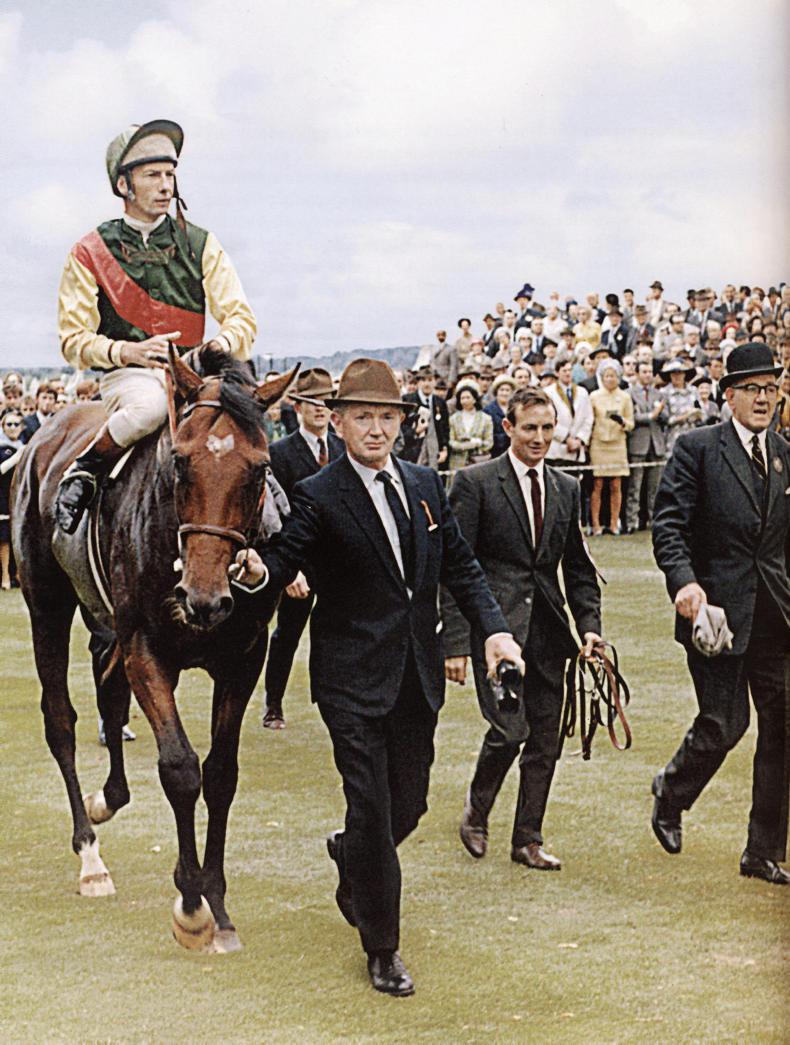
It was a well-kept secret, not least to the public who witnessed Nijinsky, as good as ever, cruising past the French-trained fancy, Gyr, to win the Derby by two and a half lengths. A victory made even more impressive given the events of the previous day.
Nijinsky’s races as a three-year-old came thick and fast. He added to his perfect tally in the Irish Derby – now nine from nine – and the King George VI and Queen Elizabeth Stakes followed, another major race in quick succession but this time against older horses. It was probably the toughest field he faced, but Nijinsky merely played with his opposition; hard-held as he passed the previous year’s Derby winner a hundred yards from the post.
“We were back about a week after the King George,” says Brabston, “when he got this bloody ringworm. It was a very bad dose of it. He was actually nearly bald. All the hair fell off him and you couldn’t ride him out. Couldn’t put a saddle on him, so we used to lunge him in the ring.
“[Mr. Engelhard] was very keen to win the Triple Crown and there was a bit of pressure on to get [Nijinsky] ready for the St. Leger, but it wasn’t looking good. We were running out of time. I’d say we used more cotton wool than we’d use in 12 months around the girth and under the saddle where he still hadn’t much hair left. We mostly lunged him, but when I rode him in some bits of work I’d be trying to keep my legs away from his sides to prevent him from bleeding.
Very relieved
“Even going to the St Leger he hadn’t his full coat of hair, really,” continues Brabston. “The vet examined every bit of him two days before and we were very relieved when he said he was okay to run. The Leger wasn’t really as tough as some of the other races we were running in, and to me he won it like it was easy, but when I went out to catch him the first thing Lester [Piggott] said was ‘that wasn’t as easy as it looked’.”
Having been, quite literally, wrapped in cotton wool, Nijinsky wrote his way into the history books and won the English Triple Crown in 1970. An extraordinary feat was made even more remarkable by the adversity he overcame before not just one, but two legs of it. It was a gargantuan effort that ultimately came at a cost.
“He lost a good bit of weight after the St Leger,” said Brabston. “His work was as good as ever, but it was when he went into that parade ring at Longchamp for the [Prix de l’Arc de Triomphe] that there were photographers left right and centre and he got himself into an awful state. He just wasn’t himself.
“It was the first time he got hit with a whip in a race and he swerved from that, which could have just cost him in the photo finish. Maybe it did, but I wouldn’t blame anyone. Everyone was looking for an excuse because he was beaten, but I’d say he just wasn’t his best.”
Devastating blow
It was a devastating blow to his perfect tally, but by this time Nijinsky’s magnificence was engraved into the many trophies on his owner’s mantelpiece. Still, a final attempt to finish on a high note was made in the Champion Stakes at Newmarket just a few weeks later.
“He seemed in great form ahead of the Champion Stakes, back to usual” recalls Brabston. “But when I led him out on to the track [at Newmarket,] he had to parade in front of the stand. He went straight back to his two-year-old days, reared up and broke into a desperate sweat. I had to pull the lead out of him and leave him go, otherwise he would have fallen over. All the signs were that he was over the top, but he still ran a super race to be just beaten. It was a pity in the finish the way it worked out.”
This is not where the story ends though. Nijinsky’s legacy lives on through the many successes of his sons and daughters and their sons and daughters. The Triple Crown winner was also to thank for the great goldrush for sons of Northern Dancer that followed, and if he hadn’t caught O’Brien’s eye at Windfields Farm in 1968 things could have turned out very differently indeed.
The master trainer was once asked which was the greatest horse he ever dealt with? Stuck between two, O’Brien answered; “Sir Ivor, for toughness. Nijinsky, for brilliance.”
It is a brilliance echoed in the stories relayed by his loyal employee Johnny Brabston who, when asked the same question, says simply;
“Nijinsky. I’ll never doubt that one.”