IS YOUR HORSE GOOD ENOUGH?
The Cheltenham Festival is the pinnacle of jumps racing, and it takes a top-notch performance to win many of the races.
Ratings, including the time-based ones which appear in The Irish Field’s weekly Time Will Tell column, give you a good guide to the existing level of achievement of individual horses, and they can also indicate what has been required historically to succeed on the big days.
The toughest races to win judged on average Timeform ratings this century have been: The Cheltenham Gold Cup (171 average rating); the Queen Mother Champion Chase (170); the Champion Hurdle and the Stayers’ Hurdle (both 165); and the Arkle Chase and Ryanair Chase (both 161).
Make sure your selection has what it takes to figure at an elevated level, or at least has enough potential to do so. The Festival is an unforgiving crucible for the hype horse.
THE GOING
The state of the going can be a guessing game right up to and beyond the start of the Cheltenham Festival. The official version sometimes changes after the first race has been run, for no reason other than that the forecast was wrong.
Timeform bases its ground assessment on times and weather conditions, and they have 58% of races at the Cheltenham Festival this century taking place on “good” going, 20% on “good to soft”, 10% on “good to firm”, 9% on “soft”, 2% on “heavy” and just 0.2% (one race) on “firm”.
Conditions may be a good deal different than have prevailed in the trials leading up to the event, in other words. Whatever they prove to be, it can be considered a positive for your selection to have proven form on similar ground.
THE HILL
It ain’t over until it’s over, and few places is that more true than at Cheltenham, where the closing stages are against the collar and many a dream has turned into a nightmare as legs have turned to jelly.
A total of 11 horses traded at shorter than 1/10 in running before finishing second between 2007 and 2018, including two at 1/100.
Stamina is of the essence, especially over hurdles on the New Course (Thursday and Friday), on which there are only two hurdles to be jumped in the final seven furlongs. What’s more, many Festival races are run at a strong gallop, allowing no hiding place for non-stayers.
Favour horses who have proved their worth on similarly demanding courses and/or at the full race distance or even a bit further.
JUMPING
Cheltenham is not quite as fearsome a jumping test as it once was, but it still exposes any weaknesses in that department.
One in eight runners in chases at the Festival this century have either fallen, unseated or been brought down, while the same figure for hurdles is roughly one in 25. Perhaps the most famous of all recent incidents was the final flight fall of Annie Power in 2015, reportedly saving bookmakers millions.
The ability to navigate numerous obstacles safely, sometimes in a large field, and usually at a good pace, has to be a given, and the ability to jump both safely and slickly is a big plus. It is worth inspecting a horse’s record, not just for falls and unseats, but for significant errors along the way.
Jumping is the name of the game, after all.
RUNNING STYLE
The best races at the Cheltenham Festival from 2003 onwards for front-runners – using Timeform’s unique Early Position Figures – have been: the Fulke Walwyn Kim Muir Handicap Chase (in which pace-forcers have beaten 65.2% of their rivals, where 50% is par); the Champion Hurdle (65.1%); the JLT Novice Chase (63.9%); the Arkle Chase (63.1%); and the Cheltenham Gold Cup (62.4%).
The best races for horses out the back early have been: the Mares’ Novice Hurdle (59.4%); the Fred Winter Handicap Hurdle (55.0%); the County Handicap Hurdle (54.9%); and the Champion Bumper (51.3%). Overall, chases have been better for forward-racers and hurdles have been better for patiently-ridden types, but there is not a lot in it. More important is to have a horse who is versatile tactically or likely to be suited by an excess or absence of pace. Pace varies from race to race, so pace and run-style analysis should be done on that basis also.
IS THE TRAINER IN FORM?
The best way I know of to judge the well-being of a trainer’s string in general is to calculate the percentage of rivals beaten in handicaps in  recent weeks.
I study handicaps only because success in non-handicaps may reflect little more than opportunity and clever placement and I concentrate on the percentage of rivals beaten because wins, and even places, can be skewed by field sizes and variance.
An in-form trainer is likely to be operating at above 60% rivals beaten (certainly over 55%), whereas an out-of-form one may be at 40% or less (assuming a large enough sample size).
I will tweet up-to-date figures (@RowleyfileRRR) nearer the time.
The following active trainers have provided more than 20 winners this century: Willie Mullins (56); Nicky Henderson (40); Paul Nicholls (40); Jonjo O’Neill (24); and Gordon Elliott (22).
The JOCKEY AND THE OCCASION
“Form is temporary, class is permanent” is a saying that probably applies to jockeys more than to trainers. Like any other sportsperson, some jockeys rise to the occasion, while others struggle with it.
Many an up-and-coming jockey is absolutely convinced of his or her future greatness, and one or two may even achieve that. But the following active jockeys have been there, done that, and got the t-shirt so often that they could open their own clothing range: Ruby Walsh (57 winners this century), Barry Geraghty (36), Davy Russell (22) and 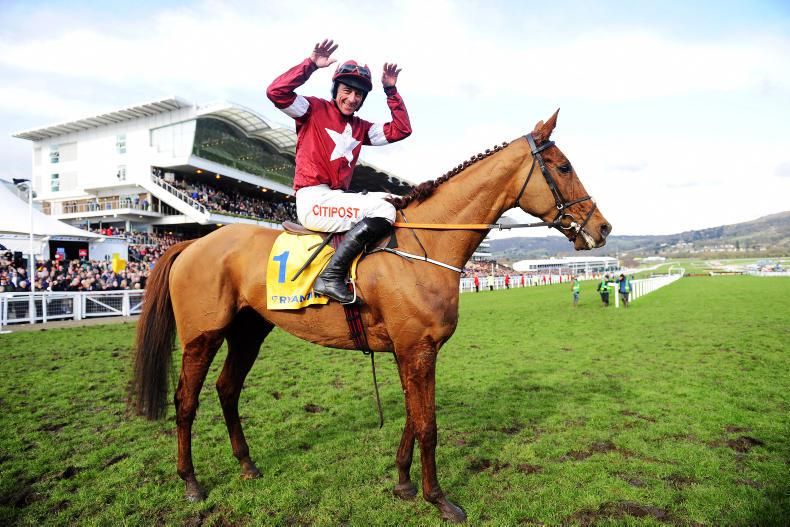 Richard Johnson (22). There is no room for sentiment, in betting, but Irish jockeys are simply the best in jumps racing.
WIN OR EACH WAY? OR SOMETHING ELSE ENTIRELY?
For mathematical reasons that I will not go into here, some races are better propositions for each-way betting than win-only betting: in particular, handicaps with 16 or more runners and non-handicaps with eight or a few more runners (especially those with short-priced favourites).
In addition, some horses are good at getting placed, and are therefore attractive for each-way purposes, whereas others are more do-or-die types. Try to figure out how to play to such strengths.
Related pieces of form may be worth including in forecasts, such as was the case with last year’s Triumph Hurdle one-two Farclas and Mr Adjudicator (who had been two-one at the Dublin Racing Festival in February), for which the Exacta (aka the Reverse Forecast) paid over 40/1.
TIMING IT RIGHT
Some good bets can be struck ante-post in the lead-up to Cheltenham, but one thing which can make the Festival a bonanza for punters is the cut-throat pricing and offers in the week or two before it.
Look out, in particular, for “Non Runner, No Bet” concessions, which eliminates much of the risk associated with longer-term betting, usually at only a small discount in price. On the day, Best Odds Guaranteed and Additional Places for each-way bettors are just two of the things which can work in the betting public’s favour.
SPECIAL BETS
Special bet markets – such as whether Ireland or Britain will have the most winners, the number of winners a specific jockey will ride and combined winning margins for all races – can provide much enjoyment and even some value across the Festival’s four days.
One of my favourites is the “longest Starting Price” market. No Cheltenham Festival goes by without some sort of an upset, but complete “flukes” are rare.
In the last 10 years, this has gone to 28/1 once, 33/1 four times, 40/1 four times, and 50/1 once, but those two mid-values – sometimes coupled in this market – are often over-priced.
The bookmakers will be eager to get your trade, and some of the less mainstream markets may not have been thought through as thoroughly as they could be!?