HUBIE de Burgh founded De Burgh Equine in 2003 which specialises in the sourcing of racing and breeding stock for a global client base. He is based in Grangecon, Co Wicklow.
Growing up, was being part of the bloodstock industry your goal?
“I was raised on my family farm, Oldtown Stud in Naas, Co Kildare and photographs of myself about two years of age show me sitting on a pony so I guess it was the old thing of riding before you can walk. It was a commercial stud run by my father John de Burgh and right through the summer holidays, I was always tied up with horses.
“After school I worked with Dan Moore for about nine months, just learning a bit about training and it was the time of L’Escargot, one of the great times. I rode a bit as an amateur, including a couple of winners.
“I was a shocking jockey, probably the worst amateur that’s ever been, both chases that I won, were won them by photo finishes and I should have won by 10 lengths.”
De Burgh completed the Irish National Stud thoroughbred breeding course in 1972, when the stud was under the directorship of Michael Osborne, which was a “great foundation”.
Secretariat
“Then off to America where I worked at Claiborne Farm during an extraordinary era because I was Churchill Downs the year Secretariat won the Kentucky Derby (May 1973), fantastic.
“We had horses like Buckpasser, Damascus, Forli, Nijinsky, Round Table, Sir Ivor, they were all standing there at the time. It was at its heyday, that was really, really good.
“I went to Virginia and I worked for Clay Camp who was one of the outstanding yearling consignors at the time and he sold in Saratoga mostly.
“Back then from America and I went to work for the Curragh Bloodstock Agency under the direction of Peter McKeever.
“Peter McKeever, Johnny Harrington and Colonel Dick Warden were part of the team and I worked in the pedigree department and in the nominations department.
“While I was there, the late Patrick Clarke of Cleaboy Stud was meant to be taking out Hot Spark to Australia, it was the second year of the stallion shuttle.
“And we were out water skiing before the trip and he burst an ear drum in an accident so at 24 hours’ notice I was told I was the new stallion groom taking Hot Spark to Australia. I went across to England, picked up Hot Spark at Whitsbury Manor, William Hill’s farm, got on an airplane, and it was like Noah’s ark, there was three stallions, there was Green God, Hot Spark and I think the other one was Gay Fandango and 30 mares and two zebras – don’t ask me why!
“I’d never, done anything like this no. I’d done a couple of horse flights to Japan for Curragh Bloodstock.
“I arrived down in Australia and I’d already had a bit of a run-in in one of the director’s cars in Ireland. Peter McKeever, I remember him calling me into the office before I picked up Hot Spark and he said ‘right you’re representing the Curragh Bloodstock Agency in Australia so we’re going to buy you a second-hand company car down there so you can get around. But if you crash the car you’re fired’. So I said ‘Okay, fair enough’.
“I went to Milluna Stud, One Tree Hill, South Australia and on the third day they let me off to go and buy a second hand car. I went down to pick it up on the Friday evening and I was driving back and decided to stop to look at this beautiful scenery. I was sitting on the edge looking at this view and next thing there was a sort of a scraping noise and the bloody car went over the cliff. I’d left the handbrake off!
“So I wrote off the company car when I wasn’t even in the car, within two hours of having it!
“It took them six months to find out.
“Johnny Harrington came out and my boss, a second generation Irishman called Jimmy O’Connor, a bookmaker, had his old mother with him and she said to Johnny Harrington, ‘how lucky it was that I wasn’t killed in the car’. And Johnny said ‘what do you mean? and she replied ‘well the car went over the cliff’.
“And I thought Oh. My. God.
The lure of Australia
“They didn’t fire me. I got back and I delivered the horse back to Whitsbury Manor and the next thing I’d fallen in love with Australia and I just went straight back down and worked as assistant manager at Milluna Stud, to start with. I spent another five years in Australia.
“I did another two years at Milluna, assistant manager there, then worked for Coles Brothers, the bloodstock agency in South Australia under David Coles who was a fantastic man. They were bought out by Dalgety, so I went to Melbourne and I worked with Dalgety in the bloodstock agency division.”
Was there a sophisticated bloodstock industry in operation in Australia at the time?
“No. In those days, leading up a horse to the sales, it was led up on a rope that could have tied a super tanker. There was no polish about anything.
“But they bred great horses. The era where the Star Kingdom line was really at its best and they were really, really tough horses. Probably not the most correct-looking horses, a lot of them were off-set in front, through their knees, but they were hard horses. And it was a time when there were superb horsemen there without them having had the international experience.
“As the years went on, a lot of the horsemen in Australia started to work internationally. They brought home the ideas of what was going on in America and Europe. When I was down there, and as they got better in Australia at it, a lot of people travelled from Ireland or England or Europe or further afield and they went to Australia and learned Australian ideas and brought them back to Europe.”
You’d had your American experience, but it was Australia that got to you.
“Yeah, I loved the whole attitude, the whole way of life. If you worked hard and you played hard then you got on with everybody. If you were a dodger, they had no respect for you at all. It was hot weather, but you drank a lot of beers, they just had a great sense of humour and a great outlook on life.
“I also fell in love with the Melbourne Cup, their great race.
“America was different because it was ahead on presentation and polish and techniques. I was able to bring to Australia some of the ideas that I had seen with Clay Camp in Virginia. He was a wonderful showman and an incredible seller of a horse.
Fate intervened
“My father eventually came down to Australia and made me come home, I was having too good a time there. I was getting well paid, I was eating in good restaurants twice a week, I had a horse in training and I had a lot of change left over.
“I was coming home but for one last hooley. I had a friend, a trainer in Murray Bridge in South Australia, Ron Morgan, he was a bit of a character. The St Patrick’s Day meeting was held at Broken Hill every year and he would set his horses from one year to the next to win at Broken Hill.
“It was the Galway of Ireland, in mining country, they were tough guys up there, thousands of people travelled to the meeting. We loaded up the horses, I was leaving Australia two days later after Broken Hill.
“I think it was nine races on the card and Ron thought he’d win them all. I had all the money I’d saved up in five years of being in Australia, all in cash.
“The first horse got left 10 lengths and got beaten by a head. It just got worse and worse and worse until I realised I only had A$20 left. One more race to go. I had $20 left after five years in Australia and I thought shit I can’t even have a bet on the last race.
“I had no money left, but Ron’s horse won the last race at 10/1!
“I went down to Sydney to take off and there was a $10 dollar departure tax and I had $10 dollars left over. I spent $5 on a few beers and I arrived back in Ireland with a $5 note in my pocket after five years in Australia, lost the lot at Broken Hill.
“And I had ordered my new car before I left Australia, this beautiful Fiat Supermirafiori, I’ll never forget it. I went to my bank manager and I begged him, I begged him on my knees to lend me the money to pay for the car and he did. I got this brand new car and till the day my father died he was convinced I’d made a fortune in Australia. He never knew that I came back with a $5 note!
“My father wanted me to take over running the farm. He had bred some very good horses over the years. Fair Salinia, who in 1978 became the first filly to win the Epsom, Irish and Yorkshire Oaks, Sunset Handicap and Man O’War Stakes winner Galaxy Libra and triple Hong Kong Group 1 winner Indigenous. That was never having more than 12 mares on the place.”
Derrinstown
It was the early ‘80s and 1983 was to change things dramatically for not only de Burgh but for the bloodstock industry in Ireland.
“I was back and the next thing I get a call from Harry Thompson Jones, Tom Jones, the trainer in Newmarket. The Maktoums were just starting, literally just starting in the business and I got approached by Tom and again this was all because of the international experience of my career, having been around the world.
“He said I’ve got this proposal from the Maktoums, he had just started training for Sheikh Hamdan bin Rashid al Maktoum. He wants to set up a small farm in Ireland, buy 20 mares and race the produce of 20 mares – that was the brief. It was to be a part-time job, two afternoons a week, would I take it on?
“And I said yes of course I will. And that went out the window very quickly! When I started, I was to find a farm and then the contract began. Derrinstown was the place, which we bought off the Duchess of Westminster, a very good dairy farm, never really many horses on it, it was very fresh land.
“I was about 20 years there with Sheikh Hamdan and as we got bigger and bigger we all had our roles to play but we all helped towards creating his bloodstock empire around the world.”
Did people know what this acquisition was going to grow to?
“No idea at all. Tom Jones had said the plan was probably to have about 10 or 12 horses in training.
“And within a year Sheikh Hamdan started to move and then it really began to take off. At the height of it, I was probably out of the country seven months of the year because we were expanding all over the world. We were opening up America, Australia, the empire started in England, a little bit in Ireland and because of my love of Australia I put the idea of the Melbourne Cup in his mind and he won the Melbourne Cup with At Talaq in 1986 trained by Colin Hayes. That opened up a bigger string of operations.
“Ireland was integral to the empire because of the quality animal the country produced. The sheikh and his brothers were enthralled with racing; they loved and respected the horse, the animal. An Arabian horse, a thoroughbred, but anything to do with racing, camels as well obviously.
“Whenever you were with Sheikh Hamdan, his knowledge was really interesting, what he saw in a horse and what his father had taught him, Sheikh Rashid, and I was fascinated because a lot of it was different to what we thought or did.
“He knew the horse before he knew the pedigree. And once he knew the horse, he could then easily learn the pedigrees. He was fascinated by families and pedigrees and has an incredible memory. We got bigger and bigger, when I left Derrinstown in 2003 we had about 300 horses on the place.
“The Sheikh was one of nature’s great gentlemen. You can work for people that only want to talk to you when you’ve got the favourite for the Derby. He was the opposite.
“Planning was a very big thing in his mind about a horse’s progress or a race plan, whether it would be raced out of its distance or whether the family wanted more speed. He would talk about the mare, the temperament or that the last two we had in training with so and so trainer, were very temperamental, we have to find quieter stallion.”
For a young man there was a lot of trust put in you?
“I was very young when I got the job, 28, but we’ve got to remember that they were young as well.
“They were probably in their early 30s when they really got going, Sheikh Hamdan and Sheikh Mohammed and just so passionate about the whole thing. It was so much easier to work with people like that than to work with somebody who had no idea and couldn’t understand the bad news days. There was lots of bad news days too, as well as good news days! There always is in this business.”
After 20 years with Sheikh Hamdan, de Burgh moved back to the family farm as his father was not well.
“I decided to go out on my own so I set up De Burgh Equine in 2003.
“What stood to me was I’d been traveling the world and making a lot of contacts as we were expanding Sheikh Hamdan’s business, I was meeting a lot of people, all living at the right addresses.
“There was a few people like Rick Barnes at Grangecon Stud who rang up and said what are you doing?
“At first it was just me and then I started expanding. Nearly all my client base were overseas, in fact none of them were local. After I’d been going, I don’t know seven or eight years, James Harron came on board. Now probably one of the biggest bloodstock agents in Australia, he’s Irish but he lives there now. He was with me for about three years and we’d a fantastic time with him.
“When James left, Will Johnson came on board, an Australian, he’d been assistant trainer to Roger Varian. Now back in Australia, he has set up as a bloodstock agent.
Business model
“I would describe De Burgh Equine as probably more a private sourcing agency rather than a public auction agent.
“I was doing a plan for the bank about how our business operated and we worked out that in 2018 we sold horses to 13 different countries around the world, and last year, 2019, we sold to 10 different countries. I’d spent about six months of the year away from the office every year. Australia is my core territory, three months in Australia last year alone.
“Our client base is global from the UK, Ireland, France, USA, Australia, New Zealand, Hong Kong, Libya and the UAE.”
It doesn’t matter where you’re based for your business?
“No because how it really works is building relationships. A lot of the people we work with, I would highly respect in their own right, as judges themselves and they have a big client base. If I’m buying somewhere, I will use another agent.
“For example if I’m dealing in France, when we’re buying the stayers, I work very closely with Emmanuel de Seroux of Narvick International and have done so for 15 years.
“And when we’re sourcing in Australia, we work with James Harron or with Will Johnson. And if they have an order and they’re not up here (in Europe), then I will get the first call and I’ll work sourcing for them. It’s a network of people that we trust and respect all around the world.”
When you started up in 2003, was there one horse, one deal that made your name?
“I think it was because I focused on Australia, which I knew, I could find the right horse though it still took me about three years to get going in Australia. One of my earlier clients was Terry Henderson of OTI Racing, one of the biggest of the Australian syndicates. We bought horses like Manighar for him who was triple Group 1 winner there. Actually, this year’s Australian Derby winner Quick Thinker, we bought for him a yearling.
“We sourced Gailo Chop another great horse, he won a couple of Group 1s for him in Australia.
“I got lucky working with James Harron, I bought Fiorente who won the Melbourne Cup in 2013.
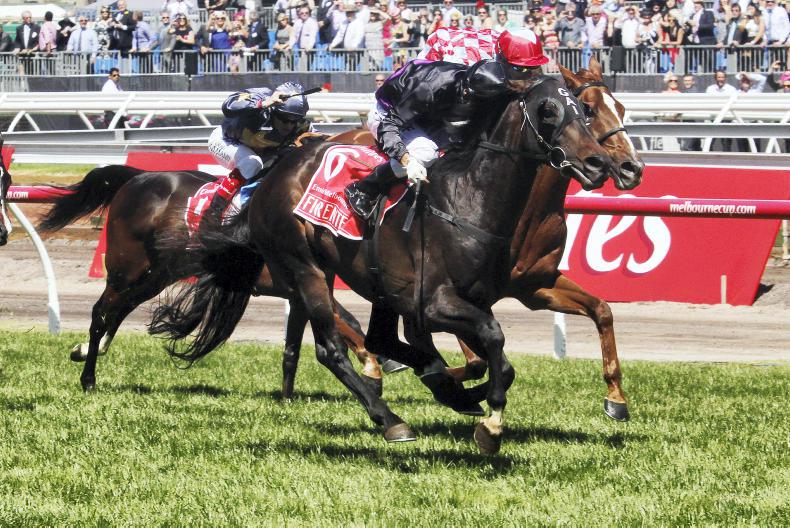
The 2013 Melbourne Cup winner Fiorente was one of the Cup winners sourced by Hubie de Burgh \ Colin Bull
“And I bought Green Moon for Lloyd and Nick Williams who also went on to win the Melbourne Cup in 2012. So once you had a few Melbourne Cup winners in, business took off because clients trust your judgement.
“We also got lucky quite early on because I had a guy that I worked with in Hong Kong and we ended up buying Lucky Nine off Andy Oliver and he won seven Group 1s in Hong Kong and was a champion sprinter.
“When Richard Gibson started up training in Hong Kong, we sold him Gold Fun and he won three Group 1s.
“In America as well, we had a Breeders’ Cup Juvenile winner Flotilla, we bought her as a yearling at Deauville. God we sold her after she got beaten in a group race. Someone came along and bid so much money for her after she got beaten that we sold and went and had the most drunken lunch you’ve ever seen in your life! Patting each other on the back.
“Clock forward three months she won the Breeders’ Cup Juvenile and the following year won the French Guineas. So they had the last laugh on us!”
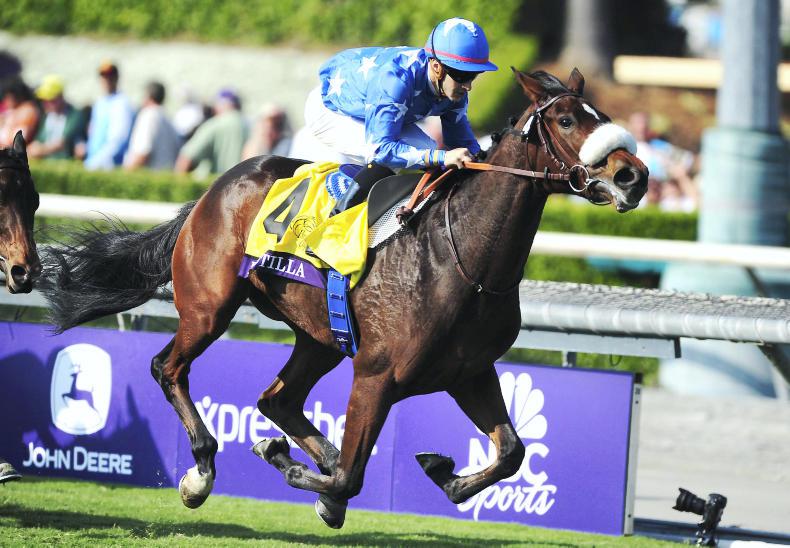
Breeders' Cup Juvenile Fillies Turf winner Flotilla was bought by Hubie de Burgh at Deauville \ Healy Racing
What type are you looking for?
“It depends whether we’re sourcing the yearlings or the proven horse, which is very easy because you know if they’ve already got an engine. For the other ones, they’ve got to be able to walk, to have good balance. They’ve got to have length, I don’t mind them not being too tall. They’ve got to be good from hip to hock, to have a good strong hind leg on them. An athletic sort of horse - everybody says the same thing!
“We work with two big syndicating groups in Australia, Darby Racing and OTI who are more into the improving stayers even though we actually bought that Derby winner this year as a yearling.
“Darby Racing are leading syndicators in Australia and they’re based out of New South Wales and are fascinating guys. They’re looking for speed horses and probably have 100 horses in training.
“Australia is light years ahead of us in Europe in digital marketing. All their selling of horses, all their management of horses, because I would be involved, I probably have shares in maybe eight horses with them in Darby Racing, I’ve seen it. And I’ve got overseas clients in horses there too and the communication structure is so good.
“You can sit in Europe and own a horse in Australia and actually feel that you’re in Australia.
“It all starts from the day they (the syndicate) buy the yearling, they have it on their site within one minute of signing it and it works all the way through to the time they go to the breakers, go into training, go on to the sales – it’s just a follow on of information, information all on your iPad when you wake up in the morning.
“They have a number of trainers, if you do not work under their structure in Australia you’ll be out of business. If you don’t keep your owners informed they move on to people that do.”
Who are these syndicate owners?
“That is the charm of Australian racing, the demographics of horse ownership in Australia is completely different to ours here. I would have met, especially in the Darby Racing syndicate, at least 50 of their owners and of those 50 I would say 40 of those are under the age of 35.
“Coming from all walks of life – crane drivers, Uber drivers, they can be landscape gardeners, waiters.
“They engage with their horses, go out onto the track, see the horses work. Darby Racing also produces merchandise with their logo if you want to deck yourself out.
“Prize money is excellent, not just for the bigger races or the prestige races and this encourages owners to hang onto their horses rather than selling on.
“Racing is reported in the mainstream press with daily pull-outs with news and form. Many of the meetings are arranged around carnivals and festivals with all the razzmatazz that goes with it. Even the best dressed competitions offer huge prizes and generate the party atmosphere.
“A syndicate member can put A$2,000 in and own 1% of a horse.
“For example, Golden Slipper winner She Will Reign cost Darby Racing $20,000 as a yearling. The people who invested in her put in A$2,500 each. She won over A$3 million in prize money and then we sold her to Japan for over A$2 million. Those guys’ original A$20,000 purchase picked them up millions between the prize money and what she was sold for.
“The Australian model is the future if we want fresh blood and younger owners to invest in bloodstock.”
the Impact on racing
“Thank goodness the breeding side of the industry kept going or there would have been a disaster in the two-year-old numbers for 2023 but undoubtedly foal numbers will drop and value of bloodstock will drop all round. The top end will drop 10-15% and so on down in scale.
“But costs of production will also drop. Just looking at some stallion fees in Australia, out of 169 stallions, 102 have had their fees dropped – they have to.
“Ireland is well placed to bounce back. We can continue to produce stock of the highest quality, produce for which we are highly respected globally.”
Any idea of slowing down, cutting back your work rate?
“I can’t really!
“But I would like to think I have been influenced by my two mentors to keep going.
“The great Australian trainer Colin Hayes is one. I never worked for him but the time spent with him was an extraordinary experience. He was a visionary, way ahead in his methods and marketing.
“Listening to him as he looked at a yearling, I learnt so much and unlike a lot of genius trainers who don’t speak, he talked out loud. It was fascinating
“My number one mentor was my father John. He foresaw the globalisation of racing. He always encouraged travel, he always supported young people. If you don’t travel you don’t stimulate new ideas or make new contacts and that’s been my experience.”