IN the 2003 Irish Racing Yearbook, Brian Graham and Justin Carthy were interviewed to review the current climate for the on-course bookmaker. That year, on-course bookmakers turned over just short of €181 million on ‘home’ betting alone. The figure rose past €200 million in 2007.
In the article Graham and Carthy talked about the transition of chalk boards over to electronic boards, that this was something the ring needed to match the vibrant and exciting atmosphere at the majority of Irish racing fixtures.
A penny or two for those problems today.
The situation for Irish on-course bookmakers is bleak. Ever since that aforementioned 2007 year, the turnover figures have been on the slide; a total fall of €142,370,503 to last year’s figure €59,738,516.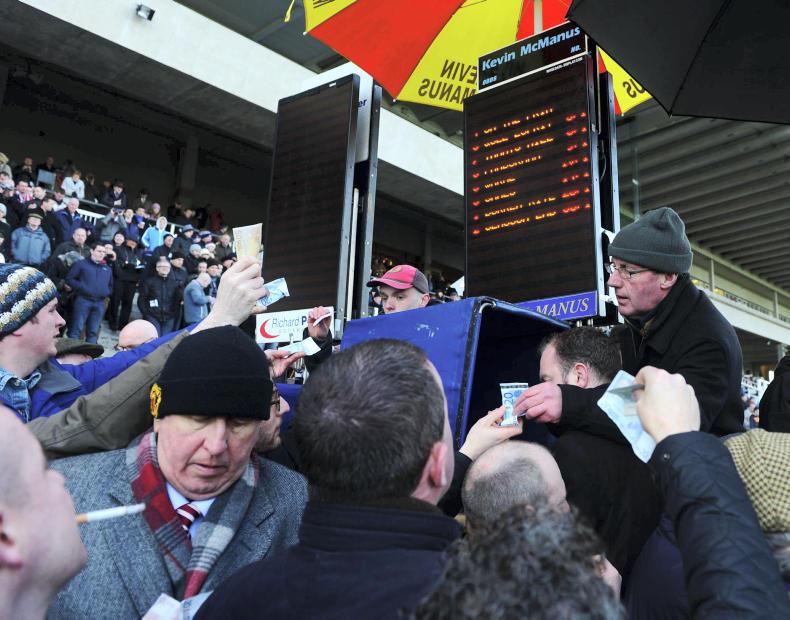
The advent of online betting and exchange betting, declining attendances at the racecourse, uncompetitive racing, and Graham’s allegation of an uneven playing field for on-course bookmakers to compete for business with Tote Ireland, have all been suggested as a collective force driving down turnover.
Graham, head of his family’s Sean Graham bookmakers, and a few of the other big names in the ring, have stood still when everything in the middle has plummeted.
Graham is currently involved in a case against HRI which involves the seniority rights for on-course bookmakers with regard to premium pitches. This is only one instance the Belfast bookmaker believes HRI could be dealing with more fairly. He answered questions on all of the above to The Irish Field this week.
Every time racing statistics are published it seems the one constant is falling bookmaker turnover. Is there any way back for the bookies?
Turnover in the betting ring has been falling since 2006. At this moment in time there are also so many more ways in which a punter can place a bet. The overall popularity and market share of horse racing in the betting shops has decreased dramatically over the last 15 - 20 years, turnover on horse racing in the off-course market is now below 50% from a height of almost 85%. This transfers to the racecourse and the numbers who follow the sport on a daily basis.
To stay in business individual bookmakers need to be pro-active and look at ways of attracting punters back to the racecourse. I don’t believe that this translates to simply offering guaranteed odds or double result. The off-course market can sustain these enhancements because they are taking bets on up to 60 races on a day. On-course bookmakers have only seven events to bet on daily.
Other on-course bookmakers Daragh Fitzpatrick and Jim Desmond believe the only way forward is to hold multiple pitches on a raceday (master/slave prices) and take in bigger turnover. Do you agree?
I would agree in principal. We now have multiple pitches at many racecourses. Multiple pitches should increase turnover but it also increases daily expenses and all overheads. Having multiple pitches at Fairyhouse for Easter makes sense but these extra pitches have to be worked on all the industry days as well. Fairyhouse is one example of a racecourse which has more “industry” days than “worthwhile” days. Bookmakers are required to pay a daily pitch fee whether they work or not.
What could HRI be doing to help and why should they?
As the regulator of all betting which takes place on the racecourse HRI is obliged to regulate impartially and fairly on all betting operators. At this moment in time this is clearly not the case.
Tote Ireland, which is a subsidiary of HRI, is not subject to the same charges or restrictions which are placed on the bookmakers. Bookmakers are obliged to adhere to the Seniority & Pitch rules and are also subject to a code of conduct. There are no such guidelines for Tote Ireland. I have requested a copy of the rules which govern Tote Ireland, but have yet to receive it.
The bookmakers don’t need “help”. What they require is a level playing field to compete against Tote Ireland. As long as HRI regulate the bookmakers they should not be allowed to run Tote Ireland due to an obvious and glaring conflict of interest. Is it not highly irregular and unethical that the body that operates Tote Ireland is allowed to regulate the on-course bookmakers who it competes against on a daily basis?
In any other business environment such a relationship would not exist. Aer Lingus would be out of business in the morning if Ryanair were allowed to regulate their business, and imagine the uproar in the racing world if ‘trainer A’ was required to pay double the entry fee for his horses compared to ‘trainer B’?
If Tote Ireland were an independent entity it would not receive the same commercial advantage which it enjoys under the self regulation of HRI.
What is the average bet on-course nowadays? Does the fact that many people don’t carry €100 notes (or cash at all) affect trade?
The average bet nowadays would probably be €15-20. We do have the facility to accept cards on the racecourse but the uptake would not suggest that we are going “cashless” anytime soon.
Improved WiFi being rolled out at racecourses now. Could this be a final straw?
It might be. It seems that the powers that be would like all of the betting which is done at the racecourse conducted through cyberspace. The turnover charge from internet betting is greater than what HRI receive on the racecourse from the bookmakers. Will this not lead to even more turnover leaving the betting ring?
How would you describe your own relationship with HRI at the moment?
I have always maintained that HRI do/have done more damage to the betting ring than good. In May 2014 I wrote a letter to The Irish Field replying to an article in which Kevin Blake questioned the “relevance” of the on-course bookmakers.
Paul Finegan, Head of The Betting Division of HRI, replied to my letter and claimed that HRI were “supportive” to the bookmakers.
On Derby Day 2017 Tote Ireland took a full page advert in The Racing Post. The advert also appeared in the racecard on the day. It featured “Dermot” with the slogan “Dermot throws money away by betting with the bookies at the Curragh…Don’t be like Dermot.”
Having claimed that HRI are “supportive” towards bookmakers in 2014, a subsidiary of HRI in 2017 tried to encourage punters NOT to bet with the on-course bookmakers on one of the busiest days of the year. From the evidence provided, I stand by my comments which I made in 2014 and believe that my conclusions (bookmakers need an impartial and independent regulator) have been vindicated.
How many shops do you have at the moment, and how does trade in the north compare to the Republic?
We currently have 34 betting shops.
Horse racing is losing market share year on year. On a Saturday afternoon we now hold more money on football than on horse racing. Almost all four-figure bets which are taken in the shops are placed on football as opposed to racing.
The turnover percentage on horse racing in the south would be slightly higher than the north. Average stake is also slightly greater in the south.
Do you have FOBTs in your Northern shops? If so, how will the new regulations affect business?
We do have FOBT’s in Northern Ireland. Without up to date legislation, we have followed the regulations which exist in the UK mainland. The machine “culture” which exists in the rest of the UK does not seem to apply to Northern Ireland.
Scotbet, who operate 80 shops in Scotland, have announced that the reduction in stakes on FOBT’s will lead to closures. If this is replicated throughout the UK the media rights deals which many of the racecourses rely on, could be under threat.
How is the lack of political leadership (Stormont closed) in the north affecting business?
The lack of government has had little impact on the betting sector at all. Prior to the “closure” of Stormont 18 months ago, we were still governed by betting legislation which dates back to 1985. There were many efforts made to update the legislation but without the backing of the DUP it was never going to happen.
Betting shops in Northern Ireland are still not allowed to open on a Sunday. This has led to a huge increase in illegal gambling taking place on licensed premises at the weekend.
Do you have any online presence or is that too competitive for independents?
We were on line over 20 years ago and found that credit card fraud was our biggest problem. Punters, who seemed to lose, simply phoned their banks and made charge backs on the funds which we had taken.
Nowadays that problem doesn’t happen with debit cards but to have any presence on line would require massive investment. So many firms have entered the market and failed with huge debts.
With all the bad publicity for punters not getting a price or even getting on at all online, is there anyway on-course bookmakers or shops can exploit this to their advantage?
The main problem about punters “getting on” doesn’t apply at the races. Off-course punters nowadays expect to get double result, full dead heat and guaranteed odds. Horse racing as a product is viewed as a loss leader for many of the internet firms. They bet “over broke” on selected races to entice punters to have a bet. This has an impact therefore on the “professional” punters who can’t get on at these grossly inflated odds.
You told me about a recent initiative whereby you brought a bus of people to a couple of big racedays last year? Tell me a bit more, has this been effective?
Over the last nine months I have launched the Sean Graham Racing Club with the support of a local West Belfast paper. We try to put an affordable package together which includes a breakfast bap, coach to the races, entrance, pint and a matched bet.
We took 40 to Morgiana Hurdle Day at Punchestown in November. We had 50 booked to go on Easter Tuesday to Fairyhouse, which unfortunately was abandoned. We had 40 to Down Royal on May Day bank holiday. We had 150 (three coaches) to Downpatrick on Fathers day in June. The last two have both been to Down Royal, Friday 27th of July and last night when we had 40 on each day.
Hopefully we would like to visit Navan and Naas before going back to Punchestown in November.
How many Irish tracks do you stand at and which ones are best/worst?
We have seniorities at every track in Ireland apart from Cork. I have been a licensed bookmaker since I was 18 years old and I still enjoy the buzz going racing.
I don’t dislike going racing at any particular track. I do however find the increasing number of “industry “days very monotonous and boring.
How could tracks improve the experience for punters and bookmakers?
I believe that racetracks are now catering for the off-course market and have overlooked the needs of the punters who come racing on a regular basis.
Here are five ways it could be improved:
The Galway Festival this year ended on a Sunday and was a fantastic week. However many people wondered why there was a requirement to have eight races on the last day with the last race at 6pm when most people, who had been there all week, wanted to get home?
Would it not be a better idea to have the eight races on Friday evening which attracts the largest crowd and have seven on Sunday and finishing at 5pm?
What was your view on the Dundalk v bookmakers legal row?
It was a regrettable incident which did neither Dundalk nor the bookmakers any good. I still believe that the bookmakers had no option but to defend their seniority rights.
David Power sold his pitches last year. A few of them were worthless. Did that surprise you?
Not particularly. The top pitches which David sold made very good money. I was sorry to see him retire. He was the same generation as my father and was very highly regarded in the ring. I spoke to him at the Curragh last weekend and he loves his racing and seems to be enjoying his “retirement”.
And finally, without getting into the nuts and bolts of it, what are the implications of a hard or soft Brexit on Sean Grahams?
Having businesses on both sides of the border could be a logistical nightmare. Any type of hard border would increase travel times on a daily basis. I presume that the costs of goods and services would also go up.