IT can’t get much better. You are a small trainer, just making your way in the business and 37 years of age, and you are responsible for a 14/1 outsider in the very first race of Royal Ascot, the Queen Anne Stakes, when everyone is watching and expectation levels for the days to come are through the roof.
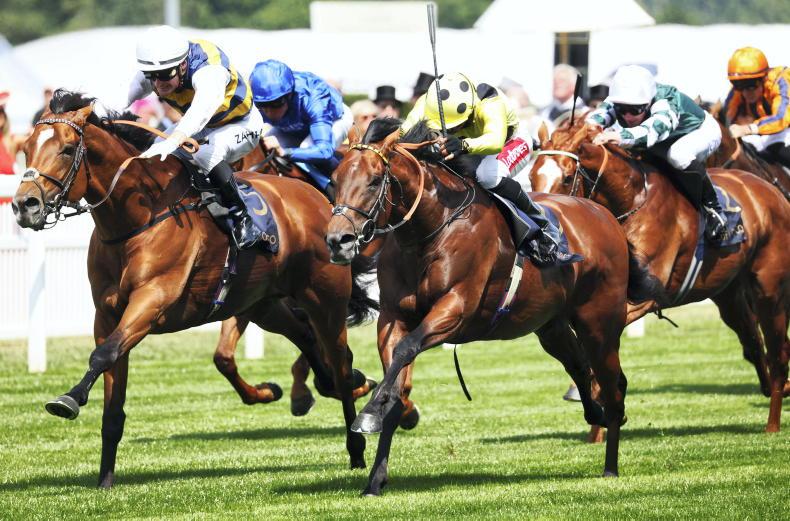
Your charge comes scything through the field prior to a final furlong duel which produces a photo finish so tight even the television ultra slow-motion cannot predict it with any certainty. The number is announced and you’ve won, the global spotlight glares upon your shoulders and congratulations rain down from all sides.
This is precisely what happened to Harry Eustace this June, thanks to his stable stalwart and Ascot specialist, Docklands.
Hard to beat but just about possible to repeat, provided your scriptwriter has a vivid imagination. Blow me down, Hans Christian Andersen himself must have been operating the autocue as, just three days later, the whole thing happens again when Time For Sandals, even more unexpectedly at odds of 25/1, carries off the Commonwealth Cup.
The international standing of Royal Ascot seems to increase with every passing year to the extent that few would now question its preeminence, and the shiniest jewels in its crown are the Group 1s. Only eight are staged each year, and Eustace has just won two of them.
Seven weeks have elapsed when, sat in the office of his Highfield Stables in Newmarket, I ask Eustace to try to make sense of it all. “I can’t really explain it,” he admits. “I think people who have been training for a lot longer than I have might comprehend it more than I can.
He was the first one I hugged, and that is literally what it’s all about, isn’t it?
Vivid memory
“I don’t think that I will really appreciate it until I haven’t managed to repeat it 15 or 20 years down the line. To have a yard of 55 horses and win a quarter of the Group 1s, it was incredibly special. One very vivid memory is when the result of the photo was announced, hearing number five. I’ll never forget ‘number five, Docklands’, as it came across the tannoy.
“I was standing right next to my brother [David]. He was the first one I hugged, and that is literally what it’s all about, isn’t it? And then Mum and Dad were there too and it snowballed from there.
“That moment was something that we’ll all remember. It was our first Group 1 and to do it with a horse who means a huge amount to us as well.”
In our 24/7, 365-days-a-year sport, which nowadays seems to lack any seasonal boundaries, some people forget to celebrate properly, obsessed with the next mountain to climb before the crampons have been released or the ropes untied at the previous summit.
Thankfully, the Eustace family have things in perspective, partly because Harry’s father, James, trained for over three decades without ever scaling the heights of Group 1 glory.
“We’ve had multiple celebrations,” his eldest son reveals, “one in particular for my staff.
“I am always very keen that it happens as soon after the event as possible, because it’s fresh and it’s to show my appreciation for them. So we booked up The Tack Room [the café renowned for its tasty offerings, which is inside the walls of the National Horseracing Museum, a minute’s walk from Park Lodge Stables, where the Eustace boys grew up and their parents still live] for the evening the very weekend after Ascot.
“We have a great relationship with Ciaron Maher [the many-times Group 1-winning Australian trainer, who held a joint licence with David until Eustace junior opted to move to Hong Kong to train a year ago]. They celebrate every single Group 1 success in roughly the same way that we did. It’s a real lesson. They take none of them for granted. And we were keen to do the same.”
Pigeonholed
Miracles do happen in racing, but this incredible double should not be pigeonholed as a water-into-wine magic trick. Eustace’s fondness for conjuring up winners at the Berkshire jamboree goes back to his first full season with a licence, 2022, when Latin Lover bagged the Palace Of Holyrood Handicap. And Docklands was second in the 2024 Queen Anne having annexed the Brittania Handicap 12 months earlier.
The Group 1s apart, Eustace saddled two other runners at the meeting this year. La Botte only failed by a neck to land the Brittania, having been caught in traffic and forced to burrow his way up the inside rail, while Divine Comedy was stopped on numerous occasions up the home straight yet still somehow managed to finish within two lengths of the winner in fifth in the Ascot Stakes.
Asked to reveal the secret formula to his ridiculous Royal Ascot strike rate, Eustace deflects the compliment like an England batsman flicking a bouncer off his nose into the pavilion at the Melbourne Cricket Ground.
“A lot of it is luck,” he says. “Docklands is mainly owned by Australians [in the form of OTI Racing]. So Ascot for them is more important than any other meeting and, as a three-year-old, we deliberately plotted a course for the Britannia. Say he’d been owned by anyone else, he most likely would have gone for a Guineas trial and would have blown his handicap mark.
“Docklands just is very good and loves the place because it suits his attributes. He’s got a big stride and he travels supremely well, but he does need time to lengthen. He can travel at any pace and finds that well within his comfort zone. As the others are beginning to hit the red zone, he’s working his way into it.”
Since his June heroics, Docklands has taken part in a bizarre renewal of the Sussex Stakes, finishing almost five lengths behind both the shock winner, Qirat, and his Queen Anne victim, Rosallion, who sat too far out of his ground before staying on into second. The prize money he earned for fifth took his career bankroll to within £70,000 of breaking the £1 million barrier.
“The Queen Anne was a funny race because, even though they didn’t go quick early, they got racing a long way out,” Eustace admits. “Not only did we win on the bob, we also had that extra run that Rosallion probably needed. He looked like he was going straight past us and we managed to fight back.
“He put us to bed at Goodwood last week and looked very impressive, but it could be fascinating if they meet again in France [in the Prix Jacques le Marois on August 17th] on a straight track.”
The plan after the Marois is back to his beloved Ascot for the QEII in October, possibly taking in the Prix du Moulin en route, before a second tilt at the Hong Kong Mile in December, his owners having enjoyed their time there so much last year.
Docklands finished unplaced, but Eustace blames himself for experimenting with blinkers that day.
“We’re well aware that Docklands isn’t a champion miler, he’s just a very good one, so his best chance of winning another Group 1 is by running in plenty of them. And he is easier for me to train when he goes to the races than he is trying to space out his runs.
“He loves being a racehorse, he really enjoys travelling in amongst horses and being competitive with them. Sometimes he gets outsprinted but he’s usually one of the last off the bridle, particularly at Ascot, and that’s what he absolutely thrives on. He always comes back from races almost in better form than he goes in to them.
“I think part of that is why running in Australia did not work out for him late last year, because he was out in quarantine. There are no horses there. He didn’t race for a number of weeks and he got bored.
“We tried to take him away and get him to Moonee Valley, as he needs his competitive juices flowing. But the travelling really hardened him up and I think he’s a better horse than last year.”

Goodwood
As for Time For Sandals, she also ran at Goodwood, finishing three-quarters of a length third in a King George Stakes run on good to soft ground.
“I thought she ran very well, I didn’t really have any excuses, and she’s probably come out of it better than she did after Ascot,” Eustace reports. “The softer ground was fine, Richard [Kingscote, her jockey] said that she handled it no problem.
“She did get stopped in her run because she didn’t have the pace to go through a gap when it came and then it shut. So Richard had to take back. What I particularly liked about her run was that, having got stopped, she managed to have another go.
“In those five-furlong sprints, if you get chopped off like that, rarely do you ever get back into the race like she did, so I was pleased with that.
“She was a three-year-old taking on older horses for the first time, back to five furlongs with a Group 1 weight penalty to carry, so we stacked it against her as much as we possibly could and I thought she came out with enormous credit.
“She won’t go to York [for the Nunthorpe], she’ll either go to Haydock for the Sprint Cup or The Curragh for the Flying Five. I’ve been very conscious all season to space her races out because her year is next year, that’s what we’ve always felt.
“We started this campaign like a lot of people do with a three-year-old filly, trying to see if you can go the three-year-old mile route. So this year was always going to be tough for her.
“I was pretty comfortable with trying five furlongs at Goodwood, but I thought she travelled much better through the race at Ascot. So I think six is probably better. But there are rumours that Lazzat goes to Haydock and you would think he’d be pretty tough to beat.
“I thought Lazzat was impressive at Ascot, if you take the Japanese horse [runner-up Satono Reve] out, he looked head and shoulders above the rest of the sprinting division. I don’t want to avoid one horse, but do we need to take on the best sprinter in Europe, if there’s a similar race eight days later?
Double at Royal Ascot
“We’re very conscious of trying to manage her workload this year, because I think next year we could be a bit aggressive. The Tuesday and Saturday double at Royal Ascot as an example. Why not go for that sort of programme?
“So it’s trying to get her through this season injury-free before giving her a proper holiday. We’re looking at two more runs maximum.
“If she doesn’t win her next start, that could be her done for the year. And, if she does, then we’ll have to entertain Champions Day. She started in the Fred Darling, so it’ll have been a long year.”
One remarkable quirk linking all three of Eustace’s Royal Ascot winners is that they were each purchased at the Tattersalls Ireland Yearling Sale, more recently in conjunction with the bloodstock agent, David Appleton.
“There is no logic to it,” concedes Eustace, with a smile. “The one thing I do think is that it isn’t a renowned, fancy sale, it would be what I call a ‘trainer sale’, where you get an array of horses not only one type of physical.
“Nice horses are available at relatively sensible money. It’s a sale that a lot of trainers go to. And then, as trainers get more successful, probably it is one of the ones that they stop attending. It’s a more competitive sale for us than some others.
On the back foot
“Last year was a prime example. Doncaster, Tatts Ireland and the Orby all happened and the market was sensible and then Tattersalls Book 1 started and it went absolutely bananas. Suddenly, you’re a bit on the back foot, but if you’ve already bought at those earlier sales, you’ll feel that you’ve got a bit of value.”
It doesn’t take long in Eustace’s company to gain the impression that here is a thoughtful young man who, while often falling back on a self-deprecating sense of humour, works very hard and takes the responsibility of running the family business incredibly seriously. He took over the licence at Park Lodge from his father in April 2021. Less than three years later, he had grown the operation sufficiently to necessitate the move to bigger premises at Highfield.
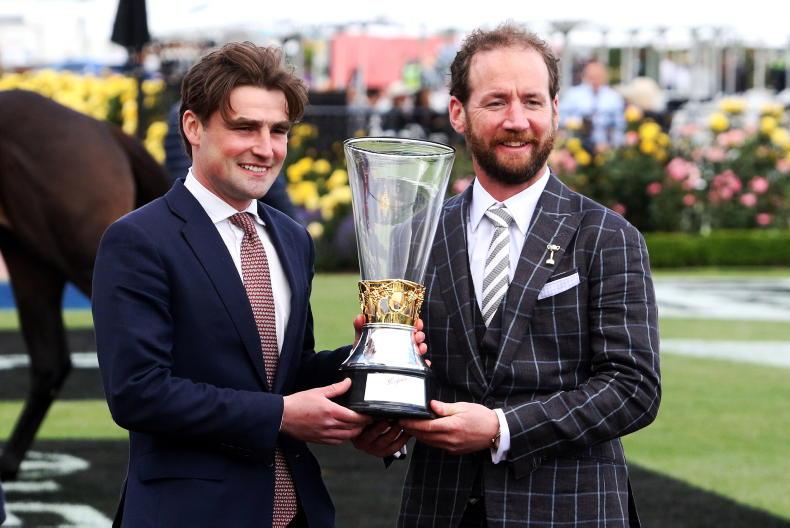
Harry's brother David Eustace and Ciaron Maher after Hitotsu won the Group 1 Victoria Derby at Flemington \ Colin Bull
His mother, Gay, is the daughter of two trainers, Alan and Diane Oughton, and when they died, her brother, David, took over before relocating to Hong Kong, where he trained for almost 20 years and enjoyed a number of big race successes, none bigger than when Cape Of Good Hope jetted into the Royal meeting in 2005 to plunder the Golden Jubilee Stakes.
Both Harry and his brother became passionate about all things racing from an early age. Though Harry did well enough at school to gain a place at Edinburgh University to study chemistry, it was no great surprise that he only managed to make it halfway through a course that was meant to last for four years.
Instead, as well as spells operating as his father’s assistant and working for fellow Newmarket trainers Chris Wall, Jeremy Noseda and William Haggas, he took off around the racing world, completing the Irish National Stud training course and working for Lee and Anthony Freedman and Peter and Paul Snowden (in Australia) and for Christophe Clement (in America).
He looks back on his time with Clement particularly fondly. “The biggest jump I took in my apprenticeship was when I worked for Christophe,” he reflects. “His recent death really hit me hard.
Fantastic man
“He was just the most fantastic man and an excellent horseman. He expected very high standards and was a big family man, so nothing would have given him more joy than having [his son] Miguel with him in his final years and seeing how well he’s done. The whole point of everything for him was being able to hand the business on.
“He never rushed his horses, was very patient, and his attention to detail was incredibly high. He was also a very logical thinker, he made you question why you did things and explain why you did them. Once you are in that routine of saying to yourself ‘this is just how it is done’, the moment that starts happening, that’s where complacency kicks in.”
Although the monthly accounts meetings run by his mother, which held sway in the early stage of his tenure, have slipped away (much to Harry’s relief), his parents remain heavily involved and are endlessly supportive. The transition from father to son has been remarkably smooth and James still rides alongside the Eustace Racing string every day on his hack.
When I suggest that there must have been disagreements, Harry’s response is a considered but firm denial. “My father had done it for 30 years and I think he was ready to take a step back,” he asserts.
“I didn’t have to wrestle it off him. I’m sure he has bitten his tongue a lot and let me make my own mistakes. They’ve both been incredibly good about it, a constant support to my brother and I.
“The best bit for me was that I took over a very healthy business and no financial headaches came with it.”
If Harry does need a sounding board, a second opinion, or a shoulder to cry on, it is as likely to come from his brother, who reached the pinnacle in Australia when Gold Trip, who he had prepared in partnership with Maher, won the 2022 Melbourne Cup.
Bounce ideas
“David and I are very close,” Harry says. “We are in contact daily, whether it’s via WhatsApp or on the phone. I probably bounce ideas off my brother as much as anyone else, mainly because he’s trained in different jurisdictions, so comes at it from a different angle.
“And when he comes back to visit or I go to visit him, we’re just very easy in each other’s company. We’re very proud of what each other has achieved.”
When I tiptoe gently onto the subject of his not having saddled a two-year-old winner so far this season, he is unflustered, quick to point out that he has run a mere handful of his 26 juveniles and even admitting that, despite having handled some useful youngsters during his short career, he is ‘not very interested’ in juvenile racing and much prefers conditioning milers and stayers.
He also highlights the dominance of mile-plus races for three-year-olds and above in the race programme and the fact that middle distance horses only need to get to a relatively modest level in order to have a sell-on value, unlike their sprint counterparts.
Ambition
The level of his ambition becomes crystal clear when I ask how he feels that the first four years of his training life have gone.
“Before Ascot, I didn’t feel we’d done enough,” he replies. “But I think every trainer goes through every day thinking that.
“You always want more. I suppose Ascot has eased my mind about it a bit - I felt like we’d potentially underperformed to that point.”
I leave Highfield struck by what a happy organisation it seems to be and marvelling at the tight-knit bond of the Eustace family.
Harry Eustace Racing can now boast such big-hitters as Wathnan, Shadwell, Nick Bradley, Airlie Stud and David Redvers among its owners and, while it may never exceed its 2025 total of Group 1 victories at a single future Royal Ascot, it would be a big surprise if further top level success does not come along pretty soon.