NOBODY has ever doubted that David O’Meara is a good trainer. Starting from humble beginnings, both professionally and geographically, this former jump jockey from Fermoy, Co Cork, wasted no time in making his mark both forging and keeping a reputation as one of the most able handlers in Britain.
He has won nine Group 1 races with six different horses at a variety of locations on either side of the Atlantic. His bread and butter has been handicaps and, under both codes, he has won over 1,600 races, but one thing that his best horses have all had in common is that they had previously raced for other yards before joining the O’Meara string.
Thanks to Estrange, that may be about to change. This daughter of Night Of Thunder, who is a potential contender for next Saturday’s Group 1 Pretty Polly Stakes at the Curragh and a leading candidate for Europe’s most prestigious race, the Prix de l’Arc de Triomphe in Paris in October, is all his own work.
Unlike most other leading trainers, in particular ones that, like him, made a fast start to the job of conditioning thoroughbreds, O’Meara had no great family background in the sport or outstanding record as a jockey, before applying for his licence.
His parents, though stalwart volunteers at the local point-to-point and more than willing to ferry him around the countryside as a child to take part in pony racing, earned their livings via estate agency and physiotherapy.
And, following an equine science degree at Limerick University, his career in the saddle brought no more than 120 wins under rules in 11 seasons, the high watermark coming when he guided the Philip Hobbs-trained Bells Life to victory in the Aintree Foxhunters when still an amateur in 2000.
His enquiring mind was constantly on alert during spells working for Jim Bolger, Michael Hourigan, Hobbs, Peter and Tim Easterby and Kevin Ryan.
On his own
Once he first started out on his own in 2015, even with the limited facilities provided him by Roger Fell at Nawton in North Yorkshire, O’Meara was quick to prove that he had a magic touch, improving recruits from other stables to such an extent that an eight-year-old hurdler called Blue Bajan suddenly transformed into a Group 2 winner on the level.
Penitent and Custom Cut were next off the production line, sourced from William Haggas and George Kent respectively, and every subsequent top-class O’Meara horse has begun its career elsewhere: G Force, Move In Time and Amazing Maria from Richard Hannon, Bryan Smart and Ed Dunlop; Mondialiste, Suedois and Lord Glitters from three French stables.
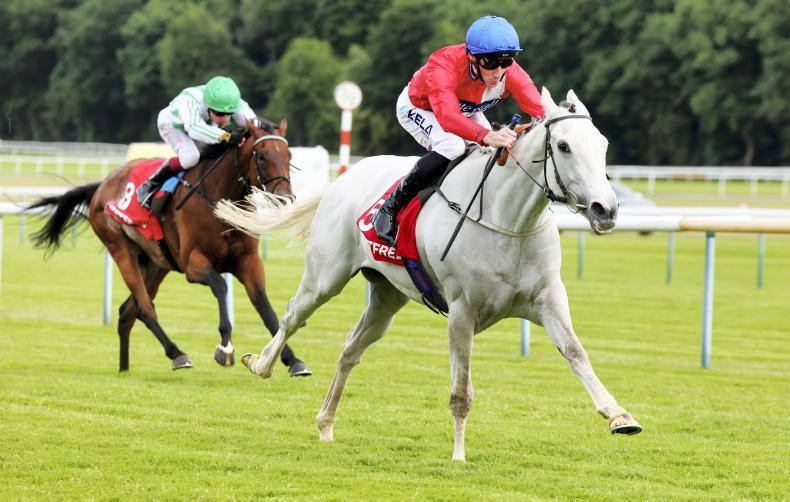
Estrange is a different type altogether. Owned and bred by the Thompson family’s Cheveley Park Stud, who have been supporting O’Meara for some dozen years now, Estrange was originally sent to John and Thady Gosden in Newmarket but didn’t see a racecourse before the Thompsons, and their racing manager Chris Richardson, had a change of heart and sent her up north last summer.
Needed time
“She’d had a little bit of trouble tying up and was maybe a little bit backward and needed a bit of time,” O’Meara explains. “Chris [Richardson] asked us if we’d take her and give her a bit of a change of scenery and see how she got on.”
Her physical issues have never resurfaced. “To be honest, by the time she came to us, she’d been back at Cheveley Park for about three weeks and she has been pretty straightforward ever since, touch wood,” O’Meara continues.
Maybe it was her new keeper’s regime or simply the Yorkshire air, but it soon became apparent that this unraced three-year-old could run a bit.
Also, perhaps surprisingly given that she is out of a half-sister to the St Leger winner, Logician, and her own half-sister, Lmay, had just been placed over a mile and six furlongs at Royal Ascot, she was not short of speed.
A bit special
“I think it was only about a week after we first saw her that we began to think that she could be a bit special,” O’Meara remembers. “From the very first time we worked her, we kind of knew that she was above average.”
Hence, late last August, she was deemed worthy of a journey all the way down to Goodwood to make her racecourse bow, and the 530-mile round trip was justified when she dotted up in maiden by five and a half lengths.
Immediately elevated to listed company, she caused a few furrowed brows when only managing seventh in the John Musker Stakes at Yarmouth but, given time to recover, redeemed herself with an all-important first blacktype victory at Doncaster in November.
Looking back on the Yarmouth debacle, O’Meara says: “It was a sharp mile and a quarter on lightning-fast ground and it was a rough old race, she got blocked. Going there after just one run in a maiden was probably a bit of a baptism of fire and it was a combination of things, led by the ground, but she got back on track next time.”
Over the winter, confidence in her ability continued to snowball, to such an extent that, when she reappeared in the Group 3 Lester Piggott Fillies’ Stakes at Haydock on the last day of May, not just a win but an impressive success was expected. She didn’t let her supporters down, cruising home over four lengths in front.
“Although I would have been delighted if she’d won, some bit of me would have been a small bit disappointed if she hadn’t have won in the style that she did,” O’Meara says. “If she’d have scrambled home by a half a length, I would have been ever-so-slightly subdued.
“It was good ground, although it wasn’t fast, and her two previous wins had been on soft, so that was a slight question mark. The other query was, being by Night Of Thunder out of an Oasis Dream mare, whether she would stay a mile and a half, although she looked for all the world like she would.”
As for the likelihood of his standard-bearer crossing the Irish Sea for her next start to contest the Pretty Polly, he responds: “I don’t feel the need to go beyond a mile and a half at the moment and, whether we decide to come back in distance and point her at the Pretty Polly, that’ll be a decision made between the owners and Chris Richardson. If the ground was soft, it would definitely be worth considering.”
“The obvious next race would be to go back to Haydock for the Lancashire Oaks, but that’s only if the ground isn’t too quick. She’s been solid on a softer surface, so you would probably be happier in those conditions again.”
One of the first
Cheveley Park, who first saw their famous red, white and blue silks carried by an O’Meara inmate aboard the sprinter Smoothtalkinrascal in 2013, were one of the first of the big owners to cotton on to his training skills.
O’Meara is understandably proud of this association, saying: “We’ve had some good horses for them, the Group 2 winner Larchmont Lad, the stayer, Repeater, and a nice mare called Perfection, and just last year we won the Greenham Stakes together with Esquire.
“The relationship with them is very good. We were only quite a young operation when then first got in touch and they’ve been sending us nice horses ever since. They’re very, very easy people to train for.”
Given that O’Meara comes across as a very measured individual, not one likely to go around bigging up the reputations of his charges, I wonder what it might take to coax him to put Estrange on a pedestal as possibly the best that he’s ever trained. As it turns out, no encouragement is required.
Unprompted, he extolls her virtues with the words: “Estrange may not have won a Group 1 yet, and we’ve had some that have won a couple, like Amazing Maria, Mondialiste and Lord Glitters, but this filly hopefully looks like she could be better than them all.
“The dream is to get her to the Arc. I enjoy having runners back home in Ireland too. Every year we send horses over for Irish Champion’s Weekend, we have won a few of the big Irish sprint handicaps and, going back a few years, Custom Cut did really well for us over there.”
Also looking back a fair way, it is now a decade and a half since O’Meara first got his name above the door of a training premises. How does he feel that it has gone?
Brilliant
“It’s gone great,” he replies. “We’ve done 12 years on the bounce with over 100 winners. I could never have expected it to have grown as quickly as it has. To maintain the numbers and the number of winners has been brilliant.”

“For the first six years, I was in partnership with Roger Fell at his place, which had a small little round gallop which was very difficult to train young horses on. I keep getting told that I made my name with handicappers, but we just did what we could with what we had.
“Since we moved to Willow Farm [on the outskirts of York, just 20 miles south of his original base] in 2016, we have an awful lot more young horses coming through. That’s what you need. Nowadays we normally hover around 135 or 140 horses at any one time. When we first got hold of the new place, it was a derelict farm that had been derelict for 10 years or so. The biggest thing for us is just the size of the place, 120 acres. We put up a few barns and redid the house, the other accommodation, the new office block, the roads.
Everything went in new, not just the uphill synthetic gallop and the round sand gallop. Even now, we are adding a bit here and there and updating every year with small tweaks.”
As for his key personnel, O’Meara is reluctant to pick out too many names, fearing that he will miss someone out and stressing the importance of the ‘team effort’. When pressed, he pays tribute to his long-serving head man, Aaron Bateman, and his stable jockey, Danny Tudhope.
“Danny has been with me almost from the start, I’m not sure that there has been a longer trainer-rider partnership anywhere in the country,” he continues.
He is also keen to give credit to Steve Parkin, without whom Willow Farm might still lie empty. “Steve very generously lent me some money to buy the place, which I paid him back within three years,” he reveals.
British racing
And what are O’Meara’s thoughts about the current state of British racing, with prize money lagging so far behind the rest of the world and the new BHA chairman unsure if he wants to take up the role?
“There’s far too much racing, in particular far too much low-grade racing these days,” he insists. “And I can see why. There’s an awful lot more low-grade horses so field sizes will fill better.
“I think that by trimming back the calendar, they’d improve the product. I get that neither the bookmakers nor the racecourses would want that because, for them, it seems that volume of runners and volume of meetings is what makes them the money.
“But for the sport itself, I think it would freshen it up and make it more appealing if there was a smaller fixture list.
Buying on spec
“Buying yearlings on spec and then trying to sell them on has become much harder. I think that even Richard Hannon, who might be one of biggest guys in the business for buying on spec, has said that he is finding it harder.
“That side of the job has tightened up while the big spenders seem to be spending bigger.
“It would be a pity if flat racing went a way that meant the small owner was less inclined to get involved.
“Thankfully, some of the large syndicates are still very strong, in particular the ones that have horses with me like Middleham Park, Rogues Gallery and Hambleton Racing.
“They all do such a good job and still seem to be buoyant, we’re delighted to have them in the yard.”
We are in serious danger of getting to the end of the interview without mentioning a single member of his current string other than Estrange.
In the nick of time, he signs off by pointing The Irish Field readers to Nighteyes, another four-year-old Night Of Thunder filly, but this time one that was bought by his assistant, Jason Kelly, for 150,000gns at Tattersalls as a yearling and who landed a six-furlong Listed contest at Naas last July.
Declared to run in the Group 1 Queen Elizabeth II Jubilee Stakes on the final day of Royal Ascot, she is clearly expected to be able to make her presence felt in top company before too long.
“I think Nighteyes could turn into a very good sprinter by the end of the year,” O’Meara concludes.