ANDRÉ Fabre is currently building the most impressive record in the history of thoroughbred racing in continental Europe.
Francis-Henri Graffard is on the verge of breaking the record for the most Group 1 wins by a French trainer in a single season.
But if you ask me who is the greatest trainer in the history of France, my answer will be quite different. This man, this genius with horses, was Étienne Pollet. In just a few decades, with fewer than 40 horses in his yard every year, he achieved absolutely incredible feats.
His pinnacle, of course, was Sea-Bird. Among the last apprentice jockeys under Étienne Pollet was a certain Gilles Ferland. And that is where our story begins.
Christophe Ferland told us: “After having been an apprentice with Étienne Pollet, my father rode in races for quite a few years. Later, he became one of the senior staff members at Mahmoud Fustok’s stable. After that, he worked for many years with Jean-Marie Béguigné, who at that time had a lot of good horses.”
Golden age
The son, Christophe, was thus born at the heart of Chantilly’s golden age, just a few hundred metres from Pollet’s stable, in the jockeys’ hospital. But who could have imagined that half a century later, the son would buy one of Chantilly’s most beautiful stables, just five minutes away, and that he would saddle the favourite for the 2025 Prix de l’Arc de Triomphe?
Since settling in Chantilly in 2023, Christophe Ferland has purchased the famous Wildenstein yard.
The very place where legends such as Allez France were trained. Much later, it was also where Doctor Dino began his career, trained by Richard Gibson… for whom a young man once worked. His name? Christophe Ferland.
This is the story of a former stable lad and then assistant who, 20 years later, bought the very stable where he had once been employed!
The Prescott influence
The story of Christophe Ferland is remarkable because it is that of a man who has always lived among horses and who has known how to make the most of an exceptional sense of timing - both in his professional choices and in the way he placed his horses.
Very early on, being physically more suited to rugby than to becoming a jockey, he realised his future lay in training. And in his education, he made decisive choices. One of them was to go and work for the legendary Sir Mark Prescott.
Was going to Prescott’s a matter of opportunity or a deliberate choice for the young Frenchman?
“I didn’t know much about English trainers. And Sir Mark, very well-known and respected in England, did not yet have the international aura he is recognised for today. I was then living in Lambourn, and the person who hosted me told me about an ad in the Racing Post: ‘This is the job that would suit you best.’
“So I did my research. Sir Mark Prescott agreed to meet me, but there were many candidates applying. A few days later, I got the job. It was two years at Newmarket, where I had a great time. With him, it was tough, but fair. With him, you really learn a lot by observing horses.”
And when one mentions Prescott, anecdotes are never far away:
“We had a little filly for Cheveley. She was very stiff at the walk and trot. But at the gallop, it was fine. The day before or two days before the races, we watched the horses trot in the yard. And she was really very stiff. Yet she went on to race and win. The next day, we saw her on the track, and she looked almost better. Sir Mark then declared: ‘Good gallop, work hard ground, nothing better.’ It was on the July Course. In the middle of July, it was hard!”
If Sir Mark Prescott ever reads these lines - he, the genius behind Pivotal, Alpinista and Alborada - may he forgive me for having said that he was “the best trainer of bad horses in the world”. From my mouth, it is a true compliment. Christophe Ferland reacts: “I don’t think he would necessarily enjoy reading that. But he has always trained the horses that were entrusted to him. And if they were not all good, he is clearly the trainer most capable of getting the best out of a very wide variety of horses, whatever their level of talent.”
It was exciting to be able to find the right race for each horse.
In the end, Christophe Ferland himself also managed to emerge early in his career thanks to this ability to win with as many horses as possible - good ones and not so good ones - all across France, quickly moving from being a young provincial trainer to a fashionable up-and-coming name: “Back then, the programme in France was structured differently. It was exciting to be able to find the right race for each horse.”
A question of timing
In 2008, barely 30 years old, Christophe Ferland decided to become a trainer. Yet he chose not to start in Chantilly, the training centre where he was born, grew up, and knew every track by heart. And for good reason: in Chantilly, it was impossible for a young man to make a name for himself at a time when André Fabre had Manduro, Alain de Royer Dupré had Zarkava, and Freddy Head had Goldikova.
Christophe Ferland chose to set up far to the south, at La Teste-de-Buch. The timing was perfect because France Galop, which wanted to develop racing in the regions, had reorganised the national programme. Suddenly, the south-west was becoming fashionable thanks to the classic wins of Jean-Claude Rouget and François Rohaut.
Christophe Ferland became part of this new wave. The gamble was that, at the time, there was a clientele who believed that in the south-west you could produce good horses while keeping training fees much cheaper than in Chantilly.
And all that with the benefit of France Galop’s transport subsidies, which reimbursed costs for bringing a good horse to Paris: “That was the way it was. We didn’t hesitate to cross France. A press article a few years ago even said I was the trainer who ran the fewest horses in the small tracks.”
With no real means to get started, Christophe Ferland nevertheless had the precious confidence of a Spanish owner, Javier Martinez Salmean, the man behind Doctor Dino. A very good horse - and now a leading National Hunt sire - whom the future trainer had looked after while working for Richard Gibson.
“I handled all the international trips with Doctor Dino [Hong Kong Vase, Arlington Million, Dubai Sheema Classic…]. Javier Martinez Salmean was a wonderful person. He was simply one of my first two owners, alongside bloodstock agent Frédéric Sauque. It’s always the same: there’s a huge difference between people who like you and those who really trust you with horses. Especially when you don’t have wealthy parents or a great trainer passing you their business.
“Starting from nothing is not easy. But there wasn’t really a transition period. I won races right away. Lots of wins - that’s what’s expected from a young trainer. Gradually, I implemented my method and I’ve never strayed from it since…”
In his very first year as a trainer, Ferland produced his first blacktype winner, Belle Jeanne. But rather than targeting a provincial listed race, the young trainer went straight up against the Parisians. She finished on the podium in the Listed Prix Roland de Chambure at Longchamp. A real symbol.
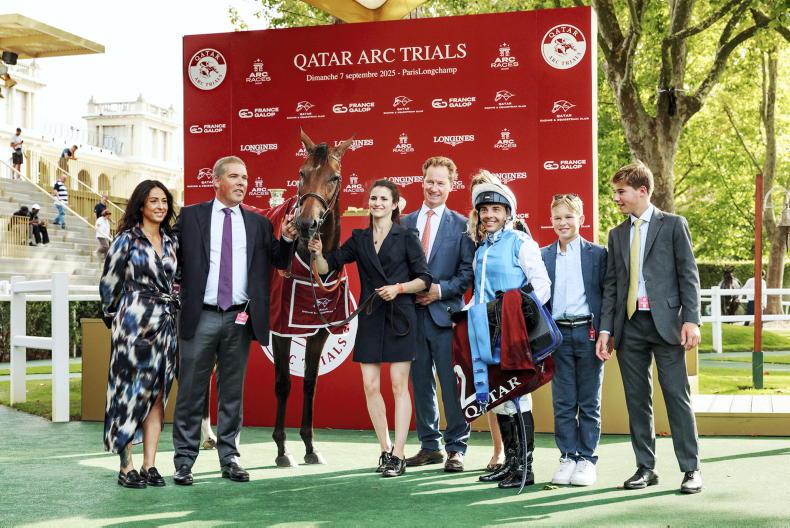
Christophe Ferland with connections after Aventure won the Group 1 Qatar Prix Vermeille at ParisLongchamp for Wertheimer family \ Zuzanna Lupa
A special bond
During his inaugural year, Christophe Ferland won many races with his first horses. In his second crop of yearlings, he received a filly named Pim Pam. And who was the owner? Jean-Claude Rouget!
“Honestly, at the start, I had a hard time believing it! Jean-Claude sometimes places a horse with another trainer, because he has not been able to resell it to his clients.”
What happened next was quite moving. Claude Rouget, Jean-Claude’s father, had just passed away, and a race in Angers had been renamed in his honour. Christophe Ferland made it his mission to win it with Pim Pam in the son’s colours. Which he did!
“It was an incredible moment of complicity. And I also won the Prix Claude Rouget the following year with another horse.”
A very strong bond developed between Rouget and Ferland: “Aude, my wife, worked as a secretary for him. I was the young guy just starting to win races. Jean-Claude is from a generation of people who love winners, but not mediocrity… Today, we are friends.”
A turning point
Quite quickly, Christophe Ferland’s statistics drew the attention of owners who closely follow the numbers. Many realised that at La Teste there was a trainer very talented with two-year-olds, boasting an unusually high winners-to-runners ratio. That was notably the case with the Englishman Jocelyn Targett and the German bookmaker Simon Springer.
Ferland recalls: “After a couple of good starting years, I was lucky enough to meet Olaf Profft, Mr Springer’s manager. We began with two average horses, but they still managed to win. Then we bought nine yearlings in August, five of whom turned out to be blacktypes. That was the case with Gloomy Sunday, who went on to win the Group 3 Henry II Stakes at Sandown, and of course with Dabirsim. Two yearlings purchased for about €30,000.”
Heading to England with a horse that had been beaten twice in listed races in France was quite a bold move for a young trainer. And when your client is a bookmaker, you cannot afford to get engagements wrong! In any case, it was a great success because Gloomy Sunday gave both the owner and the trainer their first English victory.
Unbeaten in five starts at that age, Dabirsim was crowned champion two-year-old in France and also Europe’s best two-year-old… something that had not happened with a French-trained colt for decades!
His former trainer remembers: “He was an extraordinary horse, incredibly well built, very fast, very easy to train. Just amazing. A truly exceptional horse physically. In such cases, talent is part of the story, but luck also plays a role. And luck, one day or another, passes in front of you. You have to be able to seize it.
“I’ve always tried to move forward, sometimes a bit aggressively, and I was lucky enough to cross paths with the right people: Mr Springer, the Wertheimer family, Paul Basquin…”
Rising success
Dabirsim’s success changed the course of Christophe Ferland’s career. Soon, Wertheimer and Frère joined his list of clients, and this new association quickly bore fruit with Indonésienne’s victory in the Group 1 Prix Marcel Boussac in 2013. Christophe Ferland has not had top-class horses in his yard every year, but his statistics are remarkable: for 15 years, he has never dropped below a 17% winners-to-runners ratio.
The sales have changed a lot since the days of Dabirsim and Gloomy Sunday. It has become much harder to buy very good horses at that kind of price. Nevertheless, in 2015, Christophe Ferland managed to unearth Cavale Dorée for €34,000 at Osarus. She turned out to be a terrific two-year-old, finishing third in the Group 1 Breeders’ Cup Juvenile Fillies Turf.
“I fell in love with that filly at the sales. She was exceptionally beautiful, with incredible tissue. Very fast, very precocious, very much a two-year-old type, very mature. An impressive filly.”
And what is wonderful is that her co-owners are still with him:
“They became my friends, almost my family. Olivier Lafon, my accountant, discovered our world, became passionate about it. And we’ve remained very close, along with Maxime Moczulski. A beautiful friendship, very important people in my life.”
Return to Chantilly
In Christophe Ferland’s life, everything has been a matter of timing. Having been forced to leave his native Chantilly to launch his career around 2008, he realised that the great lions of French racing - Alain de Royer Dupré, Freddy Head, Carlos Laffon-Parias, Criquette Head, Pascal Bary - would eventually retire, and so he returned in 2023. And at not yet 50 years old, he has already trained more than 1,000 winners!
Looking back, he analyses: “Among the pillars of the past decades, only André Fabre remains. And at 80 years old, he is still extremely competitive. I think it is magnificent to see this man still practicing his profession with such passion today.
“As for my return to Chantilly, I chose the timing well. The Wertheimer family no longer had a trainer in Chantilly, except for André Fabre. So, either I came to Chantilly to try to move up a level, or I stayed at La Teste to keep doing what I knew.”
The timing was again perfect, because Ferland returned to Chantilly just as French horses were regaining full competitiveness, after several years when English and Irish runners were winning all the best races in France.
Even among the two-year-olds, French horses have become much more competitive.
“I feel that the generational renewal of trainers plays a role. And owners have brought horses back to France. And those horses are competitive. Is it a coincidence? Maybe.”
The great adventure
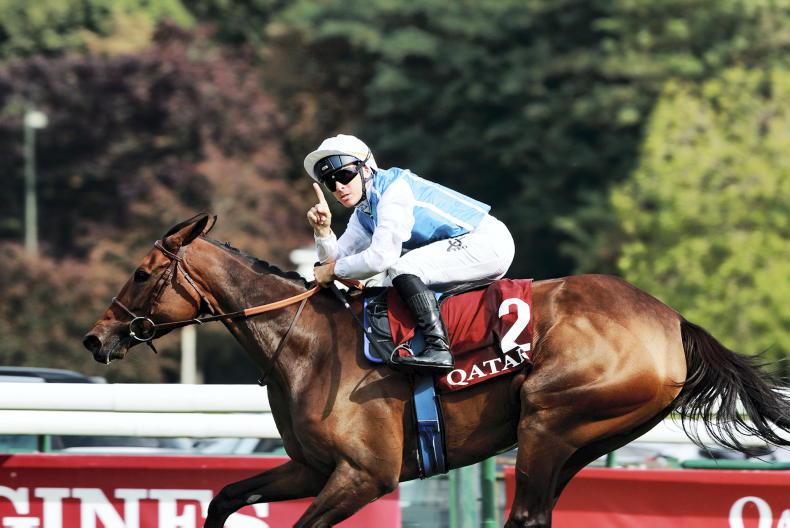
The greatest trainer of our time, Aidan O’Brien, reached the podium of the Prix de l’Arc de Triomphe with his fifth runner in the big race. Ferland, meanwhile, finished second with only his second runner, Aventure, in 2024!
“Yes, but that’s because it was her!” he says. “It’s the luck of having an exceptional filly. Nicolas Clément won the Arc with his first runner. John Hammond probably wasn’t far off either. We guide them, we show them the way, but it’s the horses that make the difference. At two, Aventure was an ordinary filly, not physically spectacular. But she always did everything right. And that is huge. Gradually, she revealed herself.
She is versatile, but she’s at her best when the ground is on the soft side
“At three, she made a real physical leap. She is easy to train, very sound. The Wertheimers give you the means to work properly. There is dialogue, shared decisions. It’s exciting.”
The 2025 Arc looks wide open, but Ferland isn’t thinking about it too much. “I have a date for my filly. I do my daily work. I’ll look at the declarations at the very last moment. She is versatile, but she’s at her best when the ground is on the soft side.”
TOMORROW in Germany, Ferland will have two runners in the Group 1 Preis von Europa, Think Giant and Columbus.
“I’ve got Espoir Avenir for the Prix Chaudenay, maybe Zingaro too. Uther is being aimed at the Prix Dollar, and Double Major at the Prix Royal-Oak. Among the two-year-olds, Elastic, a very good horse. We’ll keep him for next year. A filly, Ozone, who won at Lyon, will go for the Prix des Réservoirs. Maybe Centauri for the Listed Critérium de Bordeaux as well.”
So far, Ferland hasn’t had any runners in Ireland. “With my Irish clients, I’ve never had horses good enough to run there. Especially since they already had a programme in France. I think I’ve only ever entered one horse in Ireland so far. I hope to have the opportunity to come and run in Ireland one day with a real chance. I love that country. My son Arthur does too, and he even went for an internship with Joseph O’Brien!”