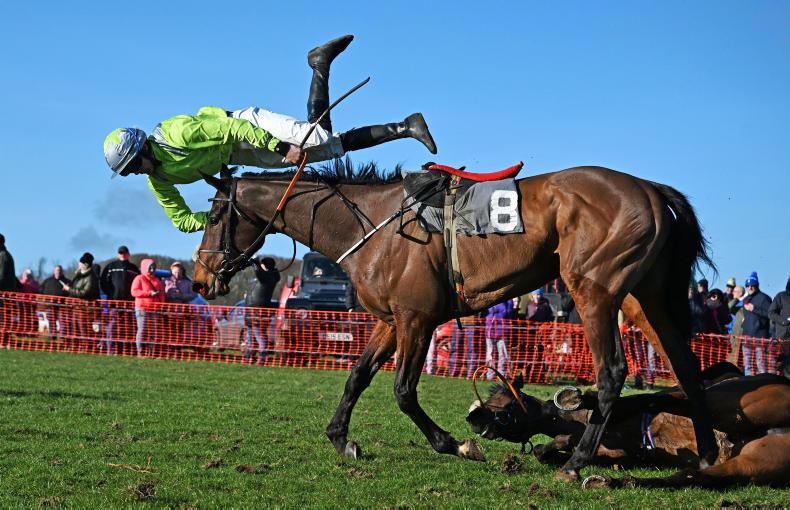
A DECADE on from the last major review, a new study into raceday falls and injuries in Ireland has revealed a clear trend. While the rate of falls has remained largely unchanged, the incidence of injury has declined.
Improved safety standards in helmets and back protectors, alongside a greater emphasis on jockey fitness, are credited as key factors. Conducted by Alannah Reville, John Corrigan, Dr Jennifer Pugh and Prof Siobhan O’Connor, the study set out to examine fall and injury incidence, identify injury characteristics, and compare trends across both professional and amateur racing.
As many within the sport will expect, professional National Hunt jockeys (table A) account for the majority of falls. However, while professional flat jockeys (table B) are less likely to part company with their mounts, the risk of injury is significantly higher, with tighter fields and greater speeds increasing the likelihood of serious incidents. Excluding bumpers, amateur riders in point-to-points (table C) recorded the highest fall-to-injury ratio.
The study suggests this may be attributed to factors such as ground conditions, the age and experience of horses, and the relative inexperience or conditioning of jockeys – an understandable pattern given the limited number of point-to-point fixtures throughout the season.
To put those findings into context, I took a trip to RACE to speak with Alannah, an athletic therapist with the Injured Jockeys Fund (IJF), and find out more about this study, and the work being done to improve raceday safety.
Rehab centre work
“The bulk of what we see coming through the rehab centre is fractures,” Alannah told me. “It’s really easy when you see numbers on a page like this to dismiss the injuries, but some of them are quite severe.
“In the study we kept concussions and brain injuries separate, as concussions were more prominent than brain injuries. We saw soft tissue, skin (cuts and bruises) and organ injuries during the study as well, but concussions and fractures were common injuries across all codes.”
This study stands on its own in terms of improving jockey safety but, on a broader scale, it could also contribute to improving safety across the sport and for the horses, and there are more studies being done that could also help.
“There’s a study going on in DCU at the moment looking at the variable factors that can influence a fall, so it will be interesting to see what comes out of that, because there’s nothing that stands out at the moment that you could pin point as a reason for falls.”
I reached out to Professor Siobhan O’Connor from the School of Health and Human Performance DCU about her study, and she said: “While, welcomingly, falls are not increasing, they do remain a constant challenge. That is why our DCU and Jockey Accident Fund co-funded research project is looking at horse, jockey and race data from the last 15 years to build a predictive model that identifies key risk factors to inform future fall prevention strategies, and ultimately make Irish horse racing safer for all involved.”
Taking responsibility
The underreporting of injuries has long been an issue for raceday medical staff, but Alannah believes that jockeys are beginning to take more responsibility.
“I think nowadays the jockeys have a lot more knowledge of injuries, and that it doesn’t work in the long run to plough through things without taking the rest that they need. Most people get into this sport quite young, and if you go down the route of hiding injuries from the start you’ll eventually run into issues further down the line. With jockeys looking after themselves that bit better, it improves their longevity in the saddle as well.
“With racing being a non-weight-bearing sport, it’s really important to have a good bone mass density. The way to increase that is resistance training like lifting weights, which is a massive factor in injury prevention. Coming to use the gym at RACE could have a huge impact in decreasing the chance of injury, or at least the severity.
“When you think of the gym it’s easy to think of big, muscular power lifters, and obviously jockeys don’t want to bulk up and put on weight. We need to move away from that mindset and focus on injury prevention and improving strength. The more muscle mass you have, the more calories you burn at rest, which will work in the jockeys’ favour when they’re managing weight. Wayne Middleton does walk-in sessions here on Tuesdays and Thursdays from 1-3pm so jockeys are welcome to pop in.
“A study we mentioned in our report noted that riding out has much less physical exertion than race riding, which of course will be the same for any sport. Training is less intense than match play, so with a large number of point-to-point jockeys being less exposed to racing, their fitness could be a factor in their high fall-to-ride ratio. Lower physical fitness can increase your chance of falling, and getting injured.
“There was also an interesting study done in the UK where they did fitness testing with professional and conditional/apprentice National Hunt and flat jockeys, and they found the professionals were stronger in everything compared to conditionals and apprentices.”
THE IHRB and HRI’s Equuip department have launched a series of fall training courses that are being made mandatory for conditional jockeys and open to all professional and amateur jockeys. I had the chance to watch a session and even took part myself. At first glance it may have looked like a bunch of lads doing rolley-pollies, but there is some science behind it.
Without getting too scientific, it’s the sudden stop that does the damage in a fall. If you land directly on your head, your head has to absorb all of that energy, but tucking and rolling slows that stop and the energy can disperse throughout your whole body rather than being confined to the body part you landed on.
The training was also harder than you’d think, it started off with some simple forward rolls from different angles, and progressed to running and jumping into a somersault. I left the more technical stunts to the jockeys.
“At the moment the jockeys come in for four sessions over four weeks, and then they come in for a refresher course,” Alannah explained.
“We’re trying to train the neuro pathway from brain to muscle how to tuck and roll properly, so that it becomes instinct. By repeating the movements over and over it should eventually become muscle memory. Even if these sessions only help a little bit, it’s better than no training in an outcome that occurs so frequently for jockeys.”
Cheif Medical Officer of the IHRB, Dr Jennifer Pugh, also weighed in on the fall training. “The science arises from research the IHRB were involved in with the UK, looking at spinal fractures,” she explained.
“Over 800 falls were analysed on video footage with the most predictive factor for a spinal fracture being landing on the head first or second and sudden deceleration. A strong recommendation from this study was the adaptation of fall training for jockeys, to teach them how to fall safely, avoiding sudden deceleration by landing directly on an out stretched arm or head, and being able to tuck and roll into a fall, so avoiding landing on the head and dissipating the force of the impact and hopefully avoiding injury.
Shifting focus
“When you think about it, we have never thought about teaching jockeys how to fall ,even though it occurs for jump racing approximately once in every 20 rides, that’s a higher strike-rate than winners for most jockeys, and yet we focus on how to win all the time,” Dr Pugh continued.
“The techniques taught by Parkour involve rolling into, and away from a fall, avoiding the sudden deceleration onto an outstretched arm and tucking the head in to avoid direct impact. It involves a huge amount of physical strength to control the body movements and spatial awareness – recognising where your body is in space, and changing that movement, so it’s all about muscle memory, which is why they tumble continuously in the training sessions!
“There is also evidence about knowing when a jockey has reached the point of no return, with many injuries occurring as a rider tries to cling on, often being sucked in under their horse or nearby horses, so this is also considered on the course. While we are focusing on the conditionals and professional jockeys initially, this training will be rolled out to all new licence holders in due course.”
While falls are inevitable in racing, it’s clear the industry is responding in the right way and continuing to evolve. During Alannah’s study there were multiple new safety protocols put in place that accounted for the drop in injuries.
“There were a number of changes made in racing during the period under review,” she said. “New back protectors, updated helmet standards, mandatory mouth guards, and racecourse saunas being closed, so we can’t really pin point one direct reason for the rate of injuries falling.
“We don’t want to change anything in racing for the sake of it, we need to make the right decisions to improve safety. With the hurdles and fences now being white instead of orange so the horses can see them more clearly, that should, in theory, help things too, but it hasn’t been in place for long enough to know for sure.”
Dr Pugh concluded: “With so much focus on injury management and rehabilitation and with the rehab clinic now supported by the Irish Injured Jockeys and Equuip, it’s time to put some focus on injury prevention strategies as well as injury management.”