THE biggest harness race in Europe, the Prix d’Amerique sponsored by Rova Caviar in 2026, takes place on the final Sunday of January every year at Vincennes, Paris.
First contested in 1920, the race has stories to rival the more familiar tales of achievements at Aintree or Cheltenham. Undoubtedly Red Rum, Nortons Coin and Cottage Rake’s three Gold Cups in a row are known off by heart to many readers of The Irish Field, but the ‘World Championship of Trotting’ (the French like a bit of hyperbole) has thrown up its fair share of fairy tales as well.
The race is named in honour of the US forces, who helped to free France during World War I. Fittingly, the first two editions were won by Pro Patria (Latin; ‘for our fathers’) and the race soon built up a huge following in the days before all the modern counter-attractions.
Early in the development of the race, the organisers picked up a marketable star as the mare Uranie won three in a row - 1926, 1927, 1928. To this day, one of the fanciest corporate suites in the massive grandstand is called ‘Club Uranie‘. Balbriggan-based equine artist Nadina Ironia has exhibited in this prestigious area.
The name Charley Mills first appears on the roll of honour in 1934. Irish-born, but based between Austria, Germany and France, Mills ‘Le Cocher Des Dieux’ (Coachman of The Gods) was the Jean Michele Bazire of the day. He drove the American stallion Walter Dear to win that year.
Mills was forced to move around by not one but two world wars. He had to vacate at least one impressive chateau and his final training centre, Chamont, can still be seen today. Mills lost some wealthy owners, who happened to be Jewish, due to the upheaval in Europe. Despite the madness all around, Charley Mills seems to have kept up a lifestyle of large chateaux, champagne, sports cars and glamorous patrons.
Another Shergar?
Even the stallion Walter Dear, a Hambletonian winner, met a sorry end due to World War II. The horse vanished without trace in the chaotic closing weeks of the conflict. The story goes that the great American trainer Delvin Miller, with Trump-like tact, kept asking the Russians what they had done with Walter Dear when he went racing in Moscow in the 60s and 70s.
To return to Charley Mills, his name crops up as trainer of Fortunato II in 1955 and trainer/driver of Gelinotte (The Grouse), winner in 1956 and 1957. Le TROT Facebook pages feature some fantastic footage of Mills, by now a sprightly 68, working Gelinotte.
Jamin won the ‘Amerique‘ in 1958 and 1959 and later caused consternation when he raced in New York, as his groom sought artichokes to include in the stallion’s feed.
The headline writers in Paris will be hoping for some serendipity in 2026, as the Levesque family, of the famous ‘yellow with black cross of Lorraine’ colours, owned the second horse to win three in a row, the mare Roquepine (1966-69).
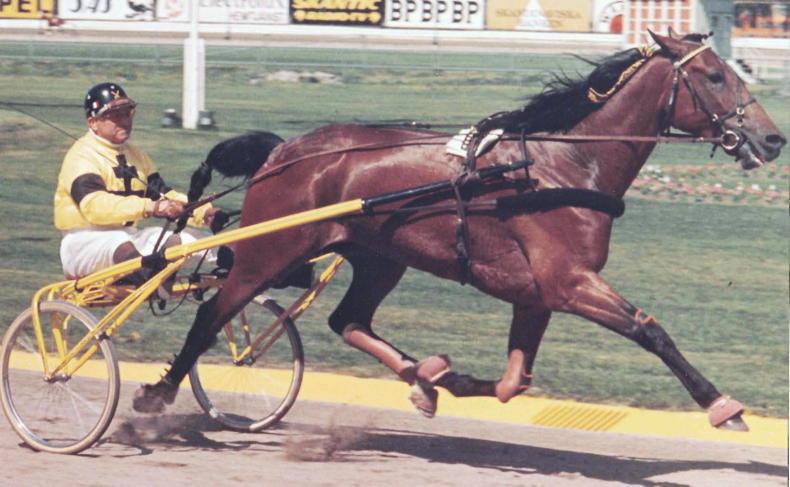
A victory for the Levesques would bring the house down. On the 25th, they will harness the mare Iroise De La Noe.
Delvin Miller’s rather wordy nickname was ‘Harness Racing’s Goodwill Ambassador’. The Pennsylvania-based horseman had a massive reputation for helping people get started in the sport and for always being willing to market harness racing. It was karma that Miller took Delmonica Hanover to win the big prize in 1974.
Miller put Johannes Frömming in the bike, as he wisely figured the German would know the European style of racing.
Jean René Gougeon was dubbed ‘Le Pape de Vincennes’ (The Pope of Vincennes) by the trade press. He showed remarkable longevity to win eight Prix d’Ameriques as a driver between 1966 and 1990. He won three with Bellino II, two with Roquepine and four with the lazy but talented Ourasi.
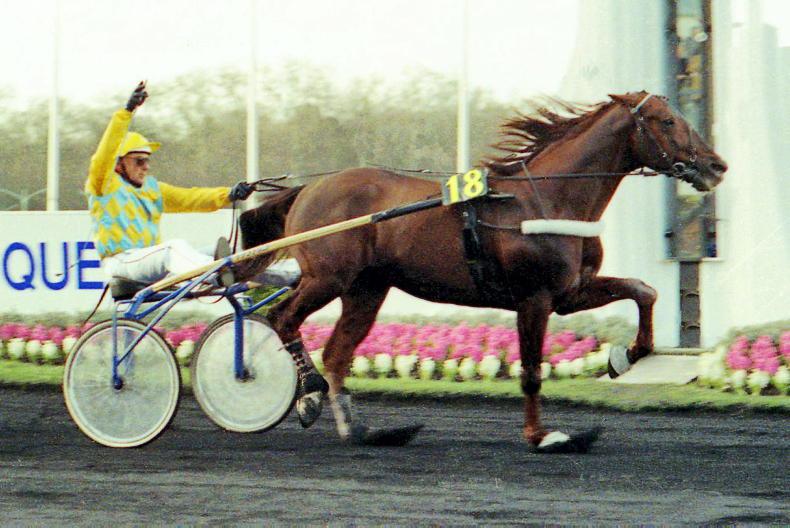
Ourasi is, to this day, the only quadruple winner.
Helen Johnannsson of Sweden scored with Ina Scott in 1995 and remains the only lady driver to stand on top of the podium.
Italian fans filled the stands with scarves, baseball caps and banners as their darling Varenne (aka ‘Il Capitano’) won back -to-back renewals in 2001 and 2002.
The German Alwin Schockemöhle, once one of the world’s greatest show jumpers, owned the 2003 winner Abo As. The horse was driven by ‘The Belgian Devil’ Jos Verbeeck. Jos, with his shoulder-length hair and skirmishes with the tax authorities, filled many column inches.
Modern-day superstar
The modern-day superstar is Jean Michele Bazire (54), who drove his first PDA winner in 1999, the American-owned mare Moni Maker. Kesaco Phedo in 2004 was JMB’s second winner and was owned by the Wildenstein family, art dealers and thoroughbred owners. Rugged looking with a chin like the guy in the razor advertisement, ‘JMB’ has now driven five Prix d’Amerique winners.
Just to spice things up, Jean Michele was recently ruled out of the 2026 line up, due to a damaged hand sustained in a training spill, and other complications. His son Nicolas, who drove Davidson du Pont to victory in 2022, will probably come in for a catch drive. The Bazires will have two or three qualified.
Oyonnax did a Nortons Coin in 2010 at odds of 172/1.
Ready Cash ruled the roost in 2011 and 2012, while his son Bold Eagle dominated in 2016 and 2017. Both were driven by the unflappable Franck Nivard. Bold Eagle’s fee at stud is ‘private’, which is a polite term for ‘you can’t afford it’.
The Swede Björn Goop won with Face Time Bourbon in 2020 and 2021 and was later sensationally jocked off following a defeat in the 2021 Prix de France.
Idao De Tillard, driven by Clément Duvaldestin and trained by his father Thierry, would have been short priced to make it three in a row in 2026, but he was knocked back by a bout of colic, a scourge which does not recognise borders or reputations.
The 2026 Prix d’Amerique will be shown on Le TROT Live on Sunday 25th and possibly some UK channels. Next week, we will bring you analysis of the 19-runner field and selections from experts in Brussels, Belfast, Cloughran and Cagnes-Sur-Mer.
With thanks to Le TROT and Alain Pages for background information.