CERTAINTIES are few and far between in racing, but one thing you can almost guarantee when driving through the gates at Gavin Cromwell’s yard is that something new will be under construction. If any facet can be upgraded, improved or reinvigorated at one of Ireland’s most burgeoning operations, chances are, the Cheltenham Gold Cup-winning trainer is already on the case.
Less than 48 hours on from a Navan Racing Festival double, that nap was landed again this week when arriving to find works ongoing to replace a sand gallop surface hit by recent rainfall. Peer around the corner, and you’ll see tweaks being made to the rows of astro-turf style outdoor living stables - designed to assist the health of horses who might be improved by being housed semi-outdoors.
Plans are already well underway to introduce a new swimming pool facility next spring, while a grass schooling strip (on the far side of an impressive hill gallop introduced a little more than two years ago) is said to have been key to the trainer’s slew of academy hurdle winners lately.
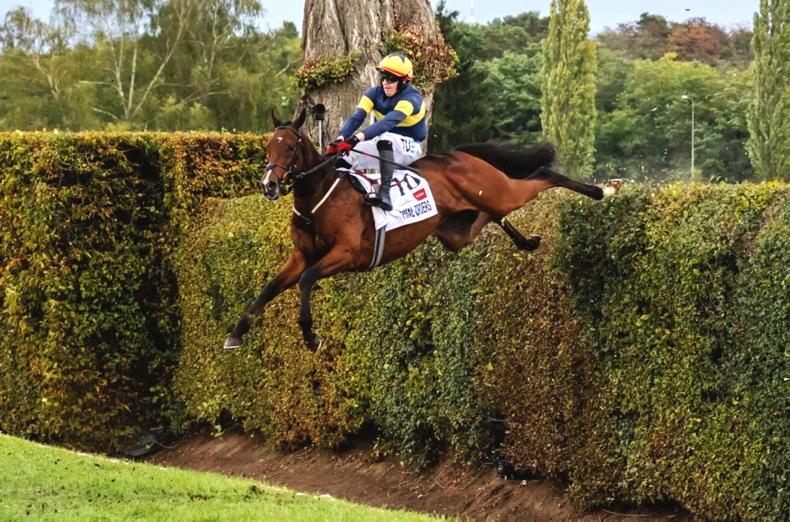
In fact, Cromwell told the Thoroughbred Daily News in 2024 that a cool €1 million had been injected into the Co Meath stable in that year alone, and there are clearly no signs of stopping. What was once a 14-acre green field site, where the trainer and his wife Kiva lived in a one-bedroom apartment above the original block of eight stables, is now the source of 10 Grade 1 winners in as many years. Don’t forget two landmark Royal Ascot two-year-old victories and back-to-back triumphs in the Velka Pardubicka in that period too. There is an unmistakable desire for progress wherever you look.
“I’m never happy unless we’re improving something, or trying to,” Cromwell concedes.
“I enjoy thinking about those things, working on what we can make better. You just put everything you have back into this place, that’s the way I look at it.
“I live a simple enough life. I’m not one for extravagant holidays, cars or things like that. I’m very happy to put everything I have into here. It’s my life.
“We brought a few horses to Navan to work on Monday after racing at the weekend, and it’s nice to sometimes get horses away on the lorry for a little bit, but we generally don’t have to go away very much. We have pretty much everything we want here.
“Now, there are other things we could improve; I want to put in a swimming pool next year. Our latest project is that I’ve bought a good bit of land next door; 45 acres there and then another 19 acres beyond that. We’re fencing and cleaning ditches, trying to put roads into it. It’s all just paddocks and a facility for making hay. I was very lucky that it came for sale next door to me. You can never have enough land.”
Striving for quality
The Gold Cup, Champion Hurdle and dual Stayers’ Hurdle-winning handler now has stabling for close to 130 horses on his main premises, as well as an additional 48 boxes on the other side of the road. Those are numbers he insists he feels very comfortable with, having managed to successfully scale up in a way that very few others have managed to achieve in a relatively short space of time.
Consider this. A little more than a decade ago, Cromwell sat in 58th position in the Irish National Hunt trainers’ standings with five total winners across the 2014/’15 season. Exactly 10 years later, he broke into the top three for the first time with 84 Irish jumps winners and over €2 million earned in domestic prize money.
It’s been a fairly momentous five years since The Irish Field’s last feature-interview visit to the yard. What has been the most substantial change to his training in that period?
“I think the big thing was putting in the straight gallop - it’s been a huge asset,” says Cromwell, now only one win away from entering double-digits for winners at the Cheltenham Festival.
“It’s a woodchip surface and the gallop has helped to get our horses going quicker. They learn to point their toe and use their action, without being stuck in the sand. The sand gallop is wonderful for getting horses fit and for conditioning, but you can just get that little bit more speed into them on the different surface. They know how to travel.
“We can put stalls on the straight and jump four horses together. The two-year-olds can break smart and they know how to travel straight away.
“The other thing is that it’s not sapping them all the time either - they’re bouncing off a nice surface. The hill will naturally get a nice blow into them.”
Asked about his current levels of horses in training, he adds: “It’s quite manageable, but the dream is to upgrade the standard of everything.
“It’s a very hard thing to do. Horses are very expensive - the better ones - and I think you have to go through a lot of cheap stores to come across a good one that way. No doubt, if you spend the money, you have a better chance.
“When you see the price that some of these horses in France are selling for, it’s crazy. Just crazy.
“For example, we’ve been looking at Arqana this week and keeping an eye on the sale there.
“There was a nice two-year-old we liked and we had an owner interested in him, but we’ve just heard the seller wants to protect him to €190,000... And that’s for an unbroken two-year-old. It’s crazy stuff.”
Counting the costs
Given the rising costs of sourcing top material, Cromwell is among the many trainers who feel the prize money reward is not reflective of the challenge at hand.
“It’s very much a reality for everyone that the cost of pretty much everything to do with horses has risen, yet prize money hasn’t moved in a meaningful way,” he says.
“Training fees, in a short space of time, have doubled for owners in some cases. Across the board, the reward for owners is not enough. You even see a race at the weekend like the Troytown Chase, such a prestigious race, and they’re racing for a pot of 100 grand. For a horse of the calibre that’s required to run in those races, prize money hasn’t moved with the times at all. A race like that should be worth a minimum of €150,000.
“There are plenty more of those high-profile pots that aren’t getting the money they deserve, with what it costs to end up with a horse capable of running in the race.”
Nevertheless, Cromwell is fully aware that a war cannot be won without soldiers. He has been active throughout the various sales under both codes this year, and that has been a deliberate approach. After posting a higher total of winners in Ireland than the previous season for five consecutive years, last term was his first time to take a step backwards in terms of Irish winners and prize money.
While there were a number of factors, the 52-year-old has been on the record as saying he ‘took his finger off the pulse a bit’ and “didn’t hit the sales hard enough” in the summer of 2025.
“You need to be on it the whole time,” he reflects. “You look at Willie [Mullins], Gordon [Elliott] and Henry [de Bromhead] - they are constantly on the hunt for new horses, for better horses.
“You need the owners to keep sourcing those horses, but it’s a little bit of a ‘chicken and egg’ scenario. When you’re going well, that’s the time you really have to back yourself and stay going. That’s the time to keep driving it forward, when you have lads who will support you and buy you horses. If you’re going bad, it’s just not as simple.
“I’m very lucky to have a great bunch of owners behind me, big and small. They’re all very important to us and it couldn’t be done without them.”
‘Short on horses’
He continues: “Last season was frustrating for us at times. We still had some nice winners; we won the Thyestes, the Cross Country at Cheltenham, the Topham at Aintree and some grand races - but I was definitely very short on horses. We just hadn’t got the nice bumper horses coming through and the handicappers were mostly badly handicapped, having won their races a season earlier.”
How do those quieter spells impact him personally?
“I try to be as level as I can, I’m not too bad. It’s nearly more frustrating when you’re hearing negative talk around; whether it be the press or owners or different people. That’s maybe the most challenging part of it. The rest, I think I can deal with it myself.
“We’re looking forward to the year ahead and it’s a little bit of a rebuild with the team of young horses we have coming through. The season we had last year just shows that you have to be constantly trying to replace the more exposed horses.
“You’d love to raise the standard of what we have. We didn’t reload as much previously and, as a result, we’re probably light on those nicer novice chasers this season.
“When the handicapper catches up with the lesser horses, it’s very difficult for them to keep winning; especially when those horses are very slow to be dropped in Ireland compared to the UK. The system over there is far more lenient in that way; you can see a horse getting dropped 10lb for three runs. You mightn’t come down that weight or a stone in a year in Ireland.”
There has been little wrong with the form of the Cromwell horses in recent weeks, however. Nine winners over the course of 12 recent Irish National Hunt meetings doesn’t appear to have come as a surprise to the main at the centre of the operation, based on what he has been seeing at home.
“You can feel that the horses are in a good place, while still thinking that they’re going to improve for their first runs of the year,” he explains.
“There are a few of them we ran earlier in the season who got beaten, and they were probably a good bit short. Hopefully they’ll progress and win their races.”
On the topic of some novice hurdlers to follow from his recent runners, he notes: “Outofafrika, who won his maiden hurdle for us at Navan last Saturday, is a very obvious one, and I like If You Believe. I think he’s a nice horse and won very well at Galway in a maiden hurdle.
“Bud Fox is one who showed plenty the last day when he won at Fairyhouse and I hope he can build on that. Boycetown was very undercooked at Galway [when third in a maiden hurdle]. In hindsight, I hadn’t gotten him nearly ready. He could go to Fairyhouse next and I hope you’ll see a different horse there.”
It was hoped that the next acid test in store for the man behind a 1-3-4 in last season’s Glenfarclas Cross Country Chase would come in the Betfair Chase at Haydock today, but sadly drier-than-ideal ground has ruled Inothewayurthinkin out of his intended comeback.
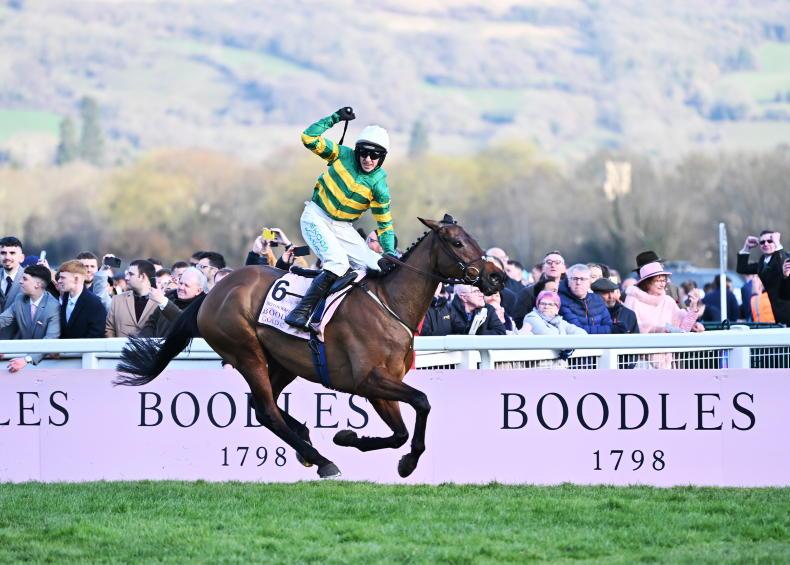
Not many would have anticipated that the star talent would go winless in the five starts that followed a Cheltenham Gold Cup demolition job in 2025 - a bloodless display in which he denied Galopin Des Champs his hat-trick in no uncertain terms. It has been a rocky road for J.P. and Noreen McManus’ homebred in the intervening period.
However, there were definite signs his big engine is still present when finishing third to Gaelic Warrior in last season’s Blue Riband event. As an eight-year-old rising nine, he could now begin his campaign in the Savills Chase at Leopardstown over Christmas, or potentially the Cotswold Chase at Cheltenham in January.
Stable star
“I’ve been watching the forecast at Haydock all week and it’s going to be good ground because they haven’t put enough water on, and they weren’t intending to,” says Cromwell, who cut the figure of a man with mixed emotions in the immediate aftermath of last year’s Gold Cup.
“Look, the winner at Cheltenham [Gaelic Warrior] was exceptional and it would have taken a fair performance to beat him on the day. From our point of view, it was disappointing that our horse didn’t run the race we felt he could deliver. He ran down fences, went in and popped others - he never properly got jumping at all.
“I never brought myself back to look at the RaceiQ data to see what his jumping was like in comparison to the others, but it can’t have been good [nearly 14 and a half lengths lost on Gaelic Warrior and more than 13 worse than Jango Baie - he was beaten 10 lengths in total]. He still ran real well.
“I don’t want to say too much, but I’m certainly much happier with the horse. He had a few things tweaked during the summer and they seem to have worked.”
Reflecting on the crowning moment of his training career, he adds: “It’s honestly hard to describe, it was an emotional day. There was a time when I thought I’d never have a horse good enough to go to Cheltenham, let alone win over there. Never did I dream we’d have a Gold Cup horse.
“But, what he did wasn’t a surprise. From a long way out, I thought he could do that. I knew I wasn’t being a dreamer. I stood out on the track with my son Jake watching it with me, it was very, very special.”
The newest generation of the Cromwell family don’t go unnoticed around the yard by any means either.
“It’s great that they’re mad into it. Camron [11] rides a couple before school every morning, he’s in fifth class, whereas Jake [15] doesn’t get time because he has to get going for the bus early. They’ve been pony racing plenty and ridden a good few winners. They love their hunting as well. You know by them that they just love being around it. My daughter Sophie [13] doesn’t ride but does her bit in the office and helps organise the weights and different things for us. It’s lovely that she has an interest too.”
Is there ever a quiet moment to take stock and feel a sense of pride at what has been built around him over the last two decades?
“Ah, it’s grand,” comes the almost deadpan response. “But it could be a lot better too. It will be some day… I bounce out of the bed every day to get going. There’s not a day when I don’t want to face this and try to make things happen. I enjoy it, it’s my life. If you’re not growing, you’re dying - isn’t that it?”
FEW trainers have made the hay in the HRI academy hurdle series quite like Gavin Cromwell, winning with three of his six runners in the initiative, but he believes there is scope to evolve what has been rolled out in the last 13 months. He has some forthright views on the series and the type of horses that Irish point-to-points are producing at present.
“We haven’t run a whole lot of horses in the academy hurdles but we’ve been lucky so far - and we’ve got a few more to go,” he says.
“I think it’s a great initiative and I like the idea of getting the horses started earlier. Now, I think there are tweaks that can be done, but I do believe we should be getting horses ready earlier overall.
“A bigger part of it, I think, is that we’re so reliant on the point-to-point fields to supply the industry. Those horses are obviously running over three miles, and I wonder are we encouraging slow horses by doing that? I think when we get started, we need more speed. For example, if you have two handicaps for horses rated 140 or less, one being over two miles and the other being over three miles, you’re probably talking about attracting double the number of entries for the three-mile race.
“There’s a lack of two milers and we’ve gone away from that, because it’s the point-to-point fields that are feeding the whole industry. In a way, I think it produces the same type of horse over and over again. Is it feeding and encouraging slow?
“When you see Willie buying all those horses from France, he’s buying horses with speed. They tend to be strong travellers. He seems to buy a lot more of them than he does point-to-pointers.”
Cromwell, who emerged from the recent flat sales with a dozen yearlings, sees the chance for the point-to-point sector to come along the academy hurdle journey in a more meaningful way too.
“My feeling is that the academy hurdles probably should be run on the point-to-point fields, and have the point-to-point handlers bringing those horses along over the shorter distances. I’m not sure how it’d be done, but could you have a day of academy hurdles in the point-to-point fields, where you have to jump 10 or 12 hurdles?
“It’s not that I think the problem is having flat-bred horses in these races; there are some nice staying flat pedigrees that are bringing speed into the game.
“You could encourage that, rather than encouraging slow all the time. I feel that we’re probably accommodating for a sales horse on the course at the moment in their current format. Should that not be on the point-to-point fields?
“Those horses can fall into their point-to-point systems the very same as the other youngsters do. Could we get to a stage where one of your four point-to-point meetings every second weekend is an academy hurdle card? I don’t know exactly how it’d work, but I’m just not sure they’re quite fitting on the racecourse at the moment.”
On the hot topic of ground conditions at Cheltenham, Cromwell adds: “I didn’t have runners there last weekend, so I shouldn’t really have much of an opinion on that. As far as March is concerned, I was a bit disappointed. You’d like to see more kindness in the ground. We had horses come out of it who were sore. I don’t know if many would have complained if we were racing on the softer side.”