MANY of you may be similar to myself, in that it doesn’t take much to make the mind drift back to racing matters, and more often than not in rather odd places!
This week, while attending a local Novena (!), one of the topics for the teachings by a theology student was on the role of women in the church. There was no doubt they did a huge volume of often unseen work, was the comment. But the speaker’s studies had led her to form the opinion that, for women, having a presence is not the same as having a value. I drifted off, thinking about the current status of women in Irish racing.
We published a letter last week from owner Declan Corbett who, in praise of Siobhan Rutledge, was of the opinion that “now is the time for racing authorities, governments, jockeys, trainers, owners and the wider racing community to have an open debate about whether female jockeys should continue to compete without any specific weight allowance”.
A quick glance at the various news around the world over the last months, featuring female jockeys, is all very positive. They are certainly valued.
Saffie Osborne has made great strides. In the top 10 in the jockeys’ list and winning a first classic for a female. Down under, Group 1 races regularly have Jamie Melham and Rachel King jocked up on top horses. Melham won the Caulfield and Melbourne Cups last season. King rides one of the current stars in Warwoven.
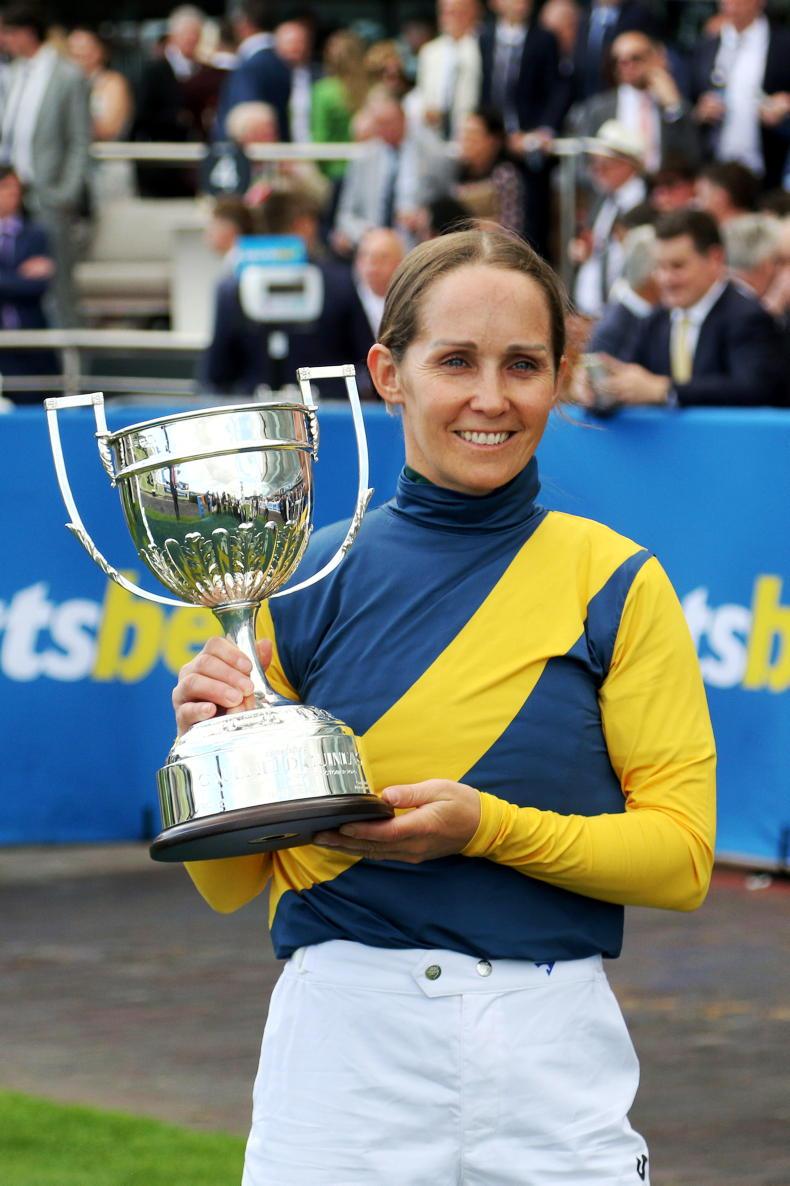
In Canada, Emma-Jayne Wilson rode her 2,000th winner last weekend. For comparison - Frankie Dettori rode around 3,359 career wins in Britain.
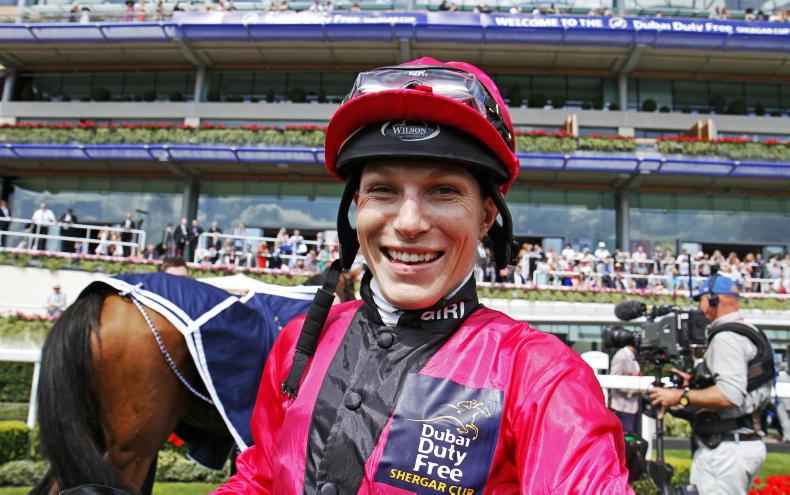
In Ireland, Joanna Morgan was one of the first female riders to be competitive.
More recently, Rachael Blackmore dominated headlines and jump racing. But have we stalled in Ireland in giving the girls a chance? Have all those smashed glass ceilings crept back?
Over jumps, Anna McGuinness, Aine O’Connor (the most with four), Georgie Benson, Phidelma Elvin are the only female riders to ride more than one winner over jumps this season.
On the flat, Siobhan Rutledge and Orla Tynan’s eight winners are the best, followed by Nicola Burns (6), Jessica O’Gorman (6), Sadhbh Tormey (5) and Robyn Donaghue-Leahy (4). Only Rutledge and Burns have had more than 100 rides this flat season.
A further alert came in compiling a short list for an upcoming racing awards event. In the seven ‘human’ categories, females are poorly represented. Only Jessica Harrington and two point-to-point riders (one since retired) were included.
So, would a weight allowance help push girl riders forward? French racing authorities did so in 2017 and it, reportedly, made for a significant increase in the number of rides for women.
France Galop also said the 2kg (4.4lb) allowance had not “destroyed the balance” of the French weighing room by handing female riders the advantage. It could be interesting.
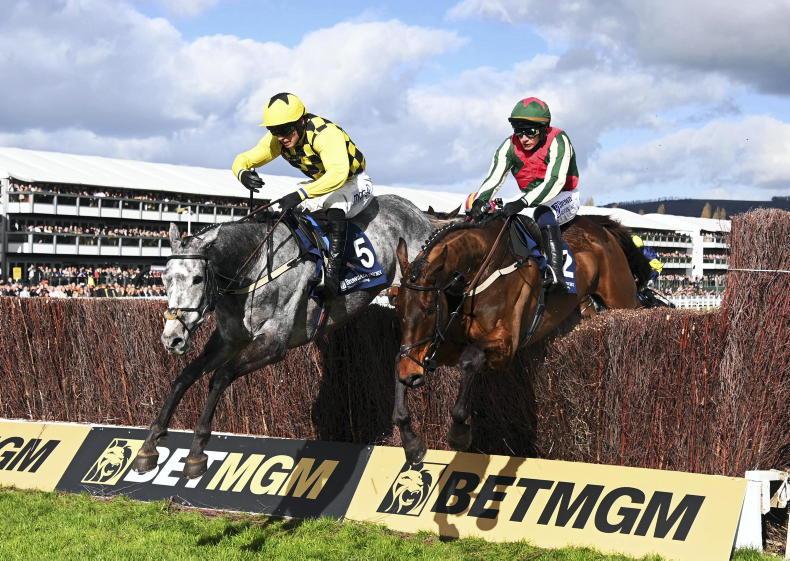
Kitzbuhel wins (left) win the Grade 1 Brown Advisory Novice Steeplechase from Final Demand \ Healy Racing
AS my current reading material is one of the books in Mick Herron’s Slow Horsesseries, my current outlook might be skewed by my reading about spies and spooks and conspiracies and things not being all they seem.
My imagination certainly went into overdrive on hearing of the BHA findings that Final Demand had failed tests for a prohibited substance after running second at Cheltenham. The investigation revealed that Final Demand arrived at Cheltenham and was stabled in a ‘Charles Turner yard’ on the Sunday before racing but, unfortunately, there was no CCTV footage available from that yard until he was moved to the ‘Irish’ yard on the day of the race. Missing CCTV footage causes alarm bells!
Willie Mullins admitted two charges under the rules of racing, that Final Demand ran in the Brown Advisory Novices Chase with mepivacaine (a Category B Prohibited Substance) in his body. And that te trainer had failed to declare use of mepivacaine on the horse in its medical declaration forms submitted prior to the race. The BHA has published a detection time of 72 hours for mepivacaine, an anaesthetic that blocks nerve impulses.
Final Demand was tested post-race for blood and urine and, on March 26th, the BHA’s approved laboratory confirmed the presence of mepivacaine.
Final Demand had, undocumented, been treated with mepivacaine on March 3rd, just after the deadline date Stage 1 declaration for medications or treatments. But that was eight days before the Festival race.
And there was also the background of rumours in the days before Cheltenham that all was not well with the horse, to add to the puzzle.
The BHA investigation concluded that “the source of the mepivacaine in the horse’s body on raceday on March 11th 2026 is unknown”.
The BHA submitted that “the precise route as to how the prohibited substance entered the horse’s body is not established and therefore Mr Mullins cannot make out any defence under (K)14 of the Rules of Racing to the (K)2.2 breach.”
Penalties were imposed but the investigation was satisfied that the Mullins stable culpability was low and the entry point financial penalty was £1,000.
“This is one error made in the context of an extremely large and well-organised system for medical declarations covering a string of approximately 250 horses, and the BHA accepts that the failure was accidental and a one-off,” it noted.
It did seem a bit peculiar though to fine the track (£5,000), since it could not provide CCTV, and was unable to provide evidence to support either side. The racecourse fine was far bigger than the one for Mullins, who is the more responsible for the horse’s condition, no matter what occurs. Maybe there’ll be no complaints about the Festival ground this season.
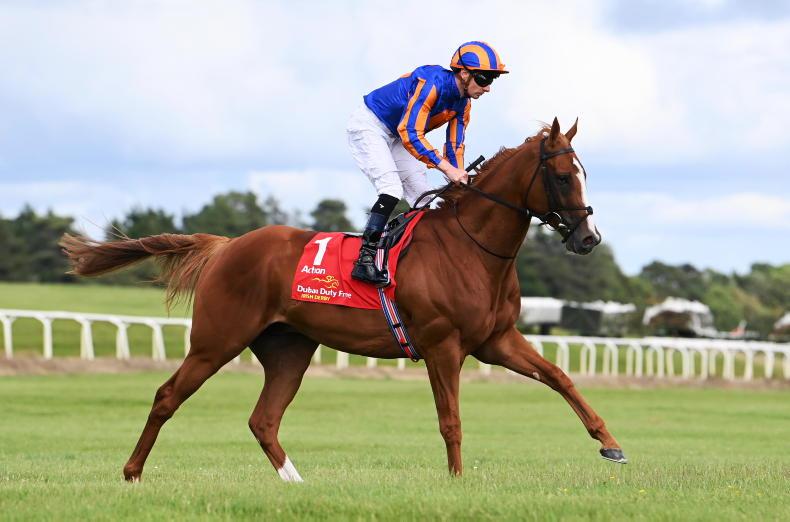
THE campaigning of some of the Ballydoyle three-year-olds has gandered a lot of attention this season. Puerto Rico and Action were in the top-10 ranked juveniles of 2025. Neither added much to their standing this season.
Action has been busy. He last ran on October 5th at Killarney Irish Stallion Farms EBF Navigation Stakes, his eighth run of the year, when he was 7/2 joint second favourite in a field of eight. He put in a peculiar wayward run, dropping out over three furlongs out before running on again. It gave rise to many online comments and in a season where the campaigning of some of the Ballydoyle ‘second strings’ or pacemakers have given rise to many negative comments. The stewards’ report that “Wayne Lordan, rider of Action, trained by A.P. O’Brien, reported to the Clerk of the Scales that his mount jumped slow from the starting stalls” provides no indication of the way the horse ran and it surely should have been recorded in more detail and questions to the mid-race behaviour posed.