GLORIOUS Goodwood is over for another year having provided its usual mix of brilliance, unpredictable weather, and hard-luck stories, and I thought I’d put the goings on in some context.
Shining Lights: Scandinavia & Whirl; Eve Johnson Houghton
First and foremost, however well run any meeting is, it isn’t the organisational skills that are the focus, and the success of major horse racing meetings are dependent on the spectacle provided by the horses. There were a number of equine stars on show, notably Aidan O’Brien’s Group 1 winning pair of Scandinavia and Whirl.
Neither of the races they won passed without negative comment, but both continued on their progressive paths, and it will be a surprise if they aren’t able to add more lustre to their respective CV’s by the end of the year.
If I had to nominate a trainer whose success at the meeting was most pleasing to see, it would be Eve Johnson Houghton, who continues to unearth good horses without rich owners and might just have a Guineas candidate in the shape of Zavateri.
The son of Without Parole showed guts and stamina to win the Vintage Stakes to add to his Superlative Stakes win at Newmarket, and he’s certainly entitled to have a crack at the Dewhurst, a race her late father Fulke won in 2002 with Tout Seul.
Eve formally took charge of the Blewbury stable in 2007, carrying the baton passed on by her grandmother Helen, twin sister of another racing great in Fulke Walwyn. Eve is very much reaping what Helen sowed back in the dark days when the Jockey Club refused to allow a woman to hold the licence of a racing stable, so that most record books still fail to recognise her as the trainer of Gilles De Retz when that colt won the 1956 2000 Guineas. In fact, Helen was never recognised as a trainer by the authorities, with the licence passing to her son some years before Florence Nagle’s famous court action.
It’s almost unbelievable today that such restrictions used to exist, and were justified, and the continued success of Eve and her ilk is a reminder that some things, at least, have changed for the better.
Dark Cloud: Trueshan
The death of Trueshan in the Goodwood Cup cast a pall over the meeting, as he had worked his way into the affections of racing fans over the years, as top stayers tend to do. It has been noted, correctly, that Alan King was at pains to pull him out of races if he felt that the ground was too quick for him, making it ironic that such a tough horse should suffer a fatal injury on ground considered safe. I was less enamoured of those who suggested King was somehow in the wrong for running him at the age of nine, and those who invoke the “doesn’t owe them anything” argument for retirement always confuse me.
Perhaps we should have a list of horses who do owe connections something, but I’m not sure I’d pay to watch a race made up of such horses.
To be clear, Trueshan had every right to race having shown that his ability and enthusiasm were still intact, and while I would be uncomfortable seeing horses race when their ability and/or desire to compete had waned, I can’t say that was the case with Trueshan, and connections deserve sympathy rather than accusations.
WTF? Flip starts for group races, pacemakers not reading the script
The farcical side of racing reared its head when thunderstorms meant that some races had to be started without stalls on Thursday, notably the Gordon Stakes and the Nassau, and the latter saw Whirl gifted an easy lead in a ragged start which was more typical of Bangor in December than one of the major flat racing festivals.
Safety must be a consideration when there is lightning about, so there may be times when starting from stalls is impractical, but I think most viewers and racegoers would have preferred a short delay to the feature race on day three rather than what they saw instead. The fact we got the ‘right’ result in the Nassau stopped a bigger outcry, but officials may not be so lucky next time.
Pacemakers have been under the microscope a lot lately, although rarely for doing the job they are ostensibly set up to do. Continuous showed how it should be done at Epsom before producing a couple of howlers at Ascot which did Los Angeles and Jan Brueghel no favours, but the ultimate sin for the pacemaker is, of course, to go out and make all the running in a Group 1.
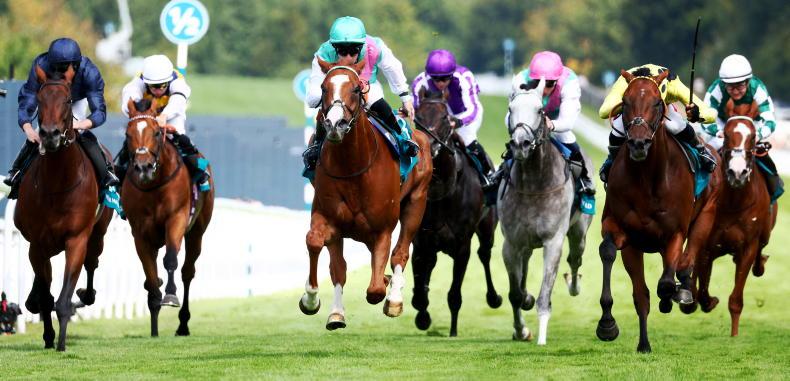
Qirat who got help from another hapless Coolmore pacemaker to win the Sussex Stakes at 150/1\ Dan Abraham-focusonracing.com
The latest to commit the cardinal sin was Qirat who got help from another hapless Coolmore pacemaker to win the Sussex Stakes at 150/1. In fairness, it’s a rare occurrence to get both an easy lead and then a useful tow into any contest, but Qirat got both when Serengeti first blew the start and then went too fast when Wayne Lordan tried to remedy the issue. As a result, the only horse able to utilise Serengeti as a hare was Qirat, and the race could not have worked out better for him.
It remains the case that bad horses cannot win Group 1 races and in order to be a viable pacemaker, a horse must have enough talent that it cannot be ignored. Maroof, Cape Cross, Summoner and Audience have all won Group 1 races when tasked with setting the race up for another in the same stable/ownership, but all were pattern-class horses running over the correct trip.
It’s incumbent on punters to consider the possibility that a front-runner will get loose or will be allowed to set a slow enough pace to see themselves to advantage; after all, pacemakers in racing aren’t there to help set records, just to confer an advantage to the team.
One thing I simply don’t understand is the minority who suggest that when a pacemaker wins against the odds, the integrity of the race should be called into question. The idea that a 150/1 shot winning is some sort of fix would make considerably more sense if the odds-on said outsider contracted sharply before the race. Fixes tend to coincide with gambles, and I’d be more concerned about the integrity of racing if all the favourites started winning. In short, if there’s no smoke, don’t look for fire.