JOHN Gosden is the ultimate man to go to for a racing quote, and his measured, erudite and yet laconic delivery means that if all breaks loose on a day of televised racing and panic begins to set in, sticking a microphone under Gosden’s nose always seems the right thing to do.
Not only will he tell you what’s happening and why, but he’s sure to remind you that it was also inevitable, and he’d informed us all of that fact some time earlier.
Nothing surprises the world-weary Gosden, whose air of Oxbridge authority has seen more than one observer claim that he’d soon fix the world’s problems if only we’d make him Prime Minister.
In truth, if Gosden read the bedtime story on CBeebies, there would be a fair range of racing people who would nod along and say that he was making some very salient points and that the BHA should be listening.
There is, in my opinion, a little bit of the Pied Piper about the Master of Clarehaven. People don’t need to listen to the actual words to want to follow Gosden, the tune is enough. As a result, there is a great reluctance from within racing to be critical of anything he says or does. It’s also true, incidentally, that if you google “John Gosden” and “pompous” you’ll get just a single result, and that from a disgruntled punter on the infamous Betfair forum.
When Kieran Shoemark was beaten in the 2000 Guineas last weekend on Field Of Gold, Gosden said, in his usual informed manner: “The race wasn’t probably run in the fractions of the Craven Stakes, and we were sat some way back.
“The winner has kicked and gone, and we ran out of racetrack.
“Given another 25 yards the race would have been ours…..It just got away from us, I’m afraid, as we came into the dip from where he was clawing the ground back.”
Gosden was careful to say: “us” and “we” rather than single out Shoemark as having done something wrong, but it was clear that if anyone had got the tactics wrong, the “we” wasn’t of the Royal variety, and that notion was cemented when it was announced on the first morning of Chester’s meeting that the Gosdens would be employing “the best rider available” in future.
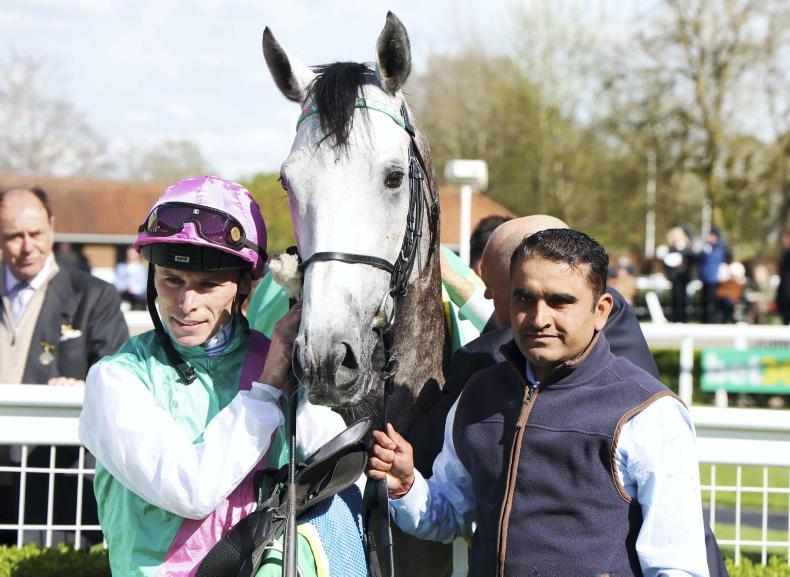
Shirking responsibility
For his part, Shoemark had the balls to come out in front of Matt Chapman on ITV to explain his ride on the Guineas favourite and he did so without shirking responsibility or skimping on detail.
In fact, his description of how Field Of Gold handled the dip in the Craven compared to how he did so in the Guineas itself was much more enlightening in terms of his failure to win than a facile “we sat too far back”.
Field Of Gold was close enough to strike two furlongs out in the colt’s classic but hit a flat spot that his rider did not expect.
Perhaps the way the race panned out is what makes Shoemark a very talented jockey but an inferior one to Ryan Moore in that his transition from Plan A to Plan B is sometimes slow and occasionally missing, whereas the great jockeys seem to be able to overcome adversity more often than not.
Moore won all four key races at Chester on Wednesday and Thursday and made it look straightforward, but I doubt it was as easy as he made it look on several young horses who needed to be taught a job as much as they needed to win.
All got a great education and Ballydoyle got the right results, which is why Moore – arguably the greatest rider in the world – is riding there and not scratching around for opportunities at the gaff tracks.
Transition
Becoming a great jockey is a transition that few talented riders ever make, and for those that do, it is rarely straightforward, but it always involves more than just talent and dedication in the saddle.
It also requires huge mental strength, as does being a champion in any competitive sport, and developing that strength means being able to meet adversity and overcome it, rather than just being shielded from it.
In that sense, blind loyalty isn’t the easy answer for a leading trainer looking to nurture a jockey to championship level. Criticism comes with the job, and sometimes it can be harsh, but its aim must be to make the subject better, and stronger.
It’s debatable whether Gosden’s tutelage of Shoemark has measured up on that framework, and the great trainer should reflect that if his jockey gets it wrong on the day, then the failure is shared.
Set up
It was interesting to hear Hayley Turner say she felt that Shoemark was “set up for a fall” in his role as stable jockey at Clarehaven and I wrote here last summer than he was ill-served by the ammunition he was given in his first few months in his role, with the Gosden stable lacking talent with its younger horses in 2024.
Shoemark’s early Group 1 rides came on horses who were massively overrated by the market. It was not going to be an easy bedding-in period, but it felt like Shoemark was hung out to dry for Gosden’s own failings at times.
The irony of that situation is that when Gosden did take responsibility, as when saying of Inspiral’s abject failure in the Lockinge: “The trainer is so hopeless, he couldn’t get her fit at home”, it was hard to take him seriously.
We know that John Gosden is not hopeless, ergo he must be making excuses for a poor ride. And when Gosden insisted that Ryan Moore replacing Shoemark on Inspiral in the Prix Jacques le Marois at Deauville was unrelated to how she had been ridden at Newbury and Ascot, and that there had been “no jockey error” he merely highlighted the fact that Cheveley Park had insisted on a change.
It wasn’t that long ago that Gosden said: “Retained jockeys are out of fashion right now. They’re for an owner, not a trainer.” If he had stuck to that policy, then the unfortunate Kieran Shoemark might not feel that the rug had been pulled out from under him.
I can only hope that this is the adversity that he overcomes in order to reach the next level in the saddle.