WE’VE all seen the ambulances trailing horses and jockeys around the track but once a fall occurs the race continues, and the crucial work of racecourse paramedics and groundstaff often goes unnoticed.
Their precision, teamwork and calm professionalism typically unfolds behind the scenes but I was fortunate enough to attend one of six recent training days, jointly hosted by Horse Racing Ireland (HRI) and the Irish Horseracing Regulatory Board (IHRB).
Each racecourse and point-to-point meeting is covered by two doctors, one IHRB medical officer and one racecourse medical officer, supported by an ambulance provider.
The Order of Malta cover many of the tracks, with Civil Defence engaged in Listowel and Roscommon, Irish Red Cross in Tipperary, Proparamedics at Down Royal, and St John’s Ambulance in Downpatrick. The minimum requirement is three ambulances per meeting, with each crewed by at least three medics holding a minimum EMT (Emergency Medical Technician) qualification.
Across the six days of training more than 400 attendees, including members of the Order of Malta, Red Cross, Civil Defence, racecourse foremen, and other industry professionals, took part.
The sessions were led by Dr Jennifer Pugh of the IHRB and HRI’s Colin Kehoe, who spearheaded the initiative.
Expanding
“One of the key actions following the critical incident review of the February accident involving jockey Michael O’Sullivan was an expansion of racecourse safety training, including scenario-based drills for multi-horse incidents, enhanced medical training in severe head injury management and coordination with emergency air services,” Kehoe explained.
“A team led by Dr Jennifer Pugh and myself put together training and set out learning outcomes. We had training in place, however, it was done separately by each of the relevant groups (medical, racecourse foremen, veterinary teams et cetera). The action called for in the review fast-tracked this training with a focus on covering each racecourse/group which we achieved.”
The training addressed challenges unique to racing, situations that paramedics seldom encounter in their day-to-day emergency response. Participants were immersed in race-specific scenarios far beyond the typical scope of paramedic work. Using lifelike human and equine mannequins, teams tackled simulations such as a jockey trapped beneath a fallen horse, a fall in a crowded parade ring, and incidents at the starting stalls.
Assessing the situation
Under the guidance of Dr Pugh and Kehoe, participants had to assess injured riders, secure distressed horses, and coordinate with veterinarians and track foremen, all while determining whether racing could safely continue, or if there was a need for an obstacle to be omitted. The exercises underscored the importance of split-second teamwork, as in the aftermath of a fall, hesitation can have serious consequences.
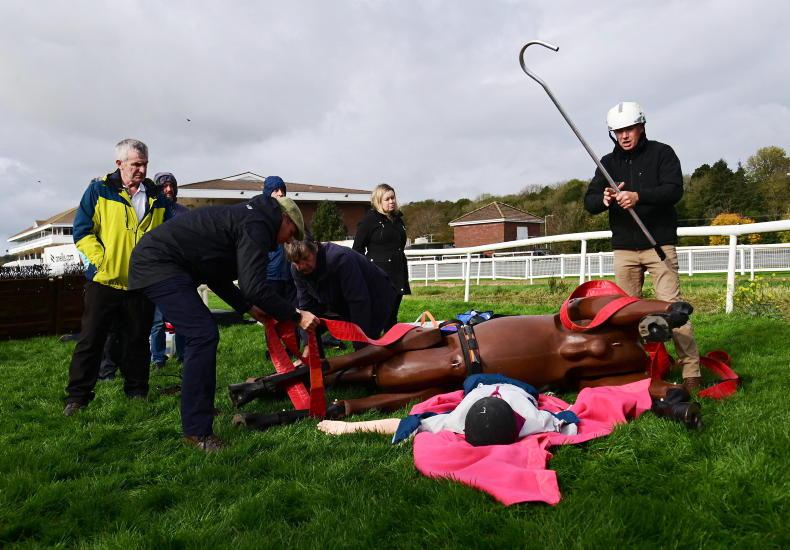
“The doctors and ambulance crews work closely together during an incident, particularly when a rider has an injury requiring initial treatment and transfer to hospital,” Dr Pugh explained, before adding: “You will have seen from the training day how many people it takes in order to ‘package’ someone. This is where we are using spinal immobilisation if there is concern around spinal fractures.
“We use combiboards for initial transfer onto the vacuum mattress, which then essentially vacuum-packs the rider, keeping their spine in a neutral position hence protecting the spine. It can be ‘all hands on deck’ during an incident and everyone on site has a role to play in ensuring equipment is to hand and utilising the skillset of each medic to ensure efficient care.”
The sessions also highlighted the blend of medical expertise and equine understanding required in these high-pressure situations. Track foremen and ground staff were coached through the safe movement of a horse in order to get to a fallen jockey, and also how to handle a loose horse. While such instincts may come naturally to those raised around horses, for volunteers and part-time racecourse staff, this knowledge is invaluable for maintaining the safety of everyone at the racecourse.
A KEY element of the training involved improving collaboration between vets and different medical personnel, which Dr Pugh emphasised when saying: “The relationship between the doctors and the ambulance crews is paramount in ensuring the quality care of an injured jockey.
“We are fortunate that the same people are generally in attendance at each meeting, with new recruits training alongside experienced teams, and so communication and strong teamwork is forged. The ambulance crews train weekly within their own units but being able to bring units together to train alongside the racecourse doctors has been extremely positive during this course. Moreso has been the recognition between the various teams of each other’s roles – veterinary and racecourse teams, and our need to work together when an incident occurs.”
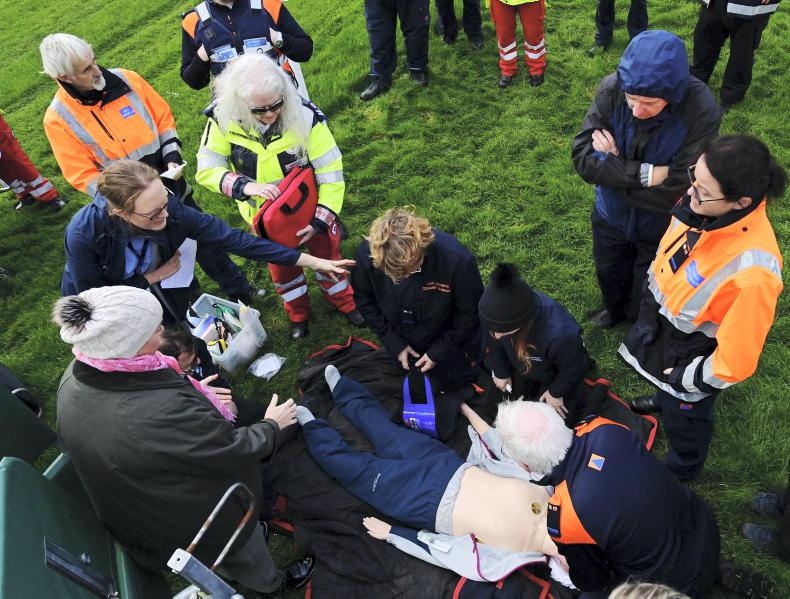
In emergencies, vets focus solely on the horse, while paramedics concentrate on the jockey, but coordination between the two is essential. This is where the help of racecourse vet Liam Sharp came to hand. In his speech and demonstration, he explained that doctors must resist the instinct to rush to a trapped jockey without considering the horse’s condition first. He demonstrated how to manage scenarios such as heat exhaustion or fatigue-related falls, guiding participants through the vital first steps in caring for a fallen horse before a vet arrives. Jim Green from British Animal Rescue and Trauma Care Association (BARTA) was on hand to explain and demonstrate strategic and tactical responses to emergency situations on the track. He led the charge with track foremen and groundstaff, establishing clear guidelines in keeping themselves and the horses safe, and guiding participants through the techniques of moving horses post-incident.
What struck me about the training day, was how far ahead everyone needs to think. From the second the doctors and paramedics arrive on the scene, they have to decide whether the race can continue. Must they clear the road outside the racecourse? If they are on the inside track, is there a clear route out? Are there loose horses that they need to watch out for? All the while trying to give an injured jockey the best care that they can.
On the positive impact of these training days, Dr Pugh told me: “The most common comment during the course days was along the lines of ‘Well, I never understood what you were doing there, or why it took so long!’.
Colin added: “Effective management of critical incidents at race meetings requires teamwork, clear communication and thorough preparation. This course brought those principles together, strengthening our collective capacity to protect the wellbeing of participants, horses, and spectators.”