FOR all that there had been plenty of chatter that British National Hunt racing would see a revival at this year’s Cheltenham Festival, surely very few of us would have anticipated the Prestbury Cup going down to the final race of the entire meeting like it did last week.
Well, credit where it’s due, The Irish Field’s Anne Marie Duff tipped the correct scoreline of 15-13 to Ireland at juicy odds of 10/1 on The Racing Edge podcast back on February 16th. She was very much in the minority of those making predictions on this side of the water, even if many of us did fear there would be one particular area of strength for the home side this spring.
After Old Park Star won the Supreme Novices’ Hurdle for the hosts, Ireland had a clean sweep of the remaining Grade 1s and championship races, except for Johnny’s Jury in the Albert Bartlett. The highest quality National Hunt horses are still in Irish hands.
There is no getting away from the fact, however, that the British-trained horses absolutely dominated the Cheltenham Festival’s handicaps in 2026. Nine out of the 12 handicaps - 75% - went the way of the hosts.
Back in this column in January, it was highlighted that Willie Mullins, not helped by a slower-than-usual start to the season, was struggling to get his often dangerous novice hurdlers qualified for Cheltenham handicaps after the authorities moved to clamp down on unexposed youngsters exploiting the marks at the Festival. That avenue had been a fruitful one for the champion trainer, and it has really been clamped down on.
How did he fare in handicaps at this year’s meeting? A return of 0-24 for Mullins tells a fair story of how the rule changes have impacted that division of his remarkable squad.
Arguably, however, it might even be having a bigger impact on Gordon Elliott. To credit the Irish Independent’s Michael Verney for generating an equivalent statistic in the lead-up to this year’s meeting, just 14 of Willie Mullins’ 121 Cheltenham Festival wins have come in handicaps - meaning 88.4% of his winners came outside those races.
As for Gordon Elliott, 18 of his 42 Cheltenham Festival winners came in handicaps - 43% of his entire haul at the Cotswolds extravaganza. The statistic also demonstrates just how long the Closutton champion has been securing and delivering the very best horses in National Hunt racing.
Elliott is still only aged 48, however, and his extremely positive campaign on home soil this season must bode well for the future, even if a return of just one winner at Cheltenham wouldn’t have matched his own high standards. Not until the age of 38 had Willie Mullins trained a Cheltenham Festival winner.
Hard races?
Given that no Dublin Racing Festival winner managed to follow up with a win at the Cheltenham Festival, perhaps the much deeper ground at Leopardstown for the 2026 DRF left its mark on some big Irish guns. It very much looked that way for Romeo Coolio, and it is to Kargese’s credit (and to her trainer) that she managed to raise her game higher again in the Arkle after a gruelling Leopardstown prep.
It was interesting to note that Henry de Bromhead, who had the most winners for an Irish trainer not named Willie Mullins, and Gavin Cromwell had fine Festivals after not being in top form when the ground was at its worst through the winter. They peaked for this week.
But aside from the dramatic shift in ground conditions and rule changes, the obvious elephant in the room regarding Festival handicaps is the actual handicap treatment of the British and Irish runners. The overwhelming majority of Irish-trained runners are running with extra weight at the season-deciding fixture compared to their home ratings. Meanwhile, the visitors don’t get penalised in the same way for winning and being placed as is the case here.
That is in no way a slight towards the Irish handicapping authorities. It is simply a lack of alignment when you look at the rises horses generally receive in Britain.
What’s more, a glance at the number of British-trained novices making the end-of-season Anglo-Irish Classification tells you that novices in that jurisdiction are being treated a good deal lighter than previously. There needed to be a correction to the inflated ratings in years gone by, but has it gone too far? Let’s take a look at this year’s handicap results.
Elliott’s Search For Glory would have been involved in the finish of the Ultima but for unseating at the last. However, his late exit left British-trained runners to complete a 1-2-3-4-5-6 (including nine of the first 10 home).
Workable rises
In fairness, Irish-trained runners had a real rattle at the Plate, yet they were chasing shadows when it came to the runaway winner Madara. He won with complete ease by seven and a half lengths. A 10lb rise definitely looks on the lenient side, compared to what a similarly impressive Irish winner of a marquee handicap would receive here.
In a similar fashion, Jingko Blue bolted up in the BetMGM Cup from a sea of Irish challengers - and a 9lb hike doesn’t look excessive for a six-length strike.
Favourable treatment
Only a nose separated Jazzy Matty and Martator in the Grand Annual, and it’s well worth watching back the winner’s previous run at Sandown when he sprawled on landing five fences from home and unseated. As Timeform noted, he was “creeping closer” at the time of his exit and didn’t look out of the equation. If you were involved in owning him, seeing him dropped 1lb for the run would have felt like quite the coup given he wasn’t out of it at the time. It probably made all the difference given his winning margin at Cheltenham was a nose.
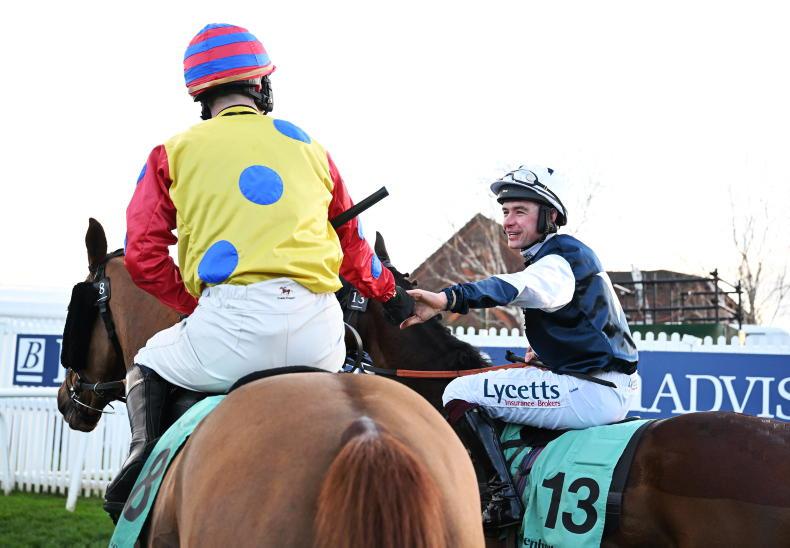
Meetmebythesea had the feel of an unexposed handicap plot of 139 and didn’t disappoint in the Jack Richards Novices’ Handicap Chase, while eight of the first 10 home in the National Hunt Novices’ Handicap Chase were also trained in Britain (including the 1-2-3).
The Irish were outnumbered in the Pertemps, and there was another 1-2-3 for the hosts here, spearheaded by the thrown-in Supremely West for the Skeltons. Again, eight of the first 10 across the line were British-trained. The visitors’ stranglehold on the Kim Muir was broken by Ask Brewster, with Monbeg Genius also reaching the top three for the home side. Karbau, probably too far back given how the races were unfolding and running on into sixth, was the only Irish-trained horse in the first nine in Friday’s County Hurdle.
Even behind Saratoga in the Fred Winter, the second, third and fourth were all British-trained. A 1-2-3-4 for the raiding party in the Cross Country is probably not a like-for-like comparison with the rest of the handicaps, given the specialist nature of that race.
It must be stressed that highlighting some frustrating British handicapping is in no way designed to come across as sour grapes. We all want a healthy level of competition between the nations. A vibrant British National Hunt scene is essential to the wider Irish industry.
However, Britain winning 75% of the handicaps and filling nearly two thirds of the first three places (61%) up for grabs doesn’t feel like real balance. We all want a fair fight on the biggest stage.