THERE can’t be many more challenging jobs in racing than being the clerk of a course. The role is often thankless, and pleasing everyone seems virtually impossible. No sensible person in the game underestimates the key piece of the raceday jigsaw the clerks deliver, and the difficulties that come with trying to get it right. It is far from simple.
All that said, however, the feedback received from a number of trainers and jockeys in contact with The Irish Field in recent weeks is that many National Hunt connections would simply much rather over-watered ground than some of the quicker surfaces that have been presented at some tracks of late. Trainers have been voting with their feet too. Just look at some of the field sizes, and key non-runners; especially in graded jumps races recently.
As we all saw, fields for Down Royal’s popular Festival of Racing were decimated due to the drying ground and what some connections viewed as conditions too quick to run their prized National Hunt campaigners. Most notably, Gordon Elliott made his feelings well known on the matter, branding the lack of watering as “not good enough”.
There were 15 ground-related non-runners on day one of the meeting and 19 on day two. It all resulted in only one race having a double-digit field on the Friday and high-profile names like Heart Wood, Koktail Divin, Affordale Fury, Mange Tout and Ballyfad being withdrawn over the weekend. Those withdrawls left a hole in this meeting.
At Clonmel last week, we ended up with just four runners in the Listed T.A. Morris Memorial Irish EBF Mares Chase after Dinoblue was withdrawn by Willie Mullins (officially due to a temperature). Plucky connections who took their chance had a blacktype 1-2-3 with mares rated 122, 105 and 115, but that is far from the typical level required to trouble the judge in such contests. Nobody can argue that the race quality didn’t suffer as a result of the ground presented on the day. The Grade 2 Clonmel Oil Chase received a massive knock too when Il Etait Temps came out on account of the ground, leaving just the three runners and a second-placed finisher officially rated only 110. Whatever way you look at it, prominent early-season races were heavily hit by ground that many vastly experienced trainers felt wasn’t suitable for their horses.
This isn’t an Ireland-only problem by any means - Britain is facing the same issues from a historically dry summer - but we had an Irish example only last weekend that attracting top jumpers to the races at this time of year can be done successfully. Field sizes for Naas’ graded action on Sunday mightn’t have been massive - they hardly ever are for this card - but the main performers all stood their ground. Kopek Des Bordes came to town, as did The Mourne Rambler, Anzadam, Irish Panther, Love Me Tender, Eachtotheirown, Minella Machine and Kokatil Brut.
In stark contrast to Down Royal and Clonmel, to name two recent blacktype examples, there was not a single non-runner across the whole fixture at Naas due to the ground.
Attracting the best
Anyone who read Barry Connell’s comments before racing in The Irish Field last weekend could have expected as much. “I went out to walk the track at Naas on Thursday and it’s looking absolutely beautiful,” Connell said. “I think Naas is an example to many other tracks with the standard of ground that should be on offer. Compared to what some tracks have been offering lately, it’s really lovely ground.”
The going at Naas was officially yielding. At Down Royal, we ended up with ground drying out to good on Saturday.
Even on Thursday of this week at Thurles, the ground was officially described as good and it looked quite lively. That was after 7mm of rain two days earlier, and watering. ‘Good’ was the description at declaration time, yet another five horses were withdrawn on account of the ground after that.
On the theme of getting better horses to line up in these conditions, the two maiden hurdles were indicative of trainers not wanting to run their better sorts on good ground. Only seven ran in one of the maidens and the runner-up was rated a lowly 92 (favourite pulled up quickly after the last and dismounted). In the other, the winner was a well-exposed 102-rated performer.
When we all want the best calibre racing possible, producing well-watered - and even potentially over-watered - ground is surely to be preferred over quick surfaces that many trainers don’t want to run smart horses on. When turning on the taps, we ought to suit the majority at this time of year - and also reduce the risk of injury for horse and rider. It is now mid-November. We are into winter racing. Winter horses are ready to race and most want winter ground.
What any track doesn’t want is for their ground to be the talking point to emerge from their fixtures. Sadly, we are in danger of that if the current trend continues of arguably insufficient watering. There is a wider conversation ongoing about maintaining the overall health of our tracks (see last week’s The Irish Field for a news report on a recent ground-related conference). Nobody is saying the job is simple by any means. It is an unquestionably tough gig.
Still, pouring on too much water, versus too little, is surely the safest bet as the big jumping guns begin to roll out.
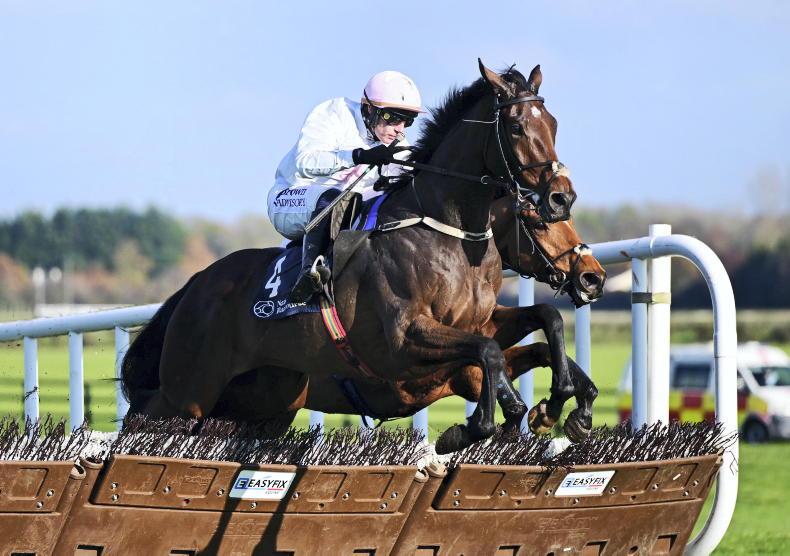
IT might only be early November, but the performance of Love Me Tender in winning the Overlander Fishery Lane Novice Hurdle by 15 lengths at Naas last Sunday was one that demonstrated major class.
Yes, Willie Mullins has been open about the fact his jumping must improve if he’s to be a force in higher grades. Make no mistake, though, he appears to have the engine to play a role in top novice company and he is an example of what has been missing from the two-mile hurdle ranks in recent times.
As touched upon in this column a couple of seasons ago, from 1995 to 2013, a whipping 63% of those who finished in the first three in the Champion Hurdle started their careers on the flat. Specifically, horses who debuted in flat races in Britain or Ireland filled 39% of the first three places in Champion Hurdles during this period.
Across the subsequent 10 runnings of the race, just two horses from off the flat in Britain and one from Ireland managed to make the first three in a Champion Hurdle - only 10% of the pool. When including horses who started on the flat in France, the rate of horses making the frame in the Champion after beginning on the flat was down to 33% (from 63%).
A big part of that shift is down to the fact those same classy flat horses that were making a big splash over hurdling’s minimum distances are now more prized than ever before with buyers overseas.
After just three runs under rules in Germany and France, this listed fourth at Chantilly (also half to a Group 3 winner) joined Mullins for €180,000 with a flat rating of 96. That was a mark off which he was sent off 7/2 favourite to win the Ebor on his stable bow - a race that often serves as a serious shop window for Melbourne Cup contenders. Being sent hurdling with that type of rating/profile is no longer the likeliest possibility for these horses nowadays.
We got a glimpse at just how well he stacks up against others at two miles over hurdles, though, when dishing out a comprehensive beating to a Grade 1 runner-up (rated 141). The proven flat engine came out in no uncertain terms.
As we’re seeing this type of horse tried over timber less and less, the two-mile hurdling ranks are suffering for it. If top owners can afford to compete with the strong overseas market for horses of this type of flat rating going forward, it can only be a positive thing for the division. Mullins is one man proving willing and able to do so. The Aga Khan Studs’ Almazann was bought for Closutton by Harold Kirk at a cost of €360,000 during last week’s Goffs Autumn Horse-In-Training Sale.
A colt by Zarak with bundles of size and scope - and rated 87 on the level following a last-time-out Curragh win - he ticks plenty of boxes to be a highly capable dual-purpose campaigner. No doubt he will have a fruitful dual-purpose career in store for a top team.