FOR all that the first three home from Epsom were in town for a rematch, it feels as though in the last week there’s been more discussion about the rights and wrongs of Irish Derby day as an event than there has been around the actual classic itself.
You could say that such a level of scrutiny on the Curragh is a product of people caring deeply about safeguarding what is one of Ireland’s marquee races in the calendar. You could also wonder if some of the serial complaining voices are likely to ever be satisfied.
Regardless, when we’re talking about one of the biggest days in Irish flat racing, none of us surely want to accept that the crowd of 11,200 who rocked up to the Curragh last Sunday is as good as we can do. The ambition has to be for better.
That said, leaning on attendances alone as a metric for an event being successful or not isn’t something I’ve ever been fully comfortable with. A fixation on figures doesn’t mean much if the racegoer experience and atmosphere isn’t favourable.
And to that point, having spoken to several racegoers who attended the meeting in a social capacity last week, the overall feeling was pretty upbeat about the experience on offer. That is positive; albeit we are starting from a low base after an €81 million redevelopment phase that went anything but smoothly in terms of keeping customers onside.
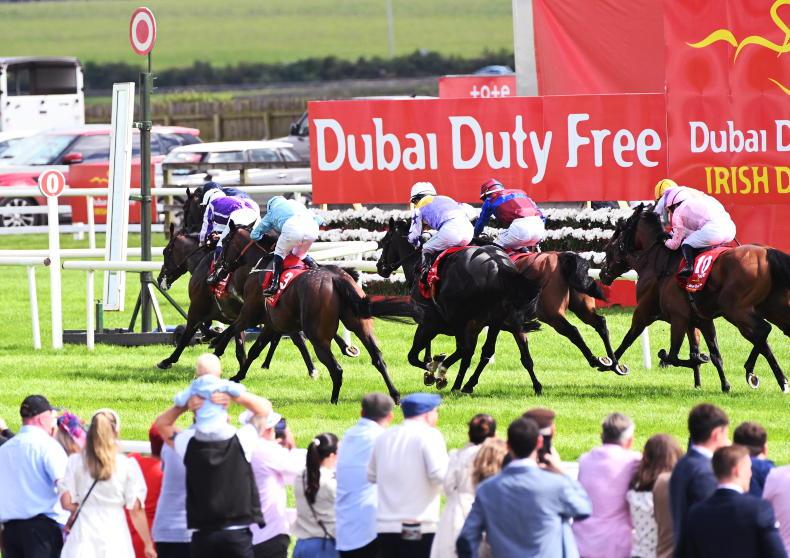
Aidan O’Brien issued a powerful defence of the Curragh and the Dubai Duty Free-backed classic in his comments following Lambourn’s gritty victory, and you could argue there has hardly been a more impactful marketing message for the Curragh since its relaunch to see the world’s top trainer being so animated.
The onus shouldn’t be on O’Brien to draw crowds to the Curragh, but it will be interesting to observe whether his passionate plea for more people to come racing can help improve public perception around the track. Similar fire in the belly being shown by others in the sport on any range of talking points is to be welcomed.
Code split
There is one key area in the entire discussion around Irish Derby crowds that barely seems to have got a mention this week, however. That is the reality of flat racing being completely the poorer relation to National Hunt racing in Ireland when it comes to resonating with the public. I personally love flat racing, but it is nowhere near as popular as the jumps, and that has to impact interest levels in meetings like the Irish Derby.
In the last 20 years, the number of flat meetings annually in Ireland has grown massively, but crowd figures have not. The Curragh is not immune to that trend.
Take a look back at the Horse Racing Ireland Fact Book from 2004. The figures exclude Northern Ireland meetings, but in that year the breakdown of fixtures were 59 on the flat, 125 over jumps and 97 mixed cards.
Fast forward to last year in Ireland, and there was a leap to 176 flat meetings, 206 National Hunt fixtures and only eight mixed cards - essentially 117 more flat-only cards than 20 years ago.
What’s most striking is that last year, the total attendance for National Hunt meetings in Ireland came in at 755,016. As for the flat, the figure was only 368,098.
Yes, there were slightly more meetings over jumps than on the level (30), but there’s no getting away from a massive gulf in attendances between the two codes. As for comparing the current state of affairs to 20 years ago, an average flat crowd of 4,641 in 2004 fell to 2,091 last year. The National Hunt average of 4,517 in 2004 hasn’t dipped as badly, though, coming in at 3,665 last year.
For what it’s worth, the 97 mixed cards in 2004 had an average crowd of 5,650, and bringing back more of these combined flat and jumps meetings has been a real desire from tracks like Listowel. As Listowel’s Pat Healy told The Irish Field in the aftermath of last year’s Harvest Festival: “I think we could have had Beyonce, Madonna and Taylor Swift playing here on the Monday and people still wouldn’t have come when it was an all-flat card.”
TV insight
RTÉ Racing’s viewing figures for 2025 are also worth looking at in this regard. When assessing the average audience watching their broadcasts from the Dublin Racing Festival, Fairyhouse Easter Festival and Punchestown Festival, their typical viewership for these National Hunt programmes was 100,544, with an audience share of 19%.
What about the flat? An average of 70,400 watched RTÉ’s 2000 Guineas coverage (audience share of 13.2%) and just 59,700 tuned in for 1000 Guineas day (7.6%). Last weekend, 75,700 watched the Pretty Polly (17%) and 73,100 had eyes on the Irish Derby (9.7%).
Long story short, none of the flat audiences were close to the overall 100,544 average for the 2025 jumps broadcasts.
There are absolutely areas where the Curragh can continue to improve, but until Irish people begin to properly connect with flat racing in the same manner as they click with National Hunt, it will continue to be an uphill climb to hit big attendances. And that is frustrating given the flat product is often more appealing than its jumping counterpart.
For example, in 2024 there were 211 odds-on shots across the calendar of Irish flat races. In National Hunt races, that total was significantly higher - 346.
What’s more, when focusing on top quality races, there were nearly three times as many odds-on shots in graded National Hunt contests than in group races on the flat last year (54 over jumps and 22 on the flat).
The handicap-heavy, nine-race programme at the Curragh last Sunday came under fire, and there are some tweaks I would personally like to see; such as one of the handicaps being replaced by a two-year-old maiden. If World Pool organisers are concerned about the prospects of a small field, why not make it Ireland’s most valuable two-year-old maiden of the year?
Two-year-old option
York hosts the £100,000 Convivial Maiden over seven furlongs during their Ebor Festival, and the outstanding prize pot has attracted fields of 17, 14, 17 and 16 in its last four runnings. A similar race at the Curragh could become a contest of proper interest each year if yards target it with their top juvenile prospects. I suspect they would.
Still, does anyone genuinely think that shifting around the programme to have a couple more group events, and reverting to seven or eight races on the card, would really put thousands more bums on seats? I don’t personally see it that way. Punchestown can still draw healthy festival crowds when having races like the Bishopscourt Cup and Ladies Cup on its schedule, which are clearly not going to be of obvious betting appeal to everyone.
Given that only a year ago officials from Horse Racing Ireland were summoned to appear before the Public Accounts Committee to answer questions on trading losses at the Curragh, accepting a ninth race to fulfil World Pool commitments and receive potentially in the region of €600,000 is an understandable move.
After all, Newmarket’s 2000 Guineas day now has nine races for the same Tote initiative. A marathon Breeders’ Cup Classic day at Del Mar even features 12 races, the first kicking off at 10.05am and the last at 5.25pm. A slightly longer format is a new dynamic for an Irish meeting, but if racegoers don’t want to stay for the full day, they don’t have to. They all surely don’t hang around that long at the Breeders’ Cup.
More pressingly, an admission fee of €45 at the turnstiles before you pay €5 for a racecard feels steep at a time when the Curragh is trying to draw back customers. Even if costs were reduced, though, the flat’s standing among the Irish racing public - and more casual followers - needs to be raised in order to feel meaningful change.
When British racegoers made up 38% of last year’s crowds at the Dublin Racing Festival, could our neighbours be a sensible market to tap into for boosting attendances on classic Curragh weekends? Some have suggested an amalgamation of the Irish Oaks and Irish Derby cards, which would have knock-on implications for the pattern, but it might be a conversation worth having.
Put simply, flat racing is in desperate need of a real marketing push to connect with an audience again. We can analyse the finer details of our meetings until the cows come home, but there just isn’t the same interest in the flat product as is the case over jumps, however disappointing that may be given our world-class standard of racing. A fresh approach is needed.
Once that imbalance starts to level out, we might be back to talking more about our best flat races again, rather than everything else around them.