BRITAIN and Ireland’s yearling sale season began to hit its stride this week with the Goffs UK Premier Yearling Sale - hot on the heels the sales race attached to that auction garnering plenty of discussion at the York Ebor Festival.
It didn’t appear to sit well with everyone that a last-time-out Group 1 winner in the shape of Sun Goddess was allowed to take part in a race she was comfortably the best in. She was officially rated 18lb higher than everything else beforehand. It also seemed to irk some that the decision to run her was made by one of the biggest and most dominant ownership operations in world racing.
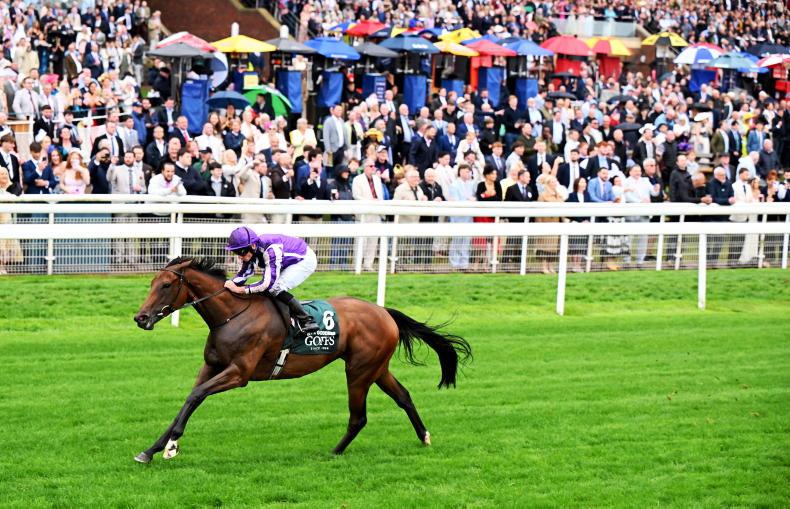
Those noises only grew louder after the Group 1 Keeneland Phoenix Stakes scorer routed her rivals at York by six lengths in a time much faster than Libertango had won the Group 2 Sky Bet Lowther Stakes in 35 minutes earlier.
But while having sympathy for those who were tasked with taking on a star juvenile in this year’s Harry’s Half Million By Goffs, the question remains for those who took exception to Sun Goddess’ presence in the line-up - would you have preferred watching the same contest without her? Take the Ballydoyle filly out of the mix and we’d have seen the pair of 81-rated outsiders, Battle Fever (66/1, trained by Kevin Ryan) and Speed Of Sound (40/1, trained by Richard Spencer) fighting out the finish together. Connections of those runners still picked up £117,321 for second and £58,660 for third - excellent paydays by all accounts. There is no way the race would have been anywhere near as interesting without her, or that it would have generated anything like the conversations it did since.
Sun Goddess wasn’t even the sales topper at last year’s Doncaster auction. She was excellently bought for £120,000 by Mark McStay’s Avenue Bloodstock for M.V. Magnier.
Just because connections have achieved massively with her, are we to punish them by making a Group 1 winner ineligible - treating her differently than every other horse from the sale? And in a race worth a whopping £596,145? It doesn’t feel right to rule out those who have done their job well in the sales ring and on the track.
It would also be denying Goffs the chance to showcase the juvenile who has put their sale up in lights for any given year. Surely a strong appeal in sponsoring a race like this is to showcase the type of horse who can come out of their auction in a primetime window.
What’s more, as Aidan O’Brien pointed out in the post-race debrief: “This race was worth more than £500,000 and she was bought at the sales for this race. She’s a Group 1 winner and it wasn’t going to make any difference going back to a Group 2 [like the Lowther on the same day]. This is a great initiative and makes us want to go and find horses back at that sale.”
Rolling the dice
It must be said too that there was a degree of gambling on Coolmore’s behalf by running Sun Goddess in the sales race. Turning out 11 days on from winning a Group 1 against the boys, running her for the sixth time in just over three months, ahead of a blacktype-filled end of season programme, they could easily have had egg on their face if it didn’t work out.
Remember, it was only 2024 when subsequent Group 1-winning sprinter Arizona Blaze (third in the Group 1 Phoenix Stakes on his previous start) had a crack at this very sales race as a short-priced favourite. He was beaten by a 77-rated rival, with an 80-rated horse behind him in third. Rolling the dice at York didn’t pay of on that occasion.
Even Ballydoyle had subsequent French Derby winner Camille Pissarro taste defeat in the 2024 Weatherbys Scientific £300,000 2-Y-O Stakes at Doncaster. Granted, he wasn’t a Group 1 winner entering the race, but he did collect at the highest level on his very next start a month later in the Prix Jean-Luc Lagardere at ParisLongchamp.
Any suggestion that Ballydoyle were directly standing in the way of small, grassroots outfits winning a big prize in the Harry’s Half Million is a bit naive too. Clive Cox masterfully won the three previous renewals, a trainer responsible for over 250 domestic winners in the last five seasons and in excess of £6.6 million in British prize money.
Richard Hannon is well established amongst the top trainers in Britain and was responsible for five of the previous seven winners, while William Haggas won three on the bounce from 2013 to 2015. Kevin Ryan and Richard Fahey have each won it twice since 2010 too. Tom Dascombe is the only other trainer to land the prize in the intervening period with Ever Given (part-owned by Michael Owen and Steve Parkin).
The presence of Sun Goddess immediately made the contest a more interesting race, including to the betting public. It has often been said that the sales race that is part of the Irish Champions Festival programme at the Curragh fails to really set pulses racing, albeit last year’s renewal was solid.
Some on-course bookmakers have expressed to me after recent ICFs that it is not typically a strong driver of betting turnover.
Sun Goddess went off the even-money favourite last week at York. That didn’t imply a foregone conclusion in advance of her rout. It was an event that brought its share of mid-race drama too. Without her in the line-up, there’s no way public interest in the race would have been as big.
Infrequent case
It’s rare a case like this comes on our radar anyway. As the Racing Post flagged beforehand, there have been just eight horses with official ratings of 100-plus to have run in the race in the last 10 years. All to try before Sun Goddess were beaten.
There is one standout issue surrounding the Harry’s Half Million, however, and one that needs urgent addressing before future editions. That is in relation to the penalties these superior blacktype winners must carry.
The current model does not look fit for purpose, and perhaps it has taken a Sun Goddess example to appear and shed light on the case. It makes absolutely no sense that the winner of a Class 3 race has to carry a 3lb penalty in this contest, yet a Group 2 and Group 1 heroine like Sun Goddess only has a 7lb penalty on her back.
The conditions note that the winner of a Class 2 race or of listed race has a 5lb penalty and the winners of any type of pattern race, which this year’s winner fell under, only has a 7lb penalty.
There is no way that we should have the same penalty in a sales race for a Group 3 winner as we do for a Group 1 winner. And a difference of only 4lb between what Class 3 winners must carry and what Group 1 winners do is way out of kilter. Sharper minds than mine can establish a more fitting penalty for those who have already won at the highest level. Sun Goddess still would have won with a 12lb penalty and more anyway.
That said, it would be a much more fitting test for those hunting the pot if she had greater weight to carry. We don’t need a knee-jerk response to this by ruling out the likes of Sun Goddess entirely from sales races, similar to the decision to exclude unraced hurdlers from the Triumph Hurdle on foot of Poniros’ shock win for Willie Mullins.
Instead, now is the time for a proper revision of penalty structures in these races. More radical red tape is simply using a sledgehammer to crack a nut.