THERE is no less than three weeks to go until the blue riband race of the hunter chase season. The race formerly known as the Cheltenham Foxhunters, which more recently has had the name of the St James’s Place Festival Hunter Chase attached to it, is currently being listed without a sponsor. What guise the race takes remains to be seen.
However, what will become clear imminently is the cast of contenders for this year’s race, with Irish entries for the race closing on Monday, ensuring this weekend is the last opportunity for connections to satisfy the entry criteria and book their ticket to the festival.
The Irish challenge for the race is likely to be strong this season, both in terms of the quality and quantity, as it provided the first two home in last year’s race, Wonderwall and Its On The Line.
Interestingly, both feature among the entries for open races between the flags this weekend. The defending champion Wonderwall is one of 10 horses entered for tomorrow’s open in Lisronagh, for what would be his first outing since he enjoyed a successful start to his season at Dromahane in early November. In contrast, we have seen more of Its On The Line this season, with the perennial Cheltenham bridesmaid most recently getting turned over at odds of 1/5 at Cragmore last month on what was his third start of the campaign.
The nine-year-old is entered for the rescheduled fixture in Oldtown this afternoon, however his handler, Emmet Mullins, indicated during the week that he would be unlikely to take up that engagement now that the race will be run seven days later than scheduled.
Unusual avenue
The likely make-up of the British challenge is becoming clear after a host of hunter chases in recent weeks. Bizarrely, the shortest-priced of the home team is Stattler, a horse who was retired after pulling-up in the 2024 Grand National at Aintree, and spent last summer competing in Retraining of Racehorses show classes.
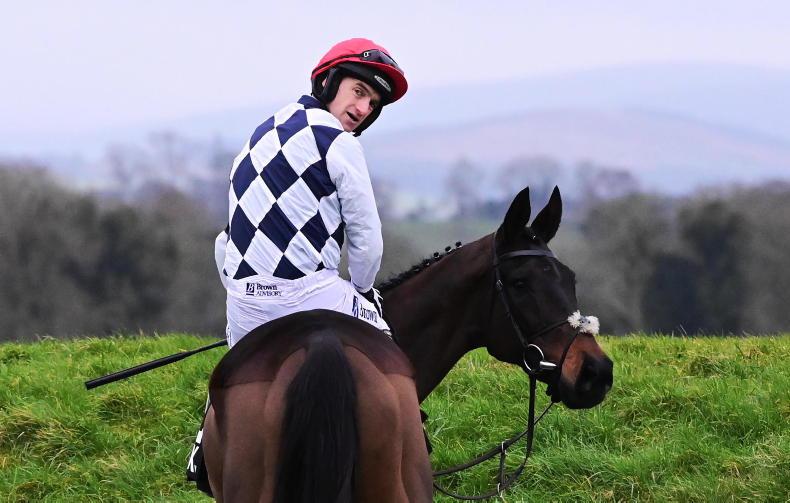
Now under the care of Faye Bramley, the 11-year-old secured his Cheltenham qualification by winning a hunter chase at Fakenham last week under Patrick Mullins, perhaps providing a clue towards who will be riding him next month.
Twenty-four hours later, the Walrus Open Hunter Chase was staged at Haydock, which is typically one of the main pre-Cheltenham hunter chases on British soil. The 2026 edition featured three horses who had contested last season’s Cheltenham hunter chase, with Shearer, who finished fifth behind Wonderwall, expected to advertise his credentials for an improved showing this year.
However, he could only finish third on his belated reappearance to Unexpected Party.
A former Grand Annual winner at the Festival, his trainer Dan Skelton suggested, after his Haydock victory, that the 11-year-old would instead be kept fresh for Aintree.
His victory does once again shine the spotlight on the British hunter chase eligibility rules, with the 147-rated chaser able to run in a handicap chase on December 7th, and win a hunter chase a month later on January 8th, without the need to run in a point-to-point.
That is not an isolated case. Eyebrows were raised when Jet Plane contested a hunter chase at Warwick on January 23rd, just 20 days after finishing second in a handicap chase at Sandown off a mark of 137.
At least on these shores, there is a requirement to finish in the first four in a point-to-point before becoming eligible to contest a hunter chase. Admittedly for some, it may only be a box-ticking exercise, but it does at least retain the link between hunter chases and point-to-pointing.
The British scenario would seem to be a further step towards losing the spirit of what hunter chases are.
THREE weeks after the new four-year-old maiden term kick-started at Bellharbour, tomorrow it is the turn of the four-year-old mares’ maiden season to commence, with the first races of that division in 2026 set to be staged at both Kildorrery and Lisronagh. They are the opening two fixtures within that category in a spring term that is set to feature 28 such races, an all-time high in the number of four-year-old mares’ maiden races that have been programmed.
The growth in the division has been sizeable. The number of spring fixtures hosting a four-year-old mares’ maiden has jumped almost 40% since 2019, and that is in response to the number of young mares starting off at an earlier stage in the pointing sphere.
At the start of the week, mares accounted for over a quarter of the four-year-old hunter certificates, as they continue to evolve as a key division within the pointing sphere.
At the end of last season, 265 four-year-old mares held an active hunter cert, a 43% increase from the same point in 2019, highlighting the demand for these additional races.
It is easy to see why this particular category is attracting these increased numbers. Rewind back 12 months ago to this corresponding Lisronagh card, and Mick Goff’s winner Clondaw Park was subsequently sold for £320,000, not far behind the £400,000 that Cristal D’Estruval made, having won the geldings’ equivalent on the card.
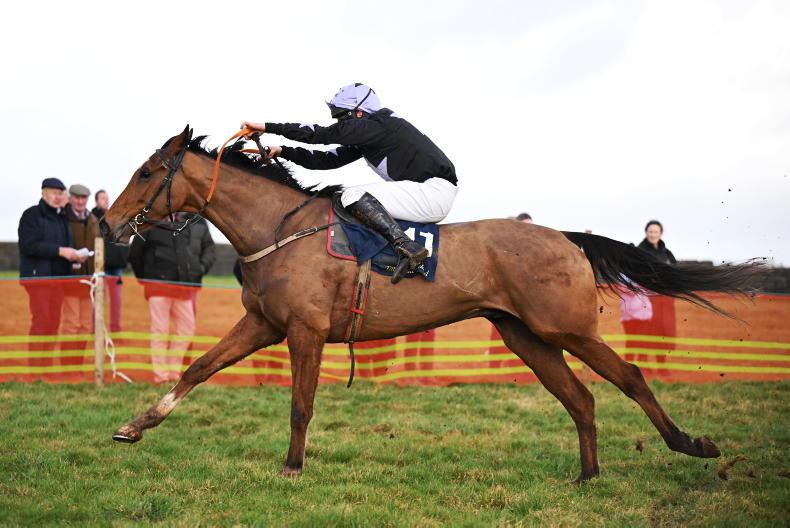
Jessber's Jury won Sunday's four-year-old maiden at Nenagh by 10 lengths \ Healy Racing
Jessber’JJessber’s Jury gets the verdict
FOR the second weekend in a row, Brian Lawless was responsible for producing an impressive four-year-old maiden winner, with Jessber’s Jury (93+) enjoying the perfect start to his competitive career at Nenagh.
This race was run to a strong tempo throughout, largely due to Cormac Doyle’s Mickos Max, who had gone 10 lengths clear by the first, blazing a trail from the front. Once Jessber’s Jury made his move entering the home straight, he quickly put the race to bed by galloping 10 lengths clear to hit the line strongly.
The pace was significantly steadier over the shorter trip at Knockanard, until Well Achieved (92+) increased the tempo at the third-last. He showed plenty of pace with this move, but was equally tough to hold on as two challengers closed in late on. An easy case can be made for the first three horses home all looking like smart track prospects.