THERE was certainly only one talking point emanating from last Sunday’s point-to-point action. The postponement of Ballinaboola left the stage clear for Bellharbour to host the opening four-year-old maiden of 2026, and it was in that spotlight that Code Name Cubitt triumphed for Ian Donoghue.
The Jet Away gelding matched the feat of his full-sister Brandy Love by winning his four-year-old maiden on his first start in this sphere. However, unlike that subsequent Grade 1 winner six years earlier, he arrived at Bellharbour with previous competitive experience under his belt.
As referenced here last week, one of the new dynamics in this year’s four-year-old maiden category is the inclusion of horses from the newly-introduced academy hurdle division.
Code Name Cubitt was one such horse to have come through that series of races, as he ran twice when under the care of Gavin Cromwell, finishing sixth at Fairyhouse in early November, before progressing to make the placings at Cork just under three weeks later.
That experience was an asset on Sunday, with the €50,000 foal purchase able to make all of the running, en route to his one-length victory in a polished performance.
This is not the first time that horses with previous track experience have figured within spring four-year-old maiden races. The most recent previous example came at Ballysteen last April, when Perfect Reel was only denied by a neck, having finished last in a three-year-old maiden on the flat over a mile at Leopardstown. He was subsequently sold for £55,000, whilst his narrow conqueror made €200,000.
Systems changing
At present, just a handful of horses appear to be moving from academy hurdles into point-to-points. Only four of the 305 four-year-olds that were hunter certed at the beginning of the week had run in an academy hurdle, with Chief Josef potentially next to appear, as he has been entered at both Comea and Punchestown tomorrow. However, there is a clear direction of travel at present towards starting horses at a younger age, and there is the possibility of that number growing.
It has already been announced that the academy hurdle races will begin in early spring 2027 to cater for the stores purchased at sales this summer, whilst last year, we saw the introduction of two-year-olds at store sales. The system in Ireland is changing, conscious of the need to start educating horses at an earlier stage, mirroring the French setup.
Up to now, point-to-pointing has fulfilled the introductory role within the Irish system exceptionally well. The strength of the four-year-old maiden division, in particular, is proof of the early platform that it has provided, with the majority of the Grade 1 performers who emerge from point-to-pointing coming from that age category.
However, with these latest developments, it does seem to leave point-to-pointing at something of a crossroads. What will it look like in 10 years in the midst of these developments?
Rewind to the early 2000s, four-year-old maiden races did not begin until the beginning of March. That changed in 2004, when it was brought forward by a month, with Tallow, Clonmel and Punchestown selected to hold four-year-old maiden races in February.
The number has grown significantly since; five alone will take place this weekend.
However, the early February starting date has remained unchanged, despite the industry evolving considerably in the interim.
Four-year-olds are already permitted to run in British point-to-points in January, a month ahead of their Irish counterparts. It would seem there is now real merit in a discussion being had around how these point-to-point maiden races evolve into the future.
One potential path for the Irish system was put forward by Michael Moore in this paper at Christmas. He wrote: “The ideal scenario for me would be two-year-old sales, and then the following year, that there was three-year-old point-to-points in November, December. From point-to-pointing all my life, I’m a firm believer that soft ground in November and December is not half as tiring as in January or February, especially for four-year-olds.”
That is just one such potential future direction for the sport to take, which was published well in advance of the Bellharbour race, but last Sunday’s result could well be the catalyst for a greater discussion being had around what the road ahead should look like.
THE reintroduction of a banks course at Knockanard has undoubtedly proven to be one of the greatest recent additions to the point-to-point calendar.
Landowner Jimmy O’Leary and members of the hard-working point-to-point committee began work on the track in 2020, and their efforts came to fruition when the open lightweight race at their February fixture in 2023 was run over the banks course.
In the years since, it has proven to be a sizeable crowd-puller, with horses negotiating a range of obstacles, including a double bank, drop bank and a laurel hedge. Twelve months ago, it was the Turlough O’Connor-trained and ridden Cloudy Tuesday who came out on top following a thrilling battle with Liam Gilligan’s Born By The Sea.
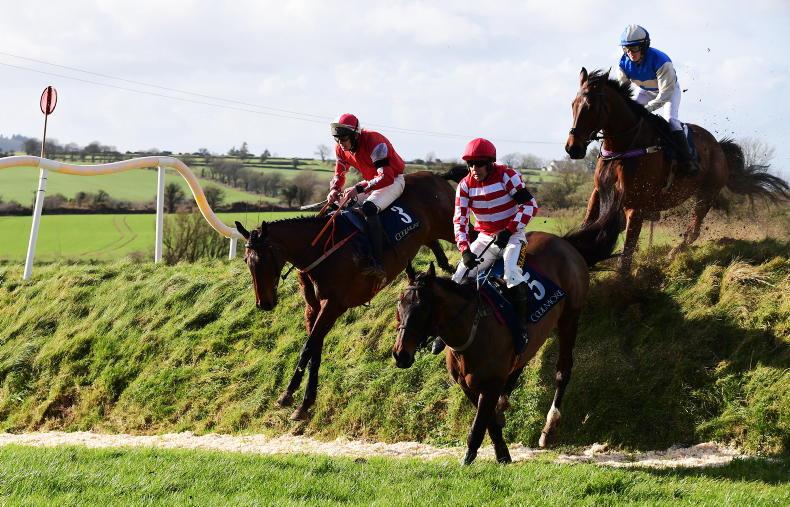
Adrenaline-filled renewal
Just half a length separated the pair, and another adrenaline-filled renewal is now just over a week away, and this year’s race on February 15th will have a €1,000 bonus prize up for grabs, ensuring that the winner will take home a first prize of €2,100.
It follows the €1,000 bonus that the Carrigtwohill committee put up for their older maiden last Sunday, and these efforts have to be applauded.
Point-to-point ratings
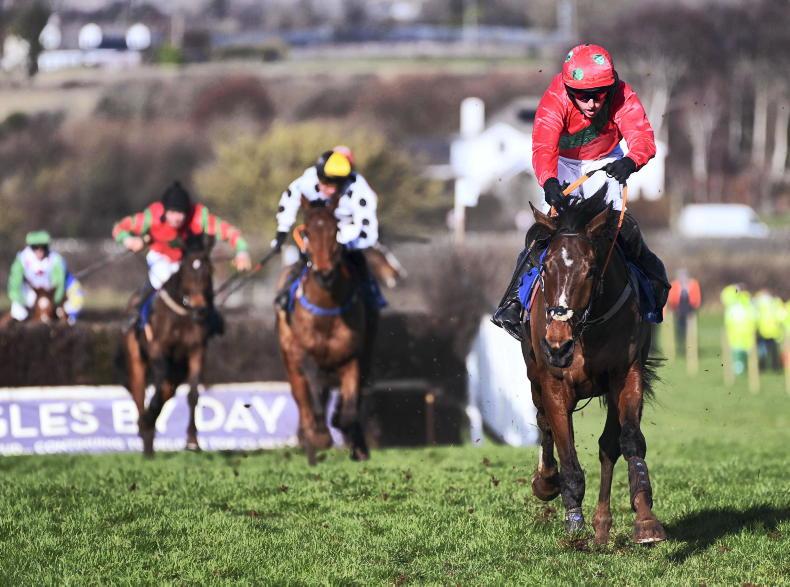
THERE was no disguising the superiority of Uncle Pad (91+) at Ballyvodock, as he justified market confidence to win easily by 10 lengths. After striking the front approaching the home straight, he was soon in command and looks like an exciting prospect.
Code Name Cubitt (90+) put his previous experience to good use at Bellharbour. Crucially, he was able to get first run on his rivals off the home bend and, whilst his two pursuers closed approaching the line, he had already built up enough of an advantage. Front-running tactics also paid off for Luxor Love (90+), who defeated a previously placed rival in a race where the four finishers returned at long intervals.