Betfred 2000 Guineas Stakes (Group 1)
PRIOR to the 2000 Guineas, there was plenty of talk suggesting that the race didn’t look to be a particularly good one this year. Some had written it off before the horses had even gone in the stalls.
Their pessimism could not have been further from the truth, with Bow Echo receiving a Timeform rating of 131, the highest rating given to any 2000 Guineas winner since Frankel in 2011.
This is a good example of facts usurping speculation and the data that Bow Echo produced provides further ballast to the performance.
A race should never be judged until it has been run and don’t get me started on the usual refrain that we hear after the Derby every year. The one that says it’s not a good Derby this year. The data and what the winner achieves after the race will be the judge of that.
The ground at Newmarket for the first classic of the season was described as good to firm. It was a shade slower than that as evidenced by the average Race IQ time index on the day of 5.1.
Nonetheless, it was ground on which horses were prepared to let themselves down and Bow Echo seemed to relish conditions, producing a winning time of 1m 35.59s, which is -0.44s under the Race IQ par and is the fastest time in this race since Kameko in 2020.
This was a strongly-run race with only Bow Echo and Gstaad (second) able to get close to the par finishing speed percentage (FSP) of 98.78%.
1st Bow Echo: FSP: 100.73%
2nd Gstaad: FSP:99.17%
Bow Echo was sensibly ridden by Billy Loughnane, who settled him in 11th place and got plenty of cover whilst producing remarkably even splits that he was able to maintain better than his rivals.
He did not quicken at any point in the race, but was able to stretch out his speed for longer than his rivals and he was the only horse in the race to produce a faster than par final furlong (12.24s), with Gstaad managing a par figure (12.57s) - all the other runners completed the final furlong slower than par.
Bow Echo’s sectionals are displayed below, with an indication of their relation to the par figure and his position in the race.
F1: 15.09s (Slow) 10th
F2: 11.42s (Par) 10th
F3: 11.31s (Par) 11th
F4: 11.28s (Par) 11th
F5: 11.30s (Par) 11th
F6: 11.47s (Par) 3rd
F7: 11.49s (Par) 1st
F8: 12.24s (Fast) 1st
The significant point in this run line came where he made a move from 11th to third between the fifth and sixth furlong and he did this without quickening, in fact, he slowed down by 0.17s, but the key point is at this stage of the race, all his rivals were weakening, all of them running slower than par, none of them able to sustain their speed as metronomically as Bow Echo. Eleven of them managed a faster furlong than Bow Echo in the first half mile, but none of them could run faster than him through the final three furlongs.
Ideal scenario
It would be wrong to suggest that this strongly-run race was the ideal scenario for Bow Echo, because he showed an ability to quicken when winning the Ascendant Stakes at Haydock last year, where in a steadily-run race, he produced a fastest furlong of 10.81s and an FSP of 111.87%.
This is evidence of his talent and versatility, and such is his talent he will be very hard to beat in the St James’s Palace stakes at Royal Ascot.
Gstaad emerges with plenty of credit on the day and, whilst beaten on merit by a very good horse, it should be noted that in breaking very smartly from the stalls and being the fastest in the race to reach 20mph (2.25s), he ended up racing without cover and a little too close to the strong pace, nonetheless in pulling eight lengths clear of the third he emerges as having produced a very smart effort.
More favourable circumstances may see him get closer to Bow Echo should they meet again, but it’s hard to see him turning the form around.
Betfred 1000 Guineas (Group 1)
IN contrast to the relentless speed shown by Bow Echo, when it came to True Love in the 1000 Guineas, we saw something different. The ground on Sunday at Newmarket was quicker than on Saturday, with an official description of good to firm backed up by the average Race IQ time index for the meeting of 6.9.
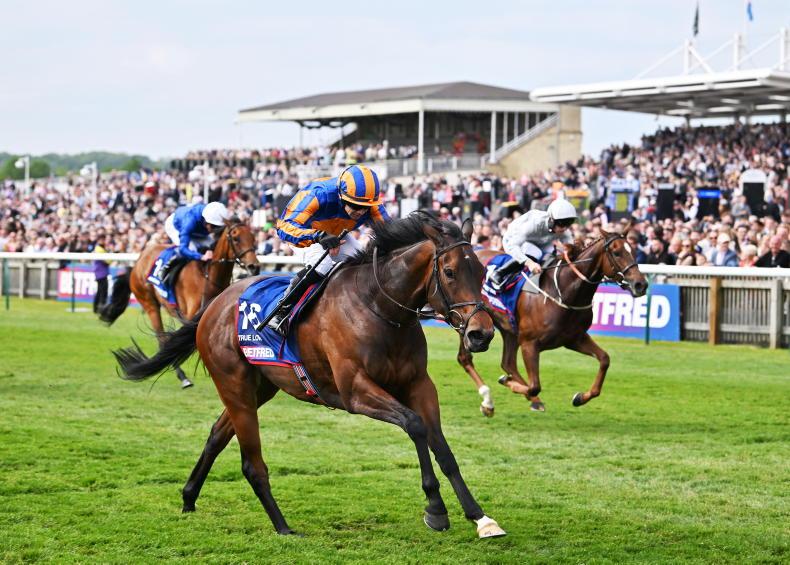
True Love won in a time of 1m 35.14s which was 0.44s quicker than Bow Echo and was -1.16s under the Race IQ par. The slightly faster ground and slight tailwind aided her to run a faster time and does not in any way suggest that she is the better of the pair because final times are not an accurate way to compare abilities, but it is my contention that she could be better than Bow Echo.
Even and strong
This race was not as strongly run as the 2000 Guineas, but the pace can be rated as being even and strong. Bow Echo ran 0.18s faster (a length) than True Love through the first half mile and then she was 0.65s (three and a half lengths) faster than him through the final half mile.
While she was able to save more energy for a faster finish and was racing on slightly faster ground, the way she quickened was impressive.
She was in 12th place with three furlongs to run, but at this point, displayed a sharp turn of foot to run a 10.93s furlong and backed that up in the penultimate furlong with an 11.22s furlong. Her sectionals are displayed in the next column.
F1: 14.96s (Slow) 12th
F2: 11.43s (Par) 9th
F3: 11.43s (Slow) 9th
F4: 11.46s (Par) 12th
F5: 11.30s (Par) 12th
F6: 10.93s (Fast) 4th
F7: 11.22s (Fast) 1st
F8: 12.40s (Par) 1st
The gallop may not have been as unrelenting as the one Bow Echo faced, but the splits she produced through the sixth and seventh furlong were both faster than Bow Echo could produce and her fastest speed in the race of 41.43mph is 1.92mph faster than Bow Echo.
Both horses must be rated as exceptional winners of their respective classics.
The handicapper has given Bow Echo an official mark of 126 and True Love 110. Given the data that they both produced True Love has been undervalued and somewhat lost in the post Guineas narrative that has rightly focused on Bow Echo.
Given that they are unlikely to ever meet on the racecourse, comparisons are somewhat futile, but I believe True Love will prove to be a lot better than she has been given credit for.
Ladbrokes Punchestown Gold Cup (Grade 1)
IT is a quantum leap in data analysis from a sub-11.00s furlong in a fillies’ classic to lengths gained jumping and jump index values in top-class jump racing, but we must make that leap this week because the Punchestown Festival sat alongside the Betfred Guineas Festival and produced some tremendous action.
There is a chance that Gaelic Warrior is the best chaser we have seen since Kauto Star, having backed up his Cheltenham Gold Cup success with an imperious victory in the Gold Cup at Punchestown.
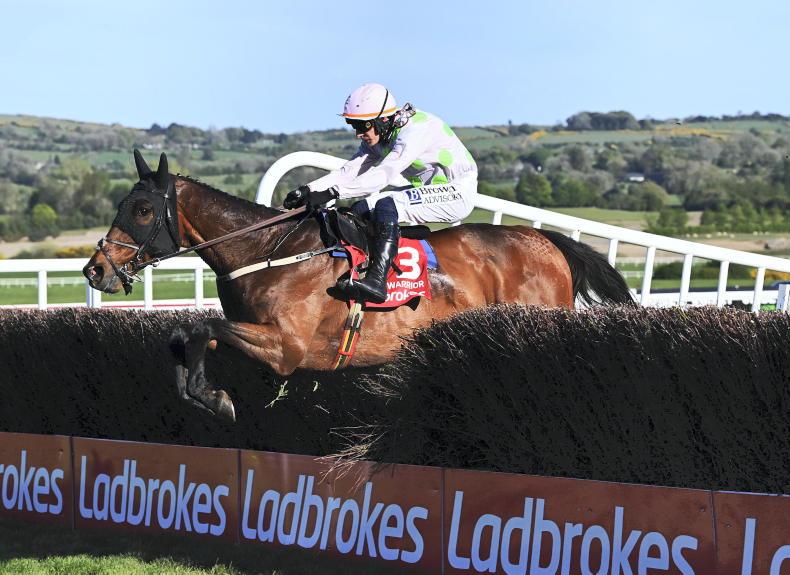
Gaelic Warrior is the highest-rated chaser in training and his versatility is why I make the comparison between him and Kauto Star.
Kauto Star was imperious from two miles to three and a quarter and, whilst he achieved a lot more in his career than Gaelic Warrior has, we should not forget that Gaelic Warrior was also an Arkle winner in 2024.
This race does not require a deep delve into the data, but it’s worth pointing out that his jumping in his last three starts has been a lot better than it was at Kempton in the King George, but for which would have a win in that prestigious race on his CV. His Race IQ jump index scores for his last four starts are set out below.
King George VI Chase: 7.8
Irish Gold Cup: 9.2
Cheltenham Gold Cup: 8.3
Punchestown Gold Cup: 8.2
On this occasion, he reversed the Irish Gold Cup form with Fact To File, thrashing him by 26 lengths in a merciless display of galloping that saw him hardly come off the bridle seeing the trip out with an FSP of 103.50% compared to Fact To File who jumped well in second (Jump index: 8.4) but appeared not to stay (FSP: 96.48%).
Il Etait Temps did what he had to do to cement his place at the top of the two-mile chasing division when winning the Champion Chase at Punchestown and it is a measure of his raw ability that he was able to win when not at his best.
William Hill Champion Chase (Grade 1)
THIS season Il Etait Temps has delivered his worst two rounds of jumping. At Ascot in January, he fell having jumped poorly and, at Punchestown, he was far from fluent at his fences producing the worst round of jumping in the race, but still managed to defeat Marine Nationale by five lengths at Punchestown.
The numbers tell us that he recorded a Race IQ jump index of 6.5 compared to Marine Nationale’s 7.3 and he lost 1.81 lengths on him due to that inefficiency, yet he was able to run faster than that rival through each of the final four furlongs producing an FSP of 101.70%.
It would be fair to say that Il Etait Temps got the job done whilst not being at his best and probably aided by Marine Nationale not being quite at his best due to a truncated season. He was certainly helped by a lacklustre performance from the enigma that is Majborough.
I have sung Majborough’s praises on these pages because his data has always been better than what he appears to do. On this occasion, the data and the visuals align in what was a disappointing effort.
He did not jump as well as he can, although he had the second-best jump index in the race of 7.9, it was the fact that he never went with much zest or the usual enthusiasm that was disappointing and his titanic performance at the Dublin Racing Festival now seems a distant memory.
Barberstown Castle Novices Chase (Grade 1)
KOPEK Des Bordes fluffed his lines in the Grade 1 novice chase at Punchestown, comkpleting what has been a three-race season of frustration. His stable companion Salvator Mundi took advantage in a strongly-run race that helped him to settle and finish his race stronger than can sometimes be the case.
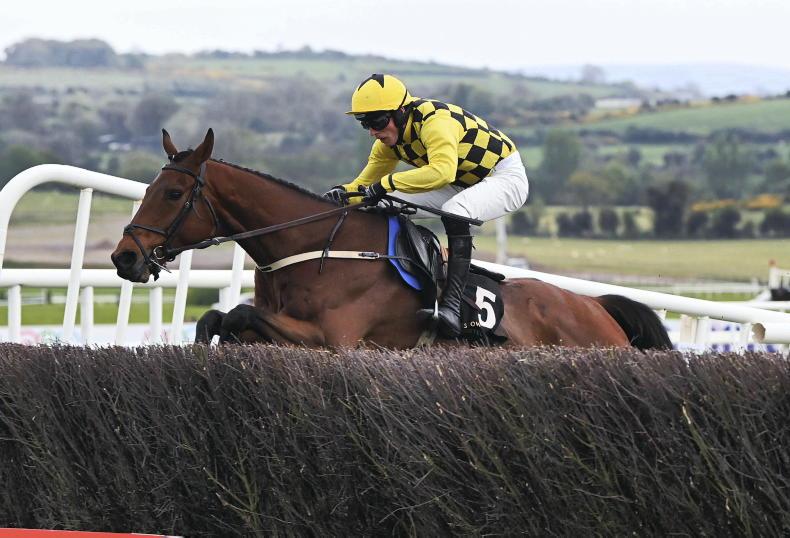
A finishing speed percentage of 99.43% for Salvator Mundi is an indication of the strong pace here, which was set by the runner-up Irish Panther, who was ultimately beaten by 12 lengths.
Salvator Mundi produced a jump index of 7.7, which although not exceptional was the best in the race, but he is most unlikely to have won had Kopek Des Bordes stood up.
Kopek Des Bordes travelled with his usual zest and jumped adequately, even if going to his left on occasions, and he gained a jump index of 7.0 over the nine fences that he completed.
Lurching
He took up the running and was three lengths clear when lurching to his left and taking a heavy fall two out. This was not a tired fall as the data shows he was just gathering momentum and accelerating as he went into that fence. His entry speed of 32.23mph was his fastest of the race and it may be that he struggled to get himself organised as he accelerated through the jumping envelope.
By contrast, Salvator Mundi went into the same fence at 31.69mph and, as such, was losing ground on Kopek Des Bordes at the time.
Kopek Des Bordes has had a tricky season, asked a big question at Cheltenham with just one run behind him and then this test straight after Cheltenham.
Learning curve
It has been a steep learning curve and, although it is never nice to see a horse take a heavy fall, it should be an experience he learns from; indeed, he will have to improve his jumping if he is to become a serious Champion Chase contender next season. He is a keen-going horse with a big engine rather like Majborough and, in the same way that Il Etait Temps took advantage of Majborough’s waywardness this season, Willie Mullins has Salvator Mundi waiting in the wings should the Kopek Des Bordes project not live up to its abundant potential.