THERE was a tremendous renewal of the Group 1 Queen Elizabeth II Jubilee Stakes, which was run for a million pounds for the fourth time.
The winner was unexposed as a sprinter coming into this, his only previous run and win at this trip coming in the Prix Servanne, a listed contest at Chantilly, on his previous start, although he did win the Prix Maurice de Gheest at Deauville last season over six and a half furlongs.
Lazzat won this in a very fast time of 1m11.40s which was 0.10s faster than Get It in the Wokingham which highlights the strength of that handicap. This winning time produced a Race IQ time index of 9.2 out of 10.
The early pace set by the now retired Storm Boy was not furious. His second and third furlongs of 11.49s and 11.28s are rated as slow for a Group 1 race at Ascot over this trip as against the Race IQ pars.
Lazzat raced in second, close to this pace with the runner-up further back in the field, still only ninth at halfway. Lazzat quickened to the front at halfway with a 10.98s furlong and then maintained that speed with an 11.13s and 11.90s furlong to win by half a length. Both of those final two furlongs are fast when compared to the par.
Satono Reve was faster than the winner through two of the final three furlongs and the data is clear that he was too far off the pace in a race that was not run at a furious gallop. His final two furlongs compared to Lazaat are detailed here:
1st Lazaat: 23.03s
2nd Satono Reve: 22.99s
That discrepancy is, bar 1/100th of a second, made up by Satono Reve running a faster final furlong. It is prudent to be wary of horses that make strong late headway in races that are strongly run, they are merely using energy they reserved whilst their rivals ran hard.
In this case, the relatively steady early pace gives us reason to be very positive about Satono Reve.
Either way, with these two horses likely to remain on the European sprinting scene, it is fair to conclude that this sometimes-maligned division is stronger than it has been for several years.
ROYAL Ascot 2025 has been scrutinised from every angle. Encouraging attendance figures and a dress code that required socks, along with a TV presenter in a pool and an heir to the Hardwicke dynasty with his House of Lords ambition, are just some of the talking points that have garnered plenty of comment!
But the stories that really showcase the sport are provided by the equine competitors and connections associated with them.
The track is worthy of comment on what was a very hot week, which was well managed by the executive who resisted the temptation to water too much.
The Race IQ Time Index scores suggest that the ground was slightly easier on the first day of the meeting, although the meeting average score for that day was skewed by the very low score recorded by Docklands in what was a very slowly-run Queen Anne Stakes.
The average scores rated out of 10 are detailed below.
Day 1: Race IQ Time Index: 5.8
Day 2: Race IQ Time Index: 8.2
Day 3: Race IQ Time Index: 7.8
Day 4: Race IQ Time Index: 8.0
Day 5: race IQ Time Index: 8.0
These scores are commensurate with Good to Firm ground and back up the day-to-day going descriptions.
There is one anomaly, and it concerns the straight course on Thursday, where in the big field races, there seemed to be a distinct advantage in racing close to the stands’ rail from a high draw.
The first four in the Royal Hunt Cup were drawn 29,30,28,27 and raced right against the stands’ rail, the first four in the Buckingham Palace Stakes were drawn 28,29,32,30 and raced in the same place.
It is therefore surprising that, on the following day, the jockeys did not want to race against the stands’ rail, preferring the middle of the track - indeed winners on the straight course were drawn in stalls 1,1,2 and 24.
Even Adrestia, winner of the Palace of Holyroodhouse Stakes from stall 24, stayed well away from the stands’ rail.
No explanation has been given for this, but it would be my belief that to remove the bias, the stands’ rail was watered to level up the playing field and the jockeys and connections who walked the track before racing on Friday, took the decision that, rather than just eradicating the bias, the watering had made the stands’ side slower.
Official explanation
This is merely speculation on my behalf, but in the absence of an official explanation, it seems bizarre that after the way the straight course races unfolded on Thursday, the jockeys then wanted nothing to do with that stands’ rail thereafter.
The two best time performances at the meeting were put up by Field Of Gold in the St James’s Palace Stakes and Ombudsman in the Prince of Wales’s Stakes.
Both are world-class racehorses who shook off previous defeats this season to show exactly what they are capable of.
They are not a good example of the effects of pace in races. Field Of Gold was beaten in the 2000 Guineas where the pace was steady to halfway and he was caught out by the better positioned Ruling Court.
Ombudsman tasted his first defeat in the Brigadier Gerard Stakes when sitting too far back in a race where Almaqam made the running, dictating even fractions.
It highlights once again that the universal bias in horse racing is pace.
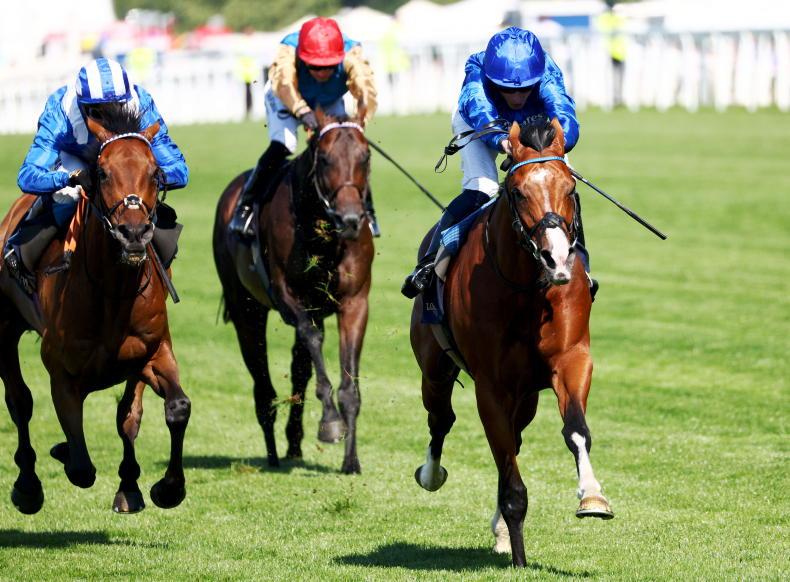
OMBUDSMAN won the strongly-run Prince of Wales’s Stakes in a very fast time of 2m2.51s which produced a Race IQ time index of 9.3 out of 10, which was the highest score at the meeting (Field Of Gold time index 8.4).
This was achieved through a patient ride from William Buick in a race where those that raced prominently did not figure in the latter stages.
The pace was made by Continuous, who seems consigned to this role these days, and he was followed closely by the favourite Los Angeles.
The first two furlongs were important in terms of energy distribution. Los Angeles was bustled along to be prominent and ran the first two furlongs in 24.49s, with Ombudsman saving energy in seventh place recording 25.5s.
After those first two furlongs, Continuous maintained a strong even gallop through the next four, with fractions of 12.22s, 12.22s, 12.32s, 12.41s and 12.72s.
Too much early
Los Angeles and Continuous were the only two horses that recorded sectionals that were slower than the Race IQ par through each of the final four furlongs, an indicator that they did too much early in the race and the attempt to repeat the tactics of the Tattersalls Gold Cup failed because Los Angeles failed to get a mid-race breather as he did in Ireland, where his fifth and sixth furlongs of 12.48s and 12.55s allowed him to fill up for a strong finish. There was no such let up here.
Ombudsman found some trouble in running in the home straight, but his sharp turn of foot got him out of trouble. He was still sixth in behind horses with two furlongs to go, but once in the clear his response was instant and impressive.
He quickened sharply with his final furlong of 11.82s rated as very fast as against the Race IQ standard. In recording this split, he was the only horse in the race to dip under 12.00s through that furlong as detailed below.
He recorded a Finishing Speed Percentage (FSP) of 102.45% (Race IQ Par 102.04%) in completing the final three furlongs in 35.77s. It is fair to assume that he could have recorded better numbers than these if he had got a cleaner trip.
Ironically, it may have helped him to be in traffic whilst others were picking up, saving his energy for that very fast furlong.
When Anmaat surged to the front, he recorded a penultimate furlong of 11.91s compared to Ombudsman, who was just getting into stride with a 12.07s split, but then the discrepancy between them in the final furlong is stark as Ombudsman found his stride:
Final Furlong splits
Ombudsman: 11.82s
Anmaat: 12.35s
Ombudsman was clearly helped by the run of the race, but this was a stunning performance from a horse having just his fourth career start.
Make no mistake, this was a world-class performance, comparable if not better than Field Of Gold.
THE wins of Gstaad, Charles Darwin and True Love made for Aidan O’Brien domination of the two-year-old races.
Their performances have been a little overshadowed by the glowing tributes that Aidan paid to the absent Albert Einstein, who is unbeaten in two starts. There is no greater believer in his horses than Aidan, but there was something more compelling about his effusive praise for Albert Einstein than is usual, reminding me of his unwavering belief in City Of Troy. Horses are not humans, but if Gstaad was, he would be entitled to be a bit fed up with all the talk of Albert Einstein after what he achieved in the Coventry.
He won in a time of 1m13.43s which garnered a Race IQ time index of 6.8 with the meeting average being 6.1.
Being by Starspangledbanner out of an Exceed and Excel mare, he is a half-brother to Vandeek, who won the Group 1 Middle Park Stakes as a two-year-old.
This speedy pedigree manifested itself here with a three-length success, which suggested that he is some way ahead of his peers at this trip currently.
Sustained pace
He travelled strongly in a race that was run at a strong gallop. He recorded an FSP of 101.23% (Par: 99.99%), which is reflective of the sustained pace that he was able to show. He raced towards the rear in 15th at halfway in a tightly-packed field.
His surge from that position to the front was impressive, with a fourth furlong of 11.31s taking him to the front and he maintained that surge with a fast fifth furlong of 11.65s.
He was fastest in the race with those two splits and was again the fastest with a 12.53s final furlong. A dominant display from a precociously talented colt.
 Gstaad looked to be a different model to his rivals in the paddock, and it remains to be seen if those that are slightly less developed than him at this stage of their careers can ultimately bridge the gap.
THE sprinting division will be further enhanced when More Thunder, who finished runner-up in the Wokingham Stakes, steps up to pattern company.
Firstly, credit to Get It who made all the running in a time of 1.11.40s which, for a handicap over six furlongs at Ascot, is very fast, and produced a Race IQ time index of 9.5.
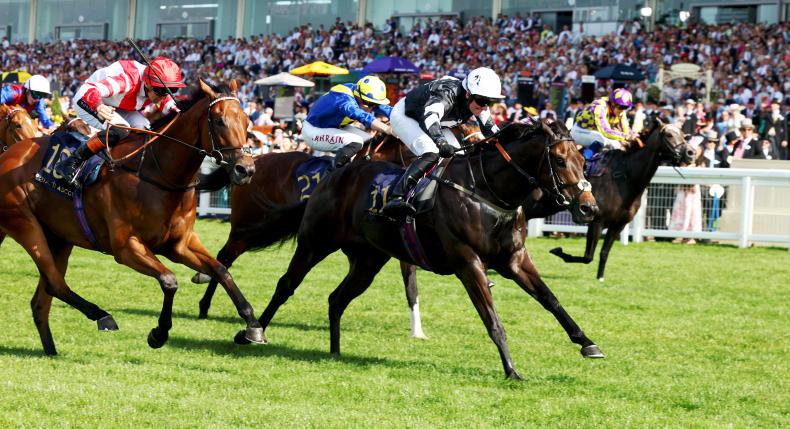
He won by racing evenly on the lead, which meant that he recorded an FSP of 98.97% (Par 99.99%).
Any horse that can lead and race evenly is going to be hard to catch and that proved the case, as More Thunder rattled home from 22nd - a place that he occupied with two furlongs still to run. He then recorded a final two furlongs of 22.94s (FSP: 103.78%) compared to the winner, who raced home evenly in 24.05s. More Thunder was much faster through each of the final three furlongs than the winner and may have won if Tom Marquand had not got his whip tangled in his reins.
Final three-furlong splits
Get It:
F4: 11.21s
F5: 11.64s
F6:12.41s
More Thunder:
F4: 10.90s
F5: 11.27s
F6: 11.67s
That final furlong of 11.67s is rated as very fast against the Race IQ par and is a faster final furlong than either Lazzat or Satono Reve on the same day.
More Thunder will be suited by a step up to seven furlongs and he does hold an entry in the Group 2 Lennox Stakes at Goodwood, the International Stakes at Ascot and the Bunbury Cup at Newmarket.
The problem with going up in trip and grade is that he may encounter tactically-run, small field contests, when a big field strong pace scenario is much more up his street.
It may be that a strongly-run six furlongs will always bring the best out of him and I would not rule him out of a race such as the Qipco Champion Sprint run back at Ascot in October.
After all, we know he is fine at the track and he does handle soft ground.