AIDAN O’Brien has a stranglehold on the Epsom Derby 2026 and potentially all the middle-distance contests next season. Pierre Bonnard backed up his Zetland Stakes success at Newmarket with Group 1 glory in the Criterium De Saint-Cloud last Sunday and Hawk Mountain advertised his Derby claims with a tough win in the Group 1 William Hill Futurity Stakes.
These two are at the head of the Derby market with stable companions Benvenuto Cellini, Action, Constitution River and Albert Einstein making up the chasing pack. Pierre Bonnard showed plenty of speed to win a steadily run Zetland Stakes as analysed here two weeks ago but showed that he can handle softer conditions and a stronger gallop when staying on too strongly for his rivals in France, and it was staying power that took Hawk Mountain to success at Doncaster.
The ground at Doncaster on Saturday was described as heavy. This description is backed up by the Race IQ data which recorded a meeting average Time Index score of 6.0. The times produced by Hawk Mountain and LamYai were the two outstanding performances on the clock as detailed below.
Race IQ Time Index values: Doncaster
Smart Vision: 5.8
Hawk Mountain: 6.7
Lam Yai: 6.7
The Resdev Scholar: 4.2
Desperate Dan: 6.5
Crowd Quake: 5.9
Prosperitas: 6.2
Conditions dictated that the William Hill Futurity Trophy was a true test of stamina at a mile with Hawk Mountain wearing down Action inside the final furlong. The race was evenly run with all the runners tiring in the final two furlongs to record slower than par sectionals.
This relatively slow finish meant that Hawk Mountain recorded a sub-par Finishing Speed Percentage (FSP) of 100.51% (Par: 104.04%).
These numbers are indicative of an attritional contest with the winner seeing the distance out better than his rivals, it certainly wasn’t a race where any of the runners could flash their speed. Hawk Mountain ground out par sectionals making all the running before slowing markedly in the final two furlongs as demonstrated below.
Hawk Mountain sectionals:
F1: 15.67s (Very Slow)
F2: 12.53a (Par)
F3: 12.66s (Par)
F4: 12.61s (Par)
F5: 12.32s (Par)
F6: 12.23s (Par)
F7: 12.39s (Slow)
F8: 13.44s (Very Slow)
That final furlong of 13.44s was slow but crucial as it was where he was able to assert his authority over Action (second) who clocked 13.51s (+0.07s). His fastest furlong of 12.23s saw him hit 36.71mph and we know from his three previous starts that he can run faster than this, having already recorded 41.52mph 38.87mph and 37.93mph in his first three starts. It is fair to say that conditions blunted his speed, but that can be said of his rivals as well.
We should remain positive about Benvenuto Cellini (third) who was the fastest horse in the race through F5: (12.27s) and F6: (12.18s).
That split of 12.18s was the fastest in the race, but he could not maintain that effort through the final two furlongs through which he was 0.58s slower than Hawk Mountain.
He showed plenty of speed when winning at Leopardstown on his previous start (FSP: 110.09%) but he failed to handle conditions which did not enable him to use his speed against two stable companions who may prove to be stronger stayers.
It’s tough to assess a horse’s merits when racing in these conditions, and comparisons between Hawk Mountain and Pierre Bonnard are hard to make. The raw data is worth outlining as an early guide to which one could win the Derby, although it is by no means conclusive.
What it does highlight is that both have plenty of speed, and it would be wrong to see Hawk Mountain as just being a stayer after his performance at Doncaster where his speed was severely blunted.
Fastest career furlong:
Pierre Bonnard: 11.20s (Newmarket)
Hawk Mountain: 10.95s (Curragh)
Top Speed:
Pierre Bonnard: 40.39mph (Newmarket)
Hawk Mountain: 41.52mph (Curragh)
Highest FSP:
Pierre Bonnard: 110.93% (Leopardstown)
Hawk Mountain: 107.87% (Curragh)
If either went on to win the Derby it would be no surprise, but when it comes to playing ante-post, it is very much a coin toss between the two, and, in essence, the Derby picture is not really a coin toss between these two but rather a Ballydoyle raffle.
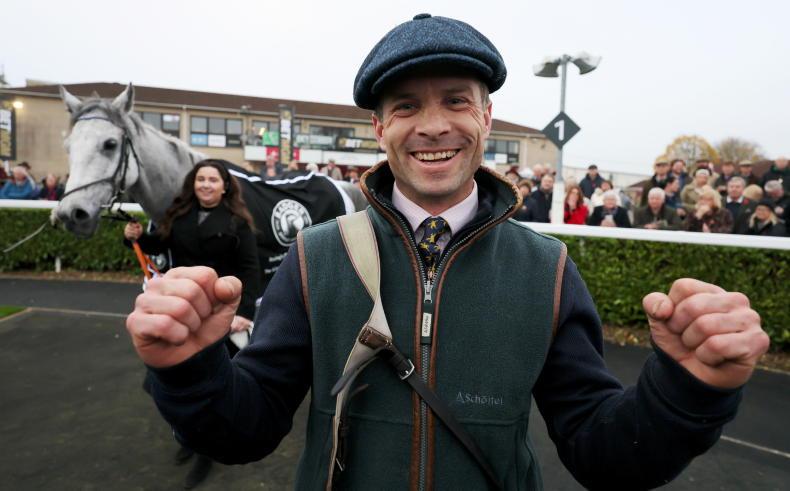
THE National Hunt season is beginning to find its feet, and my eye catcher this week comes from Cheltenham on Friday. The Race IQ Jumping data is very useful in identifying horses that run well despite some indifferent jumping, and that certainly was the case when it came to Doctor Blue in the Grade 2 Novices hurdle.
Doctor Blue was pitched into this Grade 2 on his hurdling debut off a seven month lay-off. He won a bumper last season at Taunton and ran well in defeat at Ascot in a very strong listed contest. This was a tough ask on his hurdling debut, and to only be beaten a short-head in second is testament to his raw ability.
The race was run at a modest tempo with the first eight home recording an FSP above 100% having saved energy for relatively strong finishes. This pace scenario resulted in plenty of horses having a chance from two out, and traditional analysis would be inclined to be skeptical of the form, but adding jumping data to that analysis can change that view.
Adequate
Doctor Blue jumped adequately recording a Race IQ Jump Index of 7.3 out of 10, but that was nowhere near as good as the winner Fortune De Mer, who put in an excellent round of jumping with an Index score of 8.6. The significant difference in their jumping efficiency is reflected in the lengths gained or lost on the field. Doctor Blue lost ground on the field at seven of the eight hurdles with his obvious inexperience.
Fortune De Mer gained +2.89 lengths with his jumping whereas Doctor Blue lost -4.33 lengths. The net difference is a loss of 7.22 lengths, and given that Doctor Blue was only beaten a short-head, a better round of jumping would have seen him winning readily.
At the last hurdle alone, Fortune De Mer gained a length. Only two other horses in this 12-runner race lost more ground at their hurdles than Doctor Blue, and one of those was pulled up with the other finishing a well beaten sixth.
The data is clear that Doctor Blue would have won if he had jumped better, but we must credit him with a tremendous effort on his hurdling debut under a conditional who was unable to claim his allowance.
He is a half-brother to plenty of winners in France, some of them smart, and he is a bright prospect for trainer Sam Thomas. He has no immediate entries but is one for your chosen method of tracking horses.