MANY of you, maybe those not working in the industry, probably believe a racehorse trainer typically has a good lifestyle, makes a nice few quid and keeps himself in the best company. Unfortunately, that is simply not the case for the majority.
To train horses you have to be prepared to take it on as a vocation, a passion, a love of working with horses, rather than a way to make good money.
Yes, there are trainers who make quite a good living and that is what we all aspire to, but only a few make that breakthrough.
Everyone’s circumstances are different. There’s no book you can look up and reference as to how much it costs to run a yard or train 30 horses but I will share my figures with you. I dare say, there are many more in the training ranks who are worse off than me.
I’m approaching 10 years as a trainer and I have been charging €30 a day from the start. I know for a fact that the costs of my staff, feed, bedding, insurance and mortgage have all gone up in that time, possibly haylage has as well but that is one of the least expensive elements to the overall picture.
STAFF SHORTAGE
I pay my staff €400 a week but by the time I pay their PRSI it is costing me €508 a week. Getting staff can prove to be a nightmare at times and obviously a lot of good riders are moving to the bigger yards where the wages are much higher and the bonus incentives are a lot greater. It’s hard for any trainer to compete with that. When you are outside the heart of the Curragh or other major training centres it can be difficult to get six good riders to ride out.
I use one of the leading feed companies and my bill for feed per week would be around €700 or just shy of €3,000 a month. There is a lot of competition out there among the feed companies and different people will use different brands but I go with what I think is best for the horses. With that you can add in two or three bales of haylage a week and that would cost you about €12 a horse per week if you broke it down.
Again, I remember a few years back when the price of diesel shot up, so too did the price of shavings. Diesel isn’t quite as expensive now but the price of shavings didn’t change. Some trainers will get loose shavings in bulk but I haven’t got the luxury of that and a bag of shavings cost me €6.50 a bag and a horse would get two or three bags a week depending on the horse.
It would be great to be getting €30 a day for every horse in the yard but the reality is that I own one and have shares in three others. I know there are other trainers in much deeper than I am.
Like many in my position, I bought on spec at the sales in the hope that I had found a future star. You take a chance with one and hope you either find a client for it or get rewarded yourself. Other times you need to take a share with a few lads to encourage them over the line. I feel I’m better to have a quarter of a horse and keep those owners in my yard, rather than see them going somewhere else.
This budget below is based on a yard with 30 horses in training. For this exercise we will assume I’m being paid in full by the owners. That doesn’t always happen. Also not included here are the many miscellaneous items that you purchase on a daily basis. The margins are very tight.
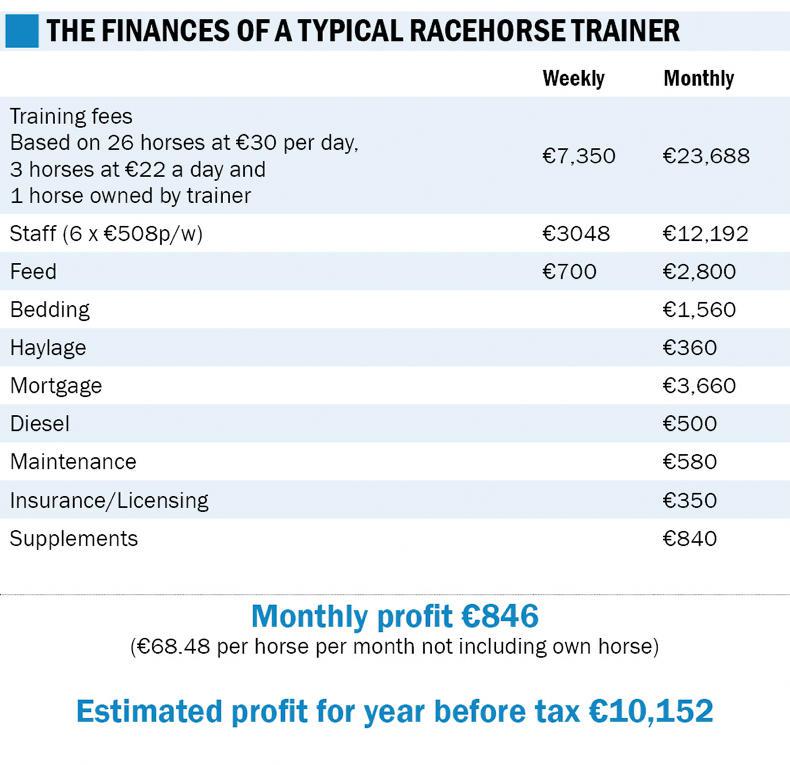
As you can see I would be very lucky to be left with €850 a month before tax. We haven’t even considered electricty, phone bills and so on. My staff are far better off than I am.
The minimum wage in Ireland is €9.15 an hour and going up in January. If I worked a normal five-day week, eight hours a day in a supermarket I would take home €1,472 a month and no stress.
My hours are a lot longer than someone stacking shelves and I don’t get paid holidays either. As I said at the start, you don’t work with horses for the money.