ANGULAR limb deformities (ALD) are a group of common conditions affecting the conformation of horse limbs. They are either present from birth or develop in the first few weeks and months of life. They are caused by disturbances in the ‘growth plates’ of the leg bones.
A growth plate is a sliver of cartilage present close to the bone ends in young animals (figure 1). The cells in the cartilage divide as the animal grows and are then replaced by new bone cells, allowing the bone to get longer. Once the bone has reached its adult length new cartilage stops being produced and the plate fills in with bone tissue and eventually disappears.
In most cases the growth plates are symmetrical and the limb elongates evenly as the foal grows. However, problems may arise if the cartilage cells in one side or section of the growth plate divide more rapidly than the opposite side (figure 2).
This will cause an uneven growth pattern to develop, causing the limb below the growth plate to be pushed away from the side where the cells are dividing more rapidly. The growth plates above the knees, hocks and fetlocks are most commonly affected. The foal’s bodyweight is then thrown off centre, making the problem worse and causing one side of the hoof wall to begin to collapse. This is turn can affect the foal’s gait.
EARLY INTERVENTION
Obviously, crooked limbs are undesirable in any athlete, but the problem is especially pressing if the plan is to enter the foal sales. You need all treatment to be completed in time to allow an adequate preparation period. The good news is that most cases of ALD can be successfully managed as long as appropriate intervention begins early in life.
Optional management requires cooperation from the owner, farrier, vet and foal.
Plenty of foals will appear a bit weak and crooked immediately after birth, especially if they are large, premature, sick, and weak or if it is the dam’s first foal. In most cases these will improve immensely during the first week of life as their muscles strengthen up.
Intervention is typically only required at this stage if the foal is struggling to get up and nurse unaided. These foals should not be turned out in a large paddock and/or in a group. The mare is likely to gallop and a weak or uncoordinated foal is at high risk of injury as it tries to keep up. A small nursery paddock or round pen is better as it will allow the mare some grass and fresh air with a much lower risk of injury.
All foals should ideally have their limb and hoof conformation assessed between 10-14 days by an experienced horseperson, farrier and vet. This will allow problems to be identified and rectified early and with as minimal expense and risk as possible.
The growth plates above the fetlocks start to close from as little as 12-16 weeks of age and the process is completed by six to 24 months of age, depending on the joint. Once the growth plates are gone the management options are greatly reduced. If this treatment window is missed the chances of a good outcome, and a successful athletic career, diminish rapidly.
Foals should be trained to lead in hand from an early age. This allows their movement and conformation to be accurately assessed by standing and walking them on a smooth, hard, level surface. Most foals have a narrow chest and a natural inclination to ‘toe out’. However, as long as this is mild and symmetrical it will disappear as they mature. 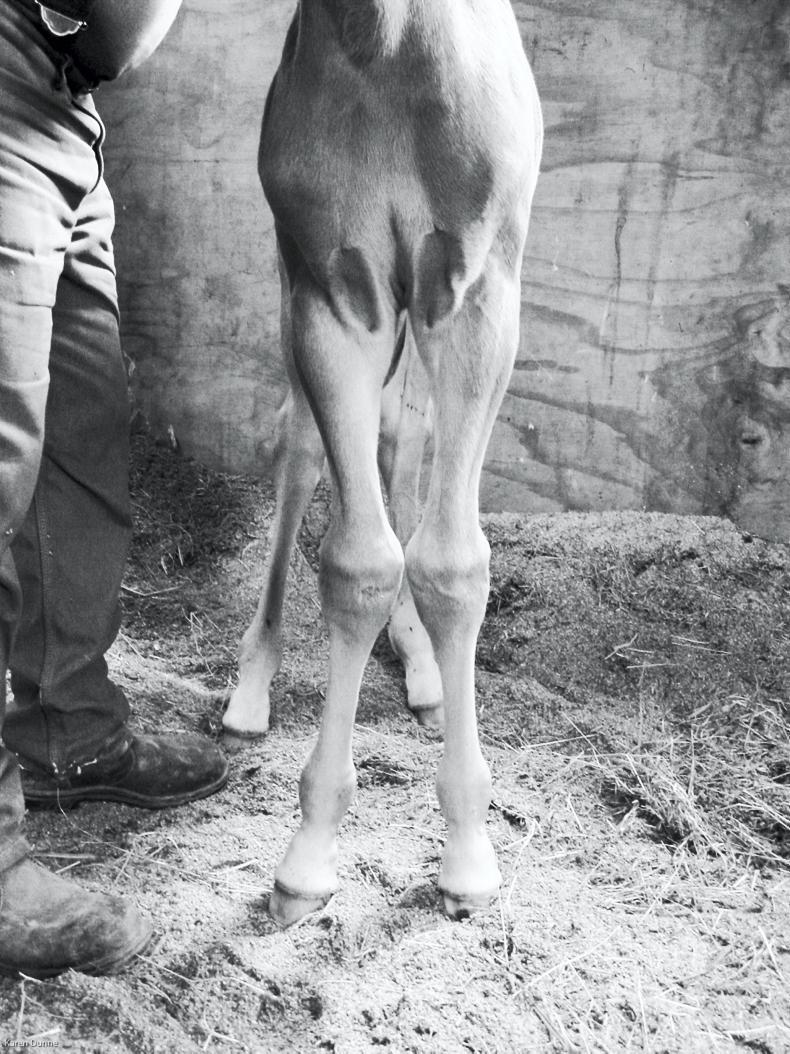
More significant problems tend to be asymmetrical (figure 4). Other issues may also be present, such as contracted tendons, joint laxity or rotated limbs. Evaluations should be conducted every seven to 14 days during the first few months. Taking photos or videos may be helpful to track progress. More severe deformities should be radiographed at an early stage as this will allow the vet to more precisely visualise the cause and severity of the problem.
CONSERVATIVE
TREATMENT
This consists of careful management and foot care. Avoid excessively strenuous exercise (lots of galloping, especially on hard or uneven ground) and prevent the foal getting too fat or heavy by careful dietary management. Foot trimming is also vital as the farrier can correct most minor imbalances by appropriate and regular dressing and trimming of the hoof. Skimping on foot care at this stage of a foal’s life is false economy.
FOOT EXTENTSIONS
The farrier can apply a synthetic acrylic or polymer extension to the side of the foal’s foot where the hoof wall is shortening or collapsing (figure 3). This works by increasing load bearing on the side of the growth plate that is growing too rapidly. This stimulates the cells in this area to slow down and begin to calcify, thereby correcting the growth imbalance.
If foot extensions are required it’s best to coordinate your vet and farrier visits as sedation of the foal facilitates extension application. The polymers used release heat as they set and if the foal fidgets excessively during this process the extension may not be as effective.
SURGERY
A variety of surgical procedures have been used over the years. Transphyseal bridging is amongst the most commonly used now. In this procedure a screw is inserted across the rapidly growing side of the growth plate (figure 3).
This physically stops the limb lengthening on this side and allow the other side to catch up. The obvious caveat is that the screw must be removed once the limb is straight. If you leave it there the leg may start to deviate in the opposite direction!
This procedure is typically well tolerated by the foal and has a low complication rate.
Like any surgery there is always a risk when placing an animal under general anaesthesia, the hair coat at the site must be clipped to reduce, but not eliminate, infection risk, and some scarring or white hairs may remain post-operatively. For these reasons it’s recommended that any foal with ALD be managed carefully from birth, with the aim of reserving surgery only for those cases that are too severe for conservative treatment or don’t respond to appropriate and early husbandry and foot care.
The take home message is: monitor the gait and conformation of all foals and intervene early, at which point most problems can be dealt with successfully. Watching young stock grow and develop is one of the most enjoyable and interesting aspects of breeding and every season is a new opportunity to gain in expertise and experience.
Karen Dunne, MA, CertEM (StudMed), MVB. Veterinary nursing programme director at Dundalk Institute of Technology (DkIT). Member of the education, research and industry (ERI) and equine groups of Veterinary Ireland. My interests include large animal nursing, equine and stud medicine and education.
MANAGEMENT
OPTIONS
• Conservative
• Foot extensions
• Surgery