IN 1700, in Western Europe, there were some 400 different kinds of jobs you could choose from. Today, there are approximately 500,000. No wonder we sometimes have a bit of trouble settling on what we might want to do.
As a career coach, it is my role to work with people and help them demystify this great conundrum. I’ve worked with hundreds of individuals, at various levels in their careers, to methodically work through a process of self-awareness, then market-awareness, to help crystallise their thinking and help clarify the route to their chosen career path.
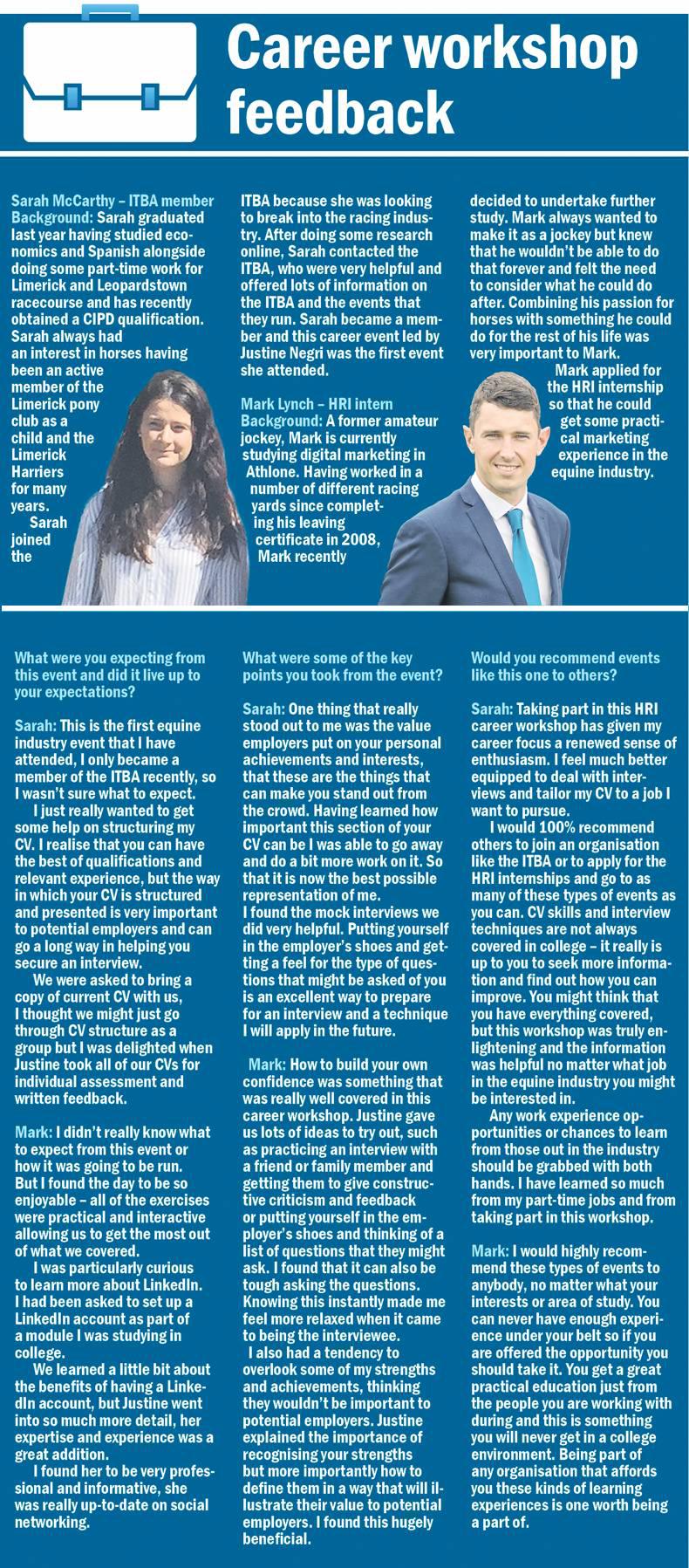
I recently had the opportunity to facilitate a careers workshop with a great group of interns from Horse Racing Ireland (HRI) and members of the Irish Thoroughbred Breeders Association (ITBA) Next Generation. The purpose of this careers workshop was to focus on three core areas to help them get ahead in their careers - how to fine-tune and tailor their CVs for a specific role; how to promote their online LinkedIn brand and lastly, how to present themselves in the best possible way for a job interview.
CONFIDENCE
When it comes to tackling any or all three of these crucial career elements, there is one very important component that is required at all times. This component is confidence. If there is one underlying current that lies (often dormant) in all of us, it is a lack of self-confidence in what we can do, what we can achieve and how we can add value in a career context.
With the help of a 1:1 career coaching session or the facilitation of a group careers workshop this underlying current can be electrically charged and allow people to harness these great positive attributes that we have all acquired over the years.
By surfacing these talents, capabilities and aptitudes we can focus our thoughts and position ourselves into a positive mind-set where we can start to understand how we do add value and how to translate this in a CV, on our LinkedIn profile or during an interview.
A core focus of the HRI and ITBA careers workshop was enabling all participants to focus on areas where they have added value in current or previous roles. These achievement examples did not necessarily have to be specific to the next role that they intended applying for as all achievements contain qualities that could be transferrable.
For example, one of the participants spent time working in the USA as a scaffolder. He was able to translate how he added value in this role by focussing on the various skills he developed and refined like communicating clearly with co-workers, being agile within his role and always completing paperwork efficiently and on time.
Rather than only focussing on the daily construction duties that he did, this participant astutely focussed on additional transferrable skills and qualities that he acquired during this period of work, which he can now showcase on his CV, LinkedIn profile and during a job interview.
CURRICULUM VITAE
Participants were brought through the purpose of a CV and the most essential components of crafting a great CV. The key takeaway at this point was showcasing how critical it is to tailor your CV for each and every role you apply for. Many participants thought the cover letter was the only area that needed to be tailored for a specific role but this belief was quickly corrected.
Examples were provided to showcase how the job specification provides clues of what the hiring manager is looking for and how participants can demonstrate how their achievements match these clues. This art of tailoring is crucial when crafting a good CV.
The most important CV components were also discussed in detail. Apart from the crucial personal details that are listed at the top of your CV, participants were brought through a step-by-step methodology of crafting a personal summary or elevator pitch which provides a synopsis of how you add value.
YOUR INTERESTS
When listing your education, use the same rule as your career history, by starting with your most recent qualifications. Further details should include the dates the qualifications were awarded and the college you attended. References to grades acquired are at your own discretion.
The interests section, which is normally listed at the end of the CV, can provide very rich and valuable information about you outside of your working environment. These insights can be very beneficial to the reader as it may highlight qualities and capabilities that have not been showcased in the main body of your CV. For example, coaching U16 jockeys can show that you have good leadership and communication skills.
ONLINE NETWORKING
The next career element that we discussed was LinkedIn. This is the world’s largest professional network with more than 400 million members in over 200 countries and territories around the globe. Due to this international scale, LinkedIn has the ability to analyse professional movement in real time.
For example, a recent survey by LinkedIn produced a report stating that Ireland saw growth of +4.8% in employment as of October 2015.
LinkedIn is critical in today’s recruitment landscape because it enables you to develop your personal brand and build and maintain your professional network. LinkedIn is also an online CV and allows hiring companies and recruiters to search for professionals who might fit their criteria. 70% to 90% of employers, depending on which survey you look at, use LinkedIn to source talent. Recruiters also continue to flock to LinkedIn to find job applicants – in effect, all recruiters now actively use LinkedIn for market research and talent search.
THE INTERVIEW
Participants on the careers workshop also got tips on how to prepare and present at interviews and they then each got a chance to experience a mock interview. This allowed theory to be brought to life through practice in a role play scenario. Although the setting was not “real” per se, participants got the chance to practice all they had learned throughout the day and showcase the confidence and knowledge they had acquired.
Technical and biographical interviews were discussed, but the main focus of the afternoon was on competency based questions. These are the trickiest to master and the most common interview style used in organisations in Ireland.
The purpose of an interview was also discussed on the day. Interviewers are not only seeking out particular skills and experiences that an interviewee has but also their levels of motivation, attitude, work style and cultural fit.